
The Everyday Bow Hunter Arrow System
Don’t Guess. Build Your Arrow System.
No single arrow weight, speed, or FOC works for every bowhunter. The right answer depends on your bow, arrow length, hunting distance, sight plan, and the game you pursue.
The Everyday Arrow System puts those decisions in the right order. Start with the bow and the hunt, plan the complete arrow, and verify one finished test arrow before you build the batch.
Choose How You Want to Work
Two Paths. One Arrow System.
The Arrow Planner and the manual process use the same decisions. Choose the path that fits how you want to work. Both end with one completed arrow that has been checked from your real bow.
Guided Path
Let the Arrow Planner connect the decisions
Enter the bow and hunting information you know. The Planner keeps arrow length, target weight, performance, trajectory, components, FOC, and dynamic spine connected while you compare a build.
Manual Path
Work through each decision yourself
Use the Everyday Arrow Weight Formula to set a practical target and range. Then follow the six decisions below or use the complete guide when you want the full explanation beside you.
Buying finished arrows? You can use the same bow, length, spine, and component decisions before you order. Use the finished-arrow buying guide.
Before you buy a dozen arrows, get one right. Avoid an expensive do-over. Get my free guide to choosing the parts, planning the build, and testing one arrow before you finish the set.
Before the Six Decisions
Confirm the Bow and Establish Arrow Length
Use the bow’s actual settings. Confirm the draw length that fits you, then establish a safe starting arrow length and prepared shaft cut. Verify rest and broadhead clearance at full draw before you cut or permanently assemble anything.
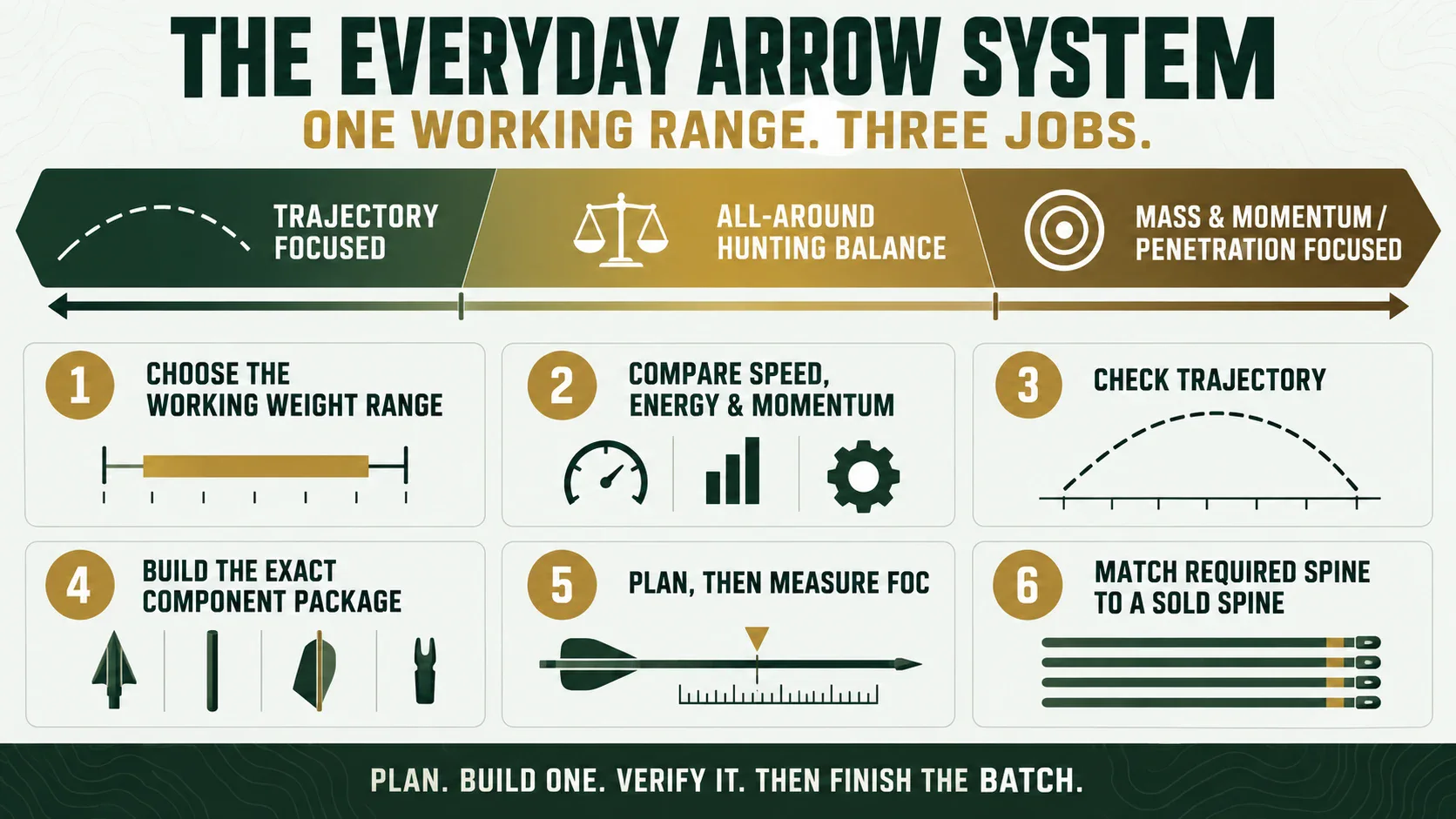
The Six Decisions
Build a Balanced Hunting Arrow in Order
Each answer changes the next one. Work forward, then circle back when a component or measurement changes the plan.
The working range is not an error margin. Its lower, middle, and upper positions have different jobs. The lower end favors trajectory. The center is the best all-around starting point. The upper end is the penetration-focused choice, using more mass and momentum while accepting less speed and more drop.
Start with the bow and hunt
Find Your Target Arrow Weight
Use actual draw weight, IBO speed, draw length, and normal hunting distance to create a bow-specific Formula Target and working range. The lower end is Trajectory Focused, the target is the All-Around Hunting Balance, and the upper end is Mass and Momentum Focused for a penetration-first priority.
Open the Everyday Arrow Weight Formula →See the tradeoffs
Check Performance of That Weight
Compare estimated speed, kinetic energy, momentum, and trajectory across the working range. A balanced hunting arrow does not come from chasing one winning number. It comes from choosing the tradeoff that fits the hunt.
Open the Arrow Performance Calculator →Make it practical
Confirm Trajectory and the Sight Plan
Check rise, drop, the zero window, and ranging error at the distances where you hunt or practice.
Open the Hunting Arrow Trajectory Calculator →Create the component plan
Plan the Shaft and Components
Before choosing an exact shaft, use the shaft maker’s current spine chart to pick a starting static-spine class for your bow and planned shaft length. Follow that maker’s point-weight instructions. Then use the target weight and established length to compare shafts and parts that work together. Check the complete plan again at Step 6.
Compare exact parts in the Component Finder →Refine the balance
Optimize FOC
Check how the completed component plan balances. FOC is one design variable, not a trophy number to chase by itself.
Open the Arrow FOC Calculator →Validate the design
Confirm Dynamic Spine
Check whether the planned shaft, length, point weight, and complete front end match the bow before you cut or glue parts.
Open the Dynamic Spine Calculator →After the Design Is Finished
Build One. Verify It. Then Finish the Batch.
A calculator can help you plan the arrow. The real bow still decides whether the completed system is ready to hunt.
Build one complete test arrow
Match the planned length and components. Square the shaft ends, measure the result, and make sure the insert and broadhead spin true.
Align and fletch it
Use the shaft maker’s markings or instructions first. If an unmarked shaft needs testing, use the spine-alignment and index-vane guide.
Tune as far as the evidence requires
Do not turn every build into a ritual. Use the beginner hunting-arrow tuning guide when launch or impact gives you a reason to diagnose the arrow. Always prove the finished broadhead.
Finish and record the batch
Once the test arrow is repeatable, finish the remaining arrows. Record final length, weight, FOC, spine, and verified speed.
Keep It Simple
The Rules That Hold the System Together
- Use your actual bow settings and real component weights whenever you have them.
- Manufacturer minimum arrow weight and the shaft maker’s spine chart remain the starting safety boundaries.
- Calculator results are planning estimates. Verify the completed arrow on the range.
- Do not let speed, momentum, FOC, or total weight overrule the complete system.
- Build and verify one test arrow before committing the full batch.
Want to see the method behind the tools? Read how the Everyday Arrow System works and how the calculations, recommendations, and releases are checked.