
Every summer, bowhunters start asking the same question:
“When is the rut going to peak this year?”
It’s a fair question, but it’s also one that gets oversimplified. Every year you’ll see articles claiming there’s one “magic week” to hunt. The problem is, the rut doesn’t begin on one day, explode for a week, and suddenly end. It’s a biological process that unfolds over several weeks, and understanding that process is far more important than memorizing a few dates on the calendar.
After hunting whitetails and studying deer behavior for the past 20 years, I’ve become convinced that successful hunters don’t just hunt the rut, they hunt the stage of the rut. That’s a big difference. Knowing what bucks are doing, why they’re doing it, and how to adjust your strategy each week will consistently put you in better position than simply taking vacation during the so-called “peak.“
This annual forecast combines published wildlife research, long-term conception studies, GPS collar research, state wildlife agency data, and my own field observations from hunting the mountains of Central Pennsylvania. It isn’t meant to predict the exact day a doe will be bred. Instead, it’s designed to help you understand when mature bucks are most likely to be vulnerable during daylight and how to use that information to plan your season.
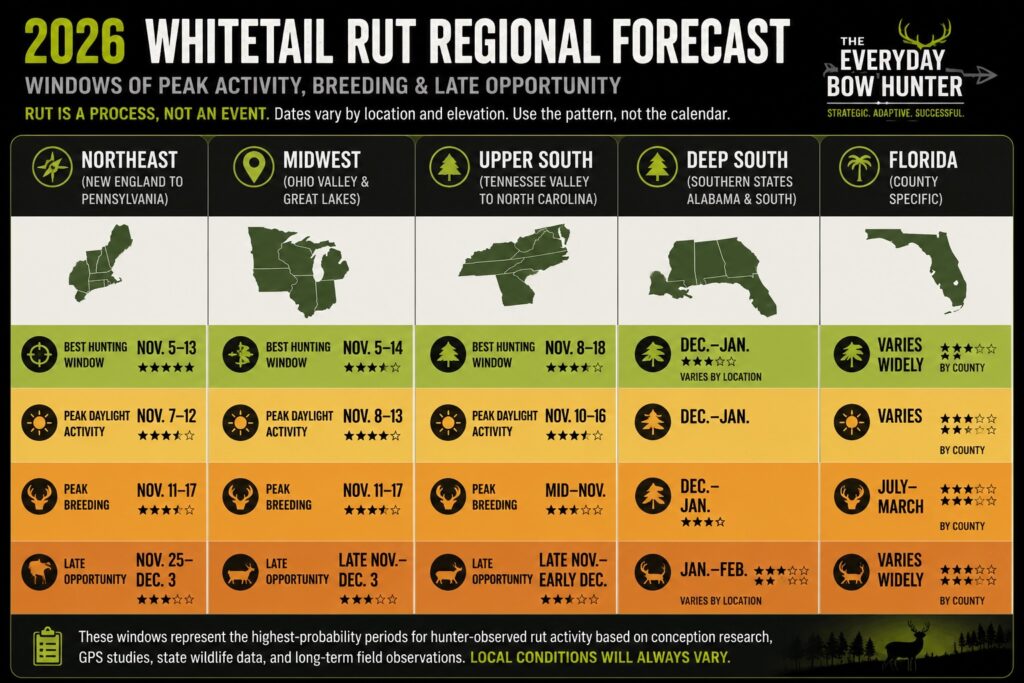
2026 Rut Forecast at a Glance
If you’re looking for the short answer, here it is.
| Region | Best Hunting Window | Peak Daylight Activity |
|---|---|---|
| Northeast | November 5–14 | November 7–12 |
| Midwest | November 5–15 | November 8–13 |
| Upper South | November 8–18 | November 10–16 |
| Deep South | December–January (varies) | Use state conception data |
| Florida | Varies by county | County-specific rut maps |
These windows represent the periods when hunters have the greatest chance of seeing mature bucks on their feet during legal shooting hours. They are based on long-term biological data, not just moon phases or weather forecasts.
Understanding the Rut
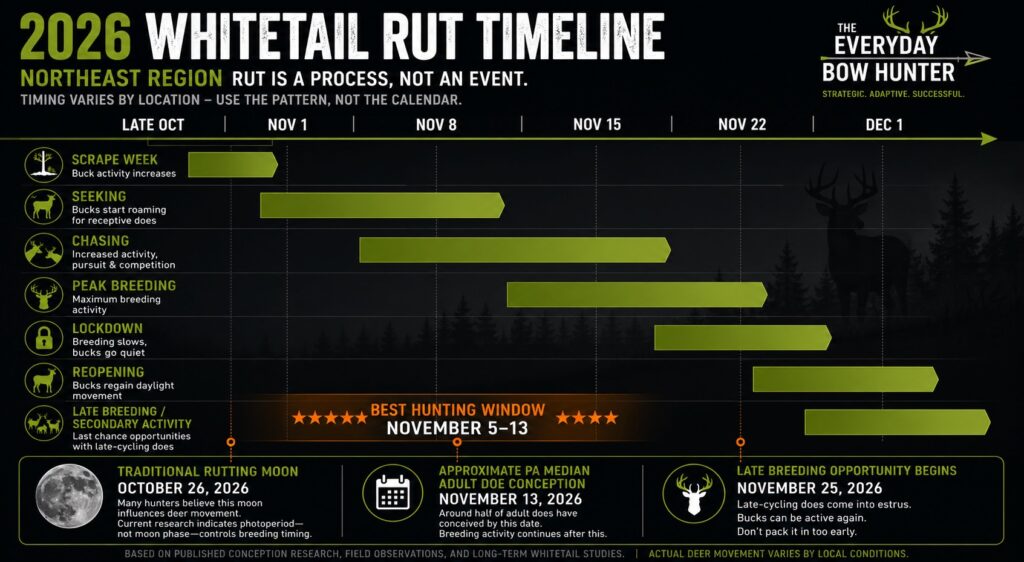
Before we talk about dates, it’s important to understand what actually drives the rut.
For years, hunters have debated whether cold fronts, moon phases, weather, or barometric pressure trigger breeding. While those factors can influence deer movement, decades of research continue to point to one primary trigger for breeding activity—photoperiod, or the amount of daylight.
As the days grow shorter each fall, does begin entering estrus at nearly the same time every year. That’s why researchers have found that conception dates remain remarkably consistent across most northern whitetail populations.
That doesn’t mean every doe is bred on the same day. Far from it. Breeding occurs over several weeks, creating different stages of rut activity that hunters experience throughout the season. Some bucks are searching. Others are chasing. Some are locked down with does. Meanwhile, other bucks are still looking for the next receptive doe.
That’s one reason I don’t believe in a single “magic week.“
The hunters who consistently tag mature bucks understand where the herd is within the breeding cycle and adjust their strategy accordingly.
What About the Rutting Moon?
The traditional Rutting Moon falls on October 26, 2026, and every year it sparks the same debate.
Some hunters believe the moon controls the rut. Others believe it has no effect at all.
The research falls somewhere in the middle.
Current biological studies continue to show that the moon does not determine when does come into estrus. Breeding remains tied primarily to day length. However, weather, temperature, hunting pressure, and possibly even moon phase may influence when hunters observe deer movement.
That’s an important distinction.
Breeding timing and deer movement are not the same thing.
Personally, I still pay attention to the moon, but I don’t use it to predict when the rut will occur. I build my season around biology first, then use weather, fresh sign, and current conditions to decide exactly where I’m hunting.
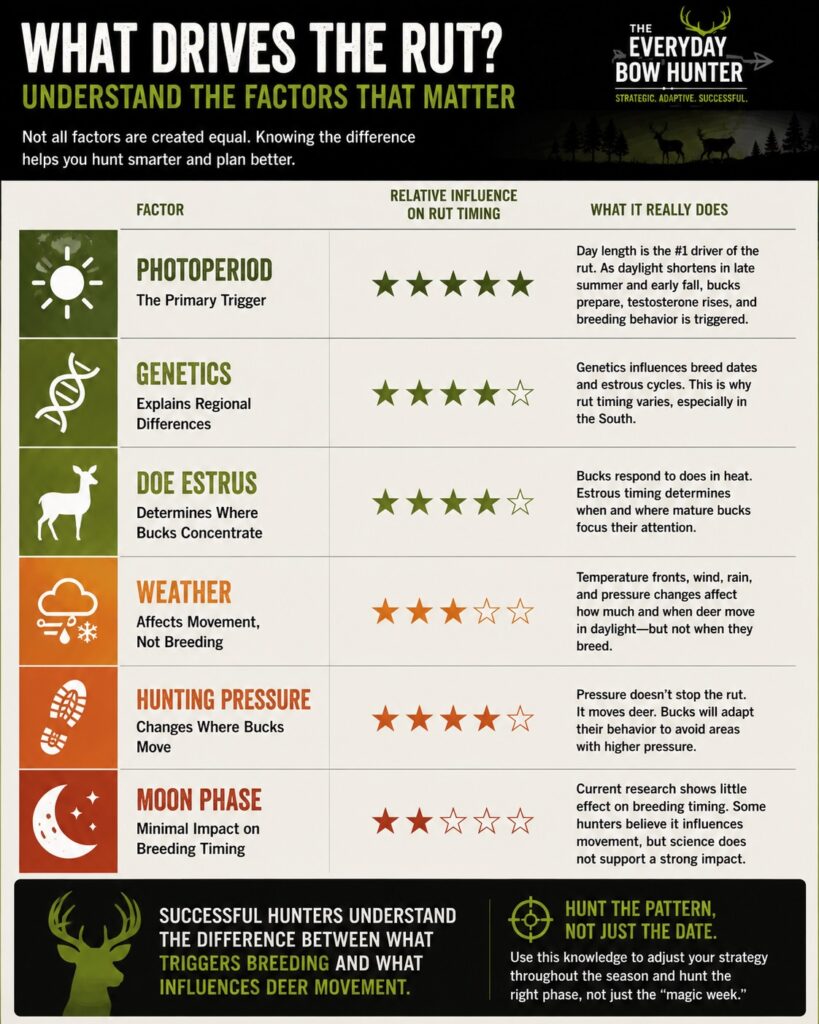
Northeast Forecast
Pennsylvania, New York, Ohio, New Jersey, West Virginia, Maryland and New England
Best Hunting Window: November 5–14
If I had one week to hunt anywhere in the Northeast, this would be it.
Historical conception studies continue to show breeding centered around the middle of November, but some of the best daylight movement occurs just before and during that period. Bucks are covering ground, checking multiple doe groups, and making mistakes they simply don’t make during most of the season.
My favorite days continue to fall between November 7 and November 12. During this period, I’ll spend as much time in the woods as possible, focusing on funnels, ridge crossings, terrain saddles, and travel corridors connecting doe bedding areas.
The Northeast remains one of the most predictable rut regions in North America. While weather can certainly influence movement on any given day, the overall breeding schedule changes very little from year to year.
Midwest Forecast
Michigan, Wisconsin, Iowa, Illinois, Indiana and Minnesota
Best Hunting Window: November 5–15
The Midwest follows nearly the same biological schedule as the Northeast, with peak breeding centered around the middle of November. Bucks typically begin expanding their range during late October before daylight movement reaches its highest levels during the first half of November.
If I were planning a Midwestern hunt, I’d spend every possible day between November 5 and November 14 in the woods. This is when mature bucks spend the most time searching for receptive does, often covering terrain they ignored for weeks during October.
Agricultural areas can concentrate doe groups, while large timber tracts often funnel cruising bucks through terrain features like saddles, creek crossings, and ridge points. Regardless of where you hunt, this is still one of the best opportunities all season to intercept an older buck in daylight.
Upper South Forecast
Kentucky, Tennessee, Virginia, western North Carolina and northern Georgia
The Upper South still experiences a fairly traditional November rut, although activity often stretches across a slightly longer window than it does farther north.
Instead of focusing on one perfect day, I’d concentrate on spending several consecutive days hunting between November 8 and November 18. Local genetics, terrain, elevation, and hunting pressure can all influence exactly when movement peaks, but mature bucks usually remain active throughout much of this period.
Like the Northeast, the key is finding concentrations of does. Bucks may travel farther between bedding areas than they do during October, creating opportunities in funnels and natural travel corridors that often produce encounters with mature deer.
Deep South Rut Forecast
Unlike the Northeast and Midwest, the Deep South doesn’t follow one consistent breeding schedule. Genetics play a much larger role, which means peak breeding can vary by several weeks, even between neighboring counties. That’s why I always recommend checking your state’s conception map before planning a hunt.
Click Here for the Deep South Planning Guide Below
Alabama
Typical Peak Breeding: Late December through late January (varies by zone)
Best Hunting Window: Approximately 7–10 days before your area’s average conception date.
Northern Alabama generally peaks earlier than central and southern portions of the state, with some southern counties not reaching peak breeding until late January or even early February.
Mississippi
Typical Peak Breeding: Late December through late January
Mississippi has one of the latest ruts in the country. Delta regions often peak earlier than eastern portions of the state, so use the Mississippi Department of Wildlife’s conception map to narrow your dates.
Louisiana
Typical Peak Breeding: Late December through January
Louisiana’s rut varies widely across the state. Northern parishes generally breed earlier than southern coastal areas, making local conception data critical when planning a hunt.
Georgia
Northern Georgia follows a more traditional November rut, but southern Georgia often peaks from December into January. If you’re hunting south of the Fall Line, don’t assume the November “magic week” applies.
Florida
Florida remains the most unique whitetail state in the country. Depending on the county, breeding can occur from summer through early spring.
If you’re hunting Florida, skip national rut calendars altogether and use the Florida county rut map to identify your local breeding window.
State-by-State Rut Planning Guide
Hunters don’t think in regions, they think, “I’m hunting Kentucky” or “I’m going to Iowa.” This table makes the article much more practical and increases its long-term value as a planning resource.
| State / Region | Typical Peak Breeding | Best Bowhunting Window | Confidence |
|---|---|---|---|
| Pennsylvania | Nov. 11–17 | Nov. 5–13 | ★★★★★ |
| Ohio | Nov. 10–16 | Nov. 5–13 | ★★★★★ |
| New York | Nov. 10–17 | Nov. 5–13 | ★★★★★ |
| New Jersey | Nov. 10–18 | Nov. 5–14 | ★★★★☆ |
| West Virginia | Nov. 10–17 | Nov. 5–13 | ★★★★☆ |
| Maryland | Nov. 10–17 | Nov. 5–13 | ★★★★☆ |
| Michigan | Nov. 10–16 | Nov. 6–14 | ★★★★★ |
| Wisconsin | Nov. 9–16 | Nov. 5–13 | ★★★★★ |
| Minnesota | Nov. 8–15 | Nov. 4–12 | ★★★★★ |
| Iowa | Nov. 8–15 | Nov. 4–12 | ★★★★★ |
| Illinois | Nov. 9–16 | Nov. 5–13 | ★★★★★ |
| Indiana | Nov. 9–16 | Nov. 5–13 | ★★★★★ |
| Missouri | Nov. 10–17 | Nov. 5–14 | ★★★★☆ |
| Kentucky | Nov. 12–18 | Nov. 8–18 | ★★★★☆ |
| Tennessee | Nov. 12–18 | Nov. 8–18 | ★★★★☆ |
| Virginia | Nov. 12–18 | Nov. 8–18 | ★★★★☆ |
| Western North Carolina | Nov. 12–18 | Nov. 8–18 | ★★★★☆ |
Deep South Planning Guide
If you’re hunting the Deep South, don’t make the mistake of following a national rut calendar. Breeding dates can vary by weeks between neighboring counties, so the planning guide below should always be used alongside your state’s official conception map.
| State / Area | Typical Peak Breeding | Best Bowhunting Window |
|---|---|---|
| North Alabama | Late Dec.–Early Jan. | Dec. 20–Jan. 5 |
| Central Alabama | Early–Mid Jan. | Jan. 1–15 |
| South Alabama | Mid Jan.–Early Feb. | Jan. 10–31 |
| Mississippi Delta | Late Dec.–Early Jan. | Dec. 20–Jan. 5 |
| Central Mississippi | Mid–Late Jan. | Jan. 5–20 |
| South Mississippi | Late Jan.–Early Feb. | Jan. 15–Feb. 5 |
| Northern Louisiana | Late Dec.–Early Jan. | Dec. 20–Jan. 5 |
| Central Louisiana | Early–Mid Jan. | Jan. 1–15 |
| Southern Louisiana | Mid Jan.–Early Feb. | Jan. 10–31 |
| North Georgia | Mid-November | Nov. 8–18 |
| South Georgia | Dec.–Jan. | Dec. 10–Jan. 10 |
| Florida | County-specific | Use the FWC county rut map |
Important: The Northeast and Midwest have remarkably consistent breeding dates from year to year. In the Deep South, breeding timing is largely controlled by local genetics and can vary dramatically, even between neighboring counties. If you’re planning an out-of-state hunt in Alabama, Mississippi, Louisiana, Georgia, or Florida, always compare these planning windows with your state’s published conception map before scheduling your trip.
What I’m Seeing in Central Pennsylvania
One thing I’ve learned over the years is that deer don’t always read the same articles we do.
For most of my hunting career, I planned my vacation around what everyone called the “magic week.” I’d hunt hard during the second week of November because that’s when everyone said mature bucks would be cruising. Some years it worked exactly as expected. Other years, it felt like I had completely missed the action.
Over the past several seasons, something has caught my attention. Since around 2022, it seems like the best rut activity in the mountains of Central Pennsylvania has been happening a little later than I remember. Last season, I captured mature bucks fighting over a doe on trail camera at the end of November and again during the first week of December. Yet during what should have been one of the hottest weeks of the rut, the second week of November, I hunted that same area several times and barely saw a squirrel. The few bucks I did see stayed well out of range and showed almost no interest in responding to calling.
That doesn’t prove the Pennsylvania rut has shifted, and I’m not claiming that it has.
The published conception data still shows a remarkably consistent breeding period centered around mid-November. That’s one reason I always compare what I’m seeing in the woods with what the research says instead of relying on one or the other.
At the same time, my own observations continue raising questions. During the past two years, I’ve noticed several fawns appearing on my trail cameras much later in June than I had become accustomed to seeing. A first trail camera photo doesn’t necessarily mean a late birth because does often keep newborn fawns hidden for days or even weeks. Still, when I combine those observations with late-November buck activity, it’s enough to make me pay attention.
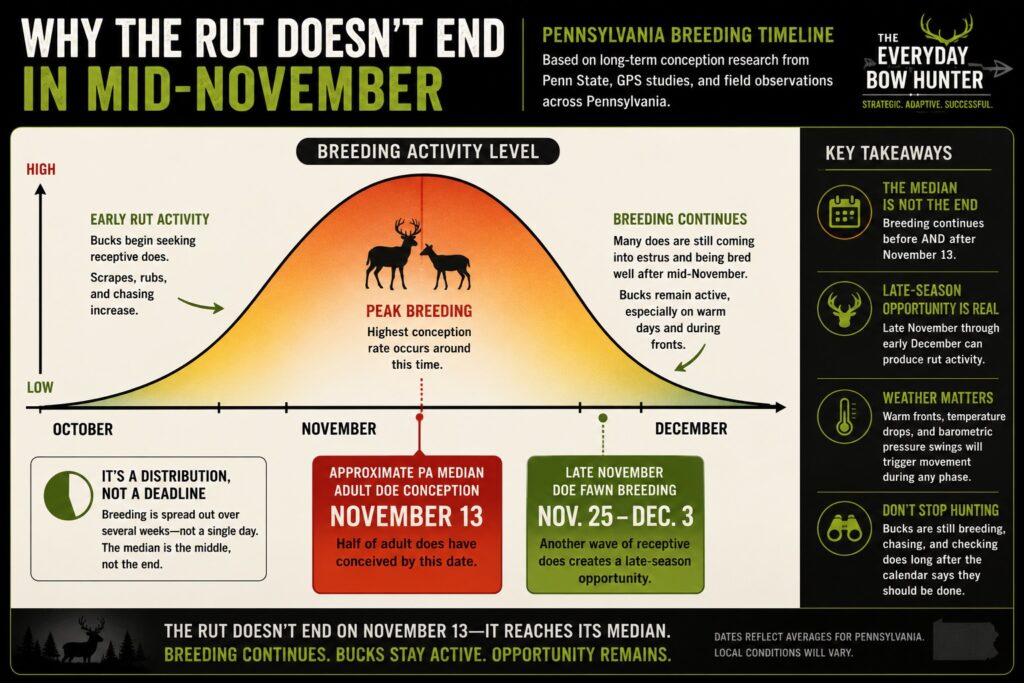
There are several possible explanations. Adult does don’t all breed on the same day. Some return to estrus if they aren’t successfully bred the first time. Pennsylvania research also shows that many doe fawns don’t enter their first estrus until later in the season, creating another period of breeding activity during late November and early December.
Maybe what I’m seeing is weather.
Maybe it’s changing habitat.
Maybe it’s increased doe fawn breeding.
Or maybe it’s simply a localized pattern in the mountain country where I hunt.
The truth is, I don’t know the answer yet.
What I do know is that I’ve stopped treating Thanksgiving like the end of the rut. Some of my most interesting trail camera footage and several memorable hunts have come after many hunters had already put their bows away. That’s one reason I’m continuing to track these observations through my 10-Year Deer Study instead of jumping to conclusions after a few seasons.
How I Use This Forecast
A rut forecast should help you plan your season, but it should never replace fresh sign.
If I can hunt the first week of November, I’m focusing on travel routes between bedding areas. Bucks are beginning to expand their range, fresh scrapes are opening almost daily, and mature deer are becoming much easier to pattern than they were in October.
Once searching and chasing activity begins, my strategy changes. I’ll spend as much time in the woods as possible because mature bucks can appear almost anywhere. This is when terrain features like saddles, ridge crossings, benches, creek crossings, and funnels really shine because they naturally concentrate deer movement.
As breeding peaks, I move closer to doe bedding areas. Bucks may travel less during this stage because many are locked down with receptive does, but they’ll stay close to the places where does spend most of their time.
After the middle of November, I don’t assume the season is over. If fresh sign tells me breeding activity is still taking place, I’ll continue hunting the same areas with confidence. Bucks searching for the last receptive does can become surprisingly vulnerable during this overlooked period.
The biggest lesson I’ve learned over the years is simple: The calendar gets me into the right neighborhood.
Fresh sign tells me exactly which tree to climb.
Use the Forecast With Hunt the Season
This forecast gives you the 2026 regional timing windows. The Hunt the Season weekly series gives you the strategy. I organize Week 1, Week 2, Week 3, and Scrape Week around Pennsylvania’s October season, but hunters elsewhere can use the same process by matching the weekly strategy to the deer behavior and rut timing in their area.
Continue Your Hunt
Knowing when to hunt is only part of the equation.
If you want a week-by-week breakdown of where I’m hunting, what I’m looking for, and how my strategy changes throughout the season, head over to the Hunt the Season Hub. It walks through every stage of the season from opening week in October through late November and beyond.
If you’re interested in the research behind these recommendations, visit the Deer Intelligence Hub, where you’ll find my 10-Year Deer Study, detailed rut analysis, buck movement observations, and the long-term field notes that continue shaping the way I hunt.
Everything works together.
The Deer Intelligence Hub explains why deer behave the way they do.
The Rut Prediction helps you understand when those behaviors are most likely to occur.
The Hunt the Season Hub shows you how I hunt each stage of the season.
Bottom Line
For most hunters across the Northeast and Midwest, November 5 through November 14 remains the highest-probability window for consistent daylight buck movement in 2026. If I had one week to hunt, I’d still choose November 5 through November 13, when searching and chasing activity usually overlap and mature bucks spend the most time covering ground.
At the same time, don’t make the mistake of believing the rut ends after Veterans Day. The research shows breeding continues well beyond the median conception date, and my own observations have convinced me that late November deserves far more attention than it receives.
The rut isn’t one magical week.
It’s a process that unfolds over several weeks, and hunters who understand that process consistently put themselves in better position to tag mature bucks.
Study the biology. Pay attention to fresh sign. Hunt where the deer are today, not where the calendar says they should be, and you’ll make better decisions every time you climb into a tree this fall.
CONTINUE THE DEER INTELLIGENCE SYSTEM
Your Next Steps
A rut forecast gives you a timing window. Deer intelligence and a flexible hunt plan help you use it on the ground.
1. Hunt the Season
Match the forecast to current sign and conditions.
2. Build Deer Intelligence
Interpret what local conditions are telling you.
3. Build Your Hunt Plan
Create three options for the dates you can hunt.
Part of the Everyday Bow Hunter System
Want to see exactly what I’m carrying this season? Check out my Personal Bowhunting Gear List for 2026