
Observe, Interpret, Predict, Plan, Execute, Learn
Deer Intelligence
Understand deer behavior. Predict movement. Stay in the right place.
Most bowhunters react to deer movement after it happens. Deer Intelligence is about learning to read the clues before the deer shows up. Food, cover, water, wind, weather, pressure, terrain, and timing all influence where deer go next. The goal is not to memorize deer facts. The goal is to make better hunting decisions before the hunt begins.
The Deer Question
Not “where did I see deer last week?” The better question is: where are deer likely to be next, and what conditions make that movement more likely?
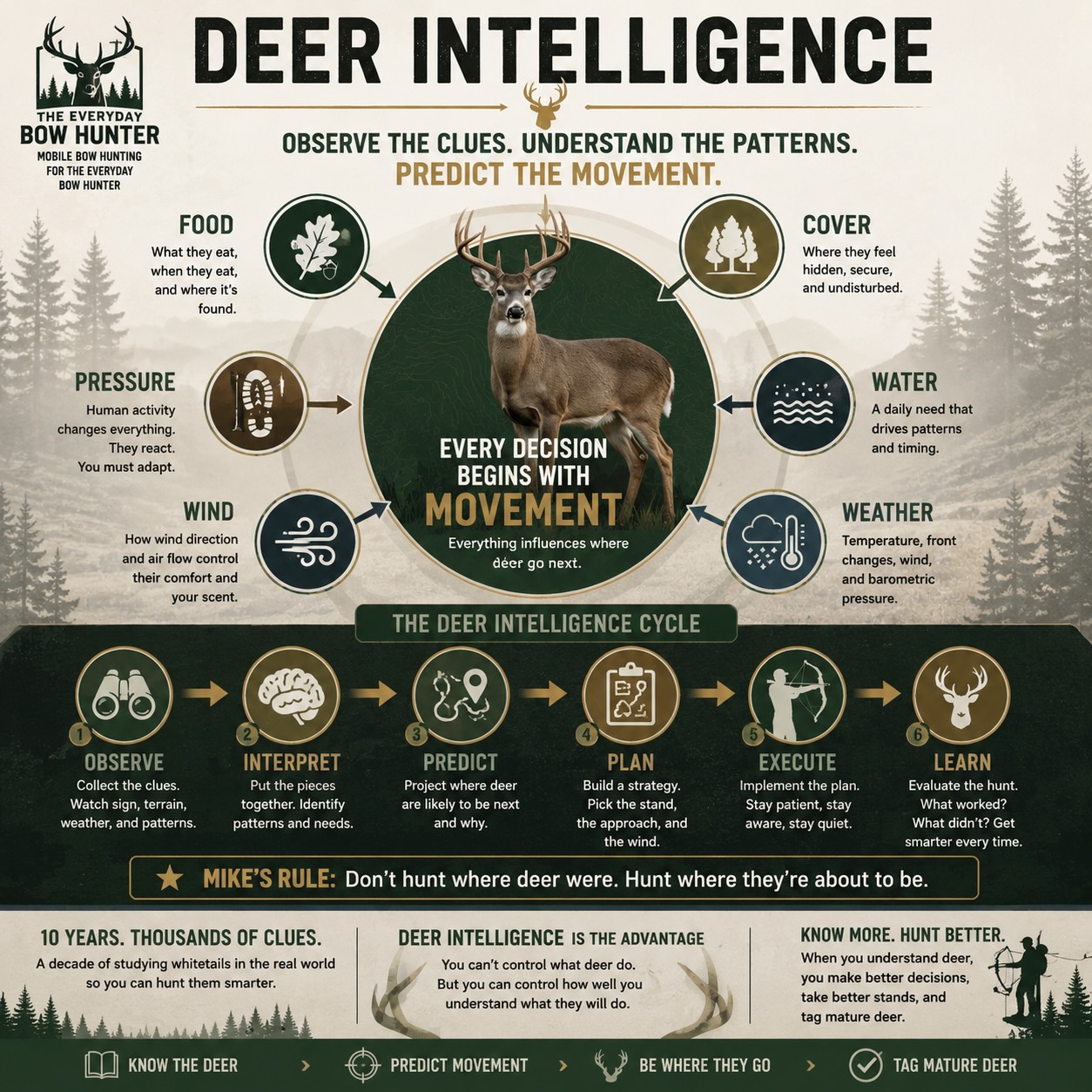
On mobile, open the full-size roadmap if you want to study the details without pinching and fighting the screen.
The Operating Manual
What Is Deer Intelligence?
Deer Intelligence is the process of observing deer behavior, interpreting sign and conditions, predicting movement, and turning that prediction into a hunt plan.
A trail camera photo, rub, scrape, track, weather shift, or food source is not intelligence by itself. It becomes intelligence when you understand what it means, when it matters, and how it should change the next hunt.
Movement Inputs
The Six Inputs That Drive Deer Movement
These are the conditions I want an everyday bowhunter checking before deciding where to sit.
Food
What deer eat, when they eat it, and where it is found. Food matters most when it connects to cover, timing, and pressure.
Cover
Where deer feel hidden, secure, and undisturbed. Cover explains daylight movement better than most hunters want to admit.
Water
Daily needs can influence patterns and timing, especially when water connects to bedding, heat, drought, or low-pressure travel.
Wind
Wind direction, thermals, and airflow affect deer movement, hunter access, and whether your setup can survive the last 200 yards.
Weather
Temperature changes, fronts, rain, snow, wind, and pressure changes can shift when deer move and where they feel comfortable.
Pressure
Human activity changes deer fast. Access routes, repeated sits, sloppy exits, and nearby hunters all teach deer where not to be.
The Framework
Build The Hunt Through The Deer Intelligence Cycle
Gather clues, make sense of them, predict what happens next, build the hunt, execute it, and then learn from what the woods taught you.
1. Observe
Collect the clues: sign, terrain, food, weather, trail cameras, tracks, rubs, scrapes, bedding, and historical movement.
2. Interpret
Put the pieces together. A rub, scrape, track, or trail only matters when it is connected to terrain, timing, wind, pressure, and bedding.
3. Predict
Project where deer are likely to be next. Movement is usually a response to need, safety, weather, pressure, timing, or breeding behavior.
4. Plan
Build the hunt around the predicted movement: stand, access, wind, timing, exit route, and backup plans.
5. Execute
Hunt the plan. Stay quiet, disciplined, aware, and ready to adapt when the woods tells you the original plan is wrong.
6. Learn
Evaluate the hunt. What changed? What did the deer teach you? What should you do differently next time?
Authority Proof
What 10 Years Of Deer Behavior Taught Me
The foundation of Deer Intelligence is years of observation, trail-camera history, hunt notes, buck movement patterns, pressure responses, bedding behavior, and real hunts.
10-Year Deer Study Series
Start here for the big-picture proof behind the system: how bucks move, bed, and react to pressure.
Whitetail Deer Study Results
The research-backed observations that shaped the way I think about deer behavior and bowhunting decisions.
How Bucks Use Home Range
A practical look at why bucks seem to vanish, shift, and show up where most hunters are not waiting.
Start By Problem
Recommended Starting Paths
Pick the path that matches the question you are trying to answer right now.
I Am New To Reading Deer Sign
Start here if rubs, tracks, scrapes, trails, and bedding areas all feel like random woods noise.
I Want To Predict Deer Movement
Start here if you already see sign but need to understand timing, conditions, and what deer are likely to do next.
I Want To Hunt Mature Bucks
Start here if you are trying to understand core areas, bedding, pressure response, and why mature bucks do not behave like every other deer.
I Need A Hunt Plan
Start here if you need to turn deer intelligence into an actual hunt you can execute without guessing.
I Hunt Hill Country And October Sign
Start here when the season shifts, sign gets hot, and bucks start moving differently than they did in early October.
I Need Better Wind And Access Decisions
Start here if deer are close, but your entry, exit, wind, or thermals keep costing you opportunities.
Resource Library
Core Deer Intelligence Topics
This is the working library. It is organized by the problem each article helps you solve, not by publication date.
Deer Sign
Learn how to read the clues deer leave behind.
Deer Movement
Understand timing, pattern changes, and where deer are likely to be next.
Bedding And Core Areas
Find the secure places that shape daylight movement.
Wind, Thermals, And Access
Get in and out without educating the deer you are trying to hunt.
Pressure And Timing
Understand why deer shift, disappear, and become huntable again.
Planning And Execution
Turn deer intelligence into a hunt plan you can actually run.
Field Rules
Mike Rules For Deer Intelligence
1. Where Deer Are About To Be
Do not hunt where deer were. Hunt where they are about to be.
3. Movement Has A Reason
Deer movement is usually a response to need, pressure, weather, or safety.
4. Wind Is More Than Scent
Wind does not just affect scent. It affects deer comfort and hunter access.
5. Access Can Ruin The Best Stand
The best stand is useless if the access route ruins it.
7. Cameras Show The Past
Trail cameras show what happened. Intelligence predicts what happens next.
9. Learn From Every Hunt
A hunt that does not end with a deer can still teach you where the next opportunity will come from.
Download The Deer Intelligence Field Checklist
Use the checklist to evaluate food, cover, water, wind, weather, pressure, sign, timing, and access before choosing a stand.
Coming soon. This should become an Insider implementation resource, not another public article.
Future Intelligence
Future: EBHIE Deer Intelligence
Eventually, The Everyday Bow Hunter Intelligence Engine (EBHIE) will use terrain, trail-camera observations, weather, wind, pressure, access routes, and hunt history to help identify higher-probability hunt plans.
From Observation To Recommendation
The public page teaches the thinking. EBHIE can eventually turn that thinking into a guided decision process based on a hunter’s actual conditions.
Connected To Strategic Hunting
Deer Intelligence explains what deer are likely to do. Strategic Hunting decides how to hunt that information without ruining it.
Start Reading Deer Like A System
Start with the proof, learn the sign, predict the movement, then build a hunt plan that gives you options.