
Seasonal Bowhunting Strategy
Hunt the Season
I do not hunt opening week the same way I hunt late October, and I do not hunt the rut the way I hunt late season. The longer I hunt an area, the more its seasonal patterns help me predict opportunity. Fresh sign, wind, pressure, and access still make the final decision.
Hunt the Season is the seasonal layer of the Everyday Bow Hunter System. Use it to understand what deer should be doing now, verify that movement in the field, and build the right hunt without burning the spot.
The Seasonal Question
Not “what is the best day to hunt?”
What are deer doing right now, and what move gives me the best chance without burning the spot?
How to Use Hunt the Season
I organize this series around Pennsylvania’s October season because that is where I hunt and plan. The calendar gives you a starting point. Your local deer movement, scouting, and conditions decide which weekly strategy fits where you hunt.
1. Predict
Use the seasonal phase and what you have learned from past years to predict where a good opportunity may form.
2. Verify
Check fresh sign, deer movement, wind, thermals, pressure, and access. The calendar never overrides what the woods are telling you.
3. Plan
Use Kill Zone Mapping to score the opportunity, then build Primary, Pivot, and Wait / Observe decisions before the hunt.
4. Adapt
Hunt the Primary plan, pivot when the conditions change, or turn the day into an observation or still-hunt. Record what you learn.
Before the Rut: Opening Week and Early Season
Before rut behavior starts changing the woods, deer are often tied to food, cover, security, and repeatable movement. This is a pattern-based part of the season. The wrong morning hunt, access route, or wind can educate deer before October ever arrives.
Build the Season-Long Plan
Start with the big picture. Decide what you need to prepare, where you need more scouting, and how your best opportunities may change as the season moves forward.
Be Careful With Early-Season Mornings
A morning hunt can work, but only when the movement, access, and wind give you a clean way in. This scenario shows how I think through that decision.
Follow the Hunt the Season Weekly Series
The first four cards follow my Pennsylvania and Northeast October calendar. They are named Week 1, Week 2, Week 3, and Scrape Week to keep the process simple. If your season opens earlier or your rut occurs later, identify the behavior you are seeing and use the matching strategy instead of forcing Pennsylvania dates onto your area.
2026 Pennsylvania and Northeast planning overlay: The forecast places the broader Northeast hunting window at November 5–14, with peak daylight activity expected November 7–12. If I had one week, I would still choose November 5–13. The weekly articles teach the strategy. The 2026 Rut Prediction supplies this year’s regional dates.
Oct. 1–7 · Week 1
Week 1: Early October
What changes: Bucks are still in a summer-to-fall transition. Daylight movement stays tight to secure cover, current food, and bedding.
Your move: Favor low-impact evening hunts, protect access, and be careful with morning intrusion unless you have a specific deer patterned.
Oct. 8–14 · Week 2
Week 2: The October Shift
What changes: Food sources change, bachelor groups break apart, and bucks relocate toward fall core areas, acorns, thicker cover, and secure bedding.
Your move: Stop hunting fading summer patterns. Verify the freshest rubs, food, and bedding transitions, then move with the deer.
Oct. 15–21 · Week 3
Week 3: The October Lull That Isn’t
What changes: Movement has not stopped. It becomes tighter, more cover-based, and easier to miss as pressure builds and daylight windows shorten.
Your move: Hunt the freshest sign close to secure cover without forcing the setup. Use every observation to prepare for Scrape Week.
Oct. 22–28 · Pennsylvania / Northeast
Scrape Week
What changes: Scrape activity and daylight visits intensify. In the Northeast, October 23–27 is often the strongest part of this October 22–28 window.
Your move: Hunt active scrapes, terrain funnels, and travel near doe bedding when fresh sign, wind, and access line up.
Oct. 29–Nov. 4 · Rut Ramp-Up
The 2026 Rut Window Opens
What changes: Bucks expand travel, scrape activity remains useful, and the first days of November begin connecting October sign to the best 2026 hunting window.
Your move: Shift toward travel between doe bedding areas, terrain pinches, saddles, and funnels. Let current sign confirm where the movement is happening.
Nov. 5–14 · 2026 Northeast Window
Peak Rut Strategy
What changes: The 2026 prediction places the broader Northeast window at November 5–14, with peak daylight activity November 7–12. If I had one week, I would choose November 5–13. The weekly Peak Rut strategy covers the practical November 8–14 hunting window.
Your move: Hunt long when conditions allow. Focus on funnels, saddles, terrain crossings, and travel connecting doe bedding areas.
Nov. 14–24 · Post-Peak Transition
Do Not Assume the Rut Is Over
What changes: Breeding continues after the highest-probability window. Movement may feel inconsistent as some bucks stay with does and others begin searching again.
Your move: Recheck funnels, doe bedding, cameras, and fresh tracks. Keep hunting the evidence instead of writing off the season after Veterans Day.
Nov. 25–Dec. 3+ · Late Opportunity
Late Breeding and Late Season
What changes: The 2026 forecast marks about November 25 as the beginning of another late-breeding opportunity. At the same time, food, security cover, pressure, and weather become more important.
Your move: Stay alert for renewed buck activity, but hunt food-to-bed movement and secure cover when local evidence says the rut action has faded.
The Research Behind the Weekly Strategy
Why the Pattern Changes Through the Season
The weekly labels make the season easier to plan, but the dates are only a starting point. Long-running GPS-collar research and what I have seen in the field point to the same basic lesson: bucks keep moving, but the places, times, and reasons for that movement change. That is why I use the calendar to predict the next opportunity, then let fresh sign, wind, pressure, food, and observation tell me what is actually happening.
Movement shifts before it expands
Early in October, a quiet field does not mean a buck stopped moving. Food can shift from fields to acorns, daylight travel can tighten closer to bedding, and the best trail can move deeper into cover. Later, breeding pressure can expand a buck’s travel and create better morning and midday opportunities.
Pressure can change the pattern fast
Human activity can change where and when deer feel safe enough to move. Repeated sits, poor access, marginal winds, and unnecessary intrusion can turn a good daylight setup into a nighttime pattern. The first clean hunt is often the best hunt, so timing and access matter as much as the date.
The phase predicts; the woods verify
Seasonal research gives us repeatable tendencies, not a script for every buck. Your local rut timing, current food, fresh sign, weather, wind, and hunting pressure still decide whether a planned hunt is ready. Hunt the sign, not the spot—and do not force a calendar prediction that the woods do not support.
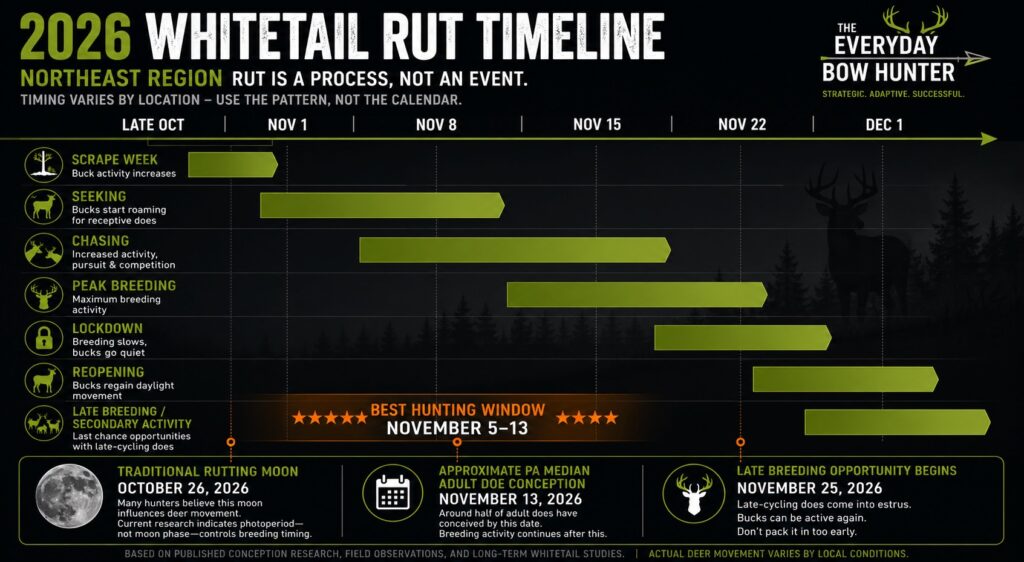
The 2026 Northeast Rut Timeline
This is the biological rut-phase overlay from the 2026 Rut Prediction. The bars overlap because the rut is a process, not a set of clean weekly blocks. Use the timeline to identify the likely phase in your region, then return to the weekly strategy that best matches what your deer are doing.
How to Time the Kill
The best hunts happen when historical knowledge, seasonal timing, fresh sign, wind, access, pressure, and deer behavior point in the same direction. History predicts the window. Current evidence tells you whether the opportunity is active now.
Read movement first
Know when bucks are likely to move, why they move, and what changes their daylight behavior.
Match the conditions
Thermals, wind shifts, cold fronts, and timing windows decide whether a setup is ready.
Respect pressure
Pressure changes where deer feel safe. The right move may be waiting, shifting, observing, or backing out.
Supporting Seasonal Content
Sign and October movement
Wind, pressure, and access
Post-rut and late season
Turn the Weekly Pattern Into a Hunt
Hunt the Season helps you identify the weekly pattern or rut phase that may be active. Deer Intelligence helps explain the movement. Kill Zone Mapping scores the opportunity. The 3 Hunt Plan prepares the Primary, Pivot, and Wait / Observe decisions you can use when real conditions change.
For the full decision-making framework, continue to Strategic Hunting.
Continue the Hunting System
Your Next Steps
Use the weekly pattern and regional rut phase to predict what should be changing. Then let scouting, conditions, and pressure decide which hunt is ready.
1. Build the Season-Long Plan
See how preparation, scouting, seasonal timing, and hunt decisions work together.
2. Map the Opportunity
Use Kill Zone Mapping to decide whether the location deserves a place in your hunting plans.
3. Build Three Planned Decisions
Prepare a Primary Hunt, Pivot Hunt, and Wait / Observe decision before conditions force the choice.
4. Open the Hunt Plan Builder
Turn the seasonal phase, current sign, wind, access, and pressure into a specific hunt.
Part of the Everyday Bow Hunter System