

There is no single best hour to hunt deer during bow season. The best time changes with the week of the season, current sign, hunting pressure, weather, wind, food, bedding, and whether you can enter and leave without educating deer.
That said, some time windows give you better odds than others. I use those windows as a starting point, then adjust them through my Hunt the Season process. My goal is not to hunt a date on the calendar. It is to be in position when deer are most likely to move through the area I can hunt effectively.
Quick Answer: The Best Times to Hunt Deer
- Early season: Late-afternoon and evening movement from bedding cover toward food is usually the most repeatable pattern.
- Morning: Be settled at least 30 minutes before first light and plan to stay until at least 10 or 11 a.m. Deer may still be returning from food, moving through staging cover, or reacting to hunting pressure after sunrise.
- Midday: It becomes more valuable near bedding cover, during the rut, after other hunters leave, and when a cold front or pressure change creates a short movement window.
- Scrape Week: Focus on daylight scrape activity, security cover, and travel routes between bedding areas.
- Peak rut: All-day sits can be worth the effort when you are covering doe bedding, funnels, and multiple travel routes.
- Late season: Afternoon movement from secure bedding toward dependable food often gives you the best opportunity.
These are starting points, not guarantees. Fresh sign, a safe wind, a low-impact access route, and the current rut phase matter more than a generic “best time” printed on a calendar.
Timing Is Only One Layer of the Hunt
Hunters often ask whether morning, evening, or midday is best. That is a fair question, but time by itself is not enough. A great movement window does not help if the wind carries your scent into bedding cover or your exit route blows deer off the food source after dark.
I look at timing through four connected systems:
- Hunt the Season: What phase are the deer in right now?
- Deer Intelligence: What do current tracks, beds, rubs, scrapes, cameras, and observations say?
- Kill Zone Mapping: Where do bedding, food, terrain, pressure, and travel overlap?
- The 3 Hunt Plan: What are my Primary, Pivot, and Wait/Observe options if conditions change?
That is how a broad idea like “hunt the evening” becomes a specific plan for a specific location.
My Minimum Sit-Time Rules
Morning Minimum
I want to be settled in the stand at least 30 minutes before first light—not 30 minutes before sunrise. First light is when the woods begin to brighten. You still must wait for the legal shooting time set by your state before taking a shot.
I also plan to stay until at least 10 or 11 a.m. Getting out at 9 a.m. is usually a bad practice for me. I have watched too much deer movement between 9 and 11, and research on hunted deer also shows that movement does not simply stop after the first hour of daylight.
Evening Minimum
During the Pennsylvania bow season, my basic rule is to be in position by 4 p.m. and hunt until the end of legal shooting light. When sunset comes earlier in the late season, I get there earlier. The point is to be settled before the main evening movement begins.
The hunt is not over when legal light ends. I still need an exit plan. If deer are feeding near my route, I may wait, use a planned alternate exit, or have someone move them naturally from a distance. Walking through the deer I want to hunt tomorrow can ruin a good evening location.
These are minimums, not limits. I can stay all day, start at 10 a.m. and hunt the rest of the day, run an observation hunt, or use a Scout-to-Hunt approach. The situation decides how long I stay.
Best Morning Hunting Times
A morning hunt usually targets deer moving from food or nighttime staging cover back toward bedding. That direction matters. You are not normally waiting for a buck to leave his bed and walk to food at daylight. You are trying to intercept him before he reaches secure daytime cover.
The first part of daylight can be excellent, but the morning window is wider than many hunters think. A buck may take a slow route through cover. Does may reach bedding later than expected. Another hunter, hiker, vehicle, or changing wind can also shift movement after sunrise.
Why I Do Not Leave at 9 a.m.
I have seen enough deer between 9 and 11 a.m. to treat that period as part of the morning hunt. Bucks may cruise later during the rut, but this is not only a rut rule. Deer on hunted ground often adjust their movement around pressure. When other hunters start climbing down, deer can move again.
Staying longer also prevents me from walking through a good area while deer are still using it. If I committed to a morning setup, I want to give it a complete chance unless the wind changes, safety becomes an issue, or I have a strong reason to pivot.
Best Evening Hunting Times
Evening movement is usually the reverse of morning movement. Deer leave bedding and security cover, use staging areas, and then work toward food. Early in the season, this can be the most predictable daylight pattern you have.
I want to be set up well before deer begin using the staging cover. Rushing in at the last minute creates noise, scent, and movement at exactly the wrong time. My 4 p.m. rule works as a practical Pennsylvania-season baseline, but it is not a national clock rule. Adjust it for your legal hours, sunset, terrain, and how far deer must travel from bedding.
Access can matter more than the stand itself. A good evening setup with a terrible exit is not a complete plan. Before I hunt it, I want to know how I will leave if deer are still in the field, near the trail, or between me and the vehicle.
Best Midday and All-Day Hunting Times
Midday is not automatically dead time. It becomes more important as the season develops and can be a major opportunity during the rut. It is also useful when pressure moves deer after other hunters leave the woods.
I am most likely to hunt midday or all day in these situations:
- A rut setup that covers doe bedding, funnels, or several travel routes.
- A cold front or weather change that could create a short movement window.
- An observation hunt where the goal is to learn when and where deer enter the area.
- A still-hunting or Scout-to-Hunt plan where I move slowly, confirm sign, and set up when I find a huntable pattern.
- A 10 a.m. start that lets me avoid a risky pre-dawn entry and hunt the rest of the day.
An all-day sit is not automatically better than a focused hunt. I use it when the location can produce movement from more than one direction or at more than one time. Sitting all day over one weak trail does not make the setup stronger.
Hunt the Season: Match the Time Window to the Phase
The rut is a process, not one magic week. My weekly Hunt the Season posts are built around what deer are doing, which is more useful than forcing every state into the same dates. If your season opens on a different week, identify the phase in your area and use the strategy that matches it.
Week 1: Early October
Evenings are usually the safer, more repeatable choice. Hunt bed-to-food movement without pushing too close to bedding. Morning access can be risky if deer are still near food.
Week 2 and the October Shift
Summer food patterns begin to break down, cover changes, and hunting pressure increases. This is often called the October lull, but deer have not stopped moving. Their movement has shifted. Use cameras, fresh sign, and observation to find the new pattern.
Week 3: Rising Buck Activity
Rubs and scrapes become more useful. Morning and midday opportunities begin to improve, especially near secure travel between bedding areas. I still avoid pushing a setup just because the calendar says the rut is close.
Scrape Week
Scrapes can help narrow down a buck’s working area, but daylight use matters more than the number of scrapes. Focus on scrape clusters near security cover, bedding transitions, and routes that can be hunted with the right wind.
Peak Rut
This is when all-day sits earn their place. Bucks may move at any hour, but the best setups still connect doe bedding, funnels, secure travel, and an access route you can use without ruining the area.
Post-Rut and Late Season
Do not assume the rut ends on one national date. Breeding can continue, and regional timing varies. As the season moves later, dependable food, cold weather, security cover, and low-pressure afternoon access become more important.
What Current Deer-Movement Research Supports
Research does not give us one perfect hunting hour, but it supports several parts of this system.
- Dawn and dusk matter. Whitetails are generally crepuscular, which means movement often rises around the transitions between dark and daylight.
- Dusk can be stronger than dawn. A 2022 GPS study of deer on a hunted landscape found movement was strongest around dusk, followed by dawn. Cover and hunting pressure changed how deer used those windows.
- The rut expands the clock. A Wisconsin DNR project that followed 188 bucks found a strong regional rut movement peak in early November and more midday movement during that period. The exact dates are regional, but the wider daily movement window fits what many bowhunters see.
- Pressure changes behavior. Deer can shift into cover, delay movement, or use different routes when hunting pressure rises. That is why a clock-based plan must also include access, security cover, and a clean exit.
Research describes averages across animals and landscapes. It does not replace what is happening on your property this week. I use research to check my thinking, then use current sign and repeated field observations to make the decision.
What My Cameras Show About the Waxing Crescent Moon
I have heard plenty of discussion about the waxing crescent moon producing better deer movement than a full moon. I pulled two years of activity data from my Moultrie cameras to see what my own locations showed from July 24, 2024, through July 22, 2026.
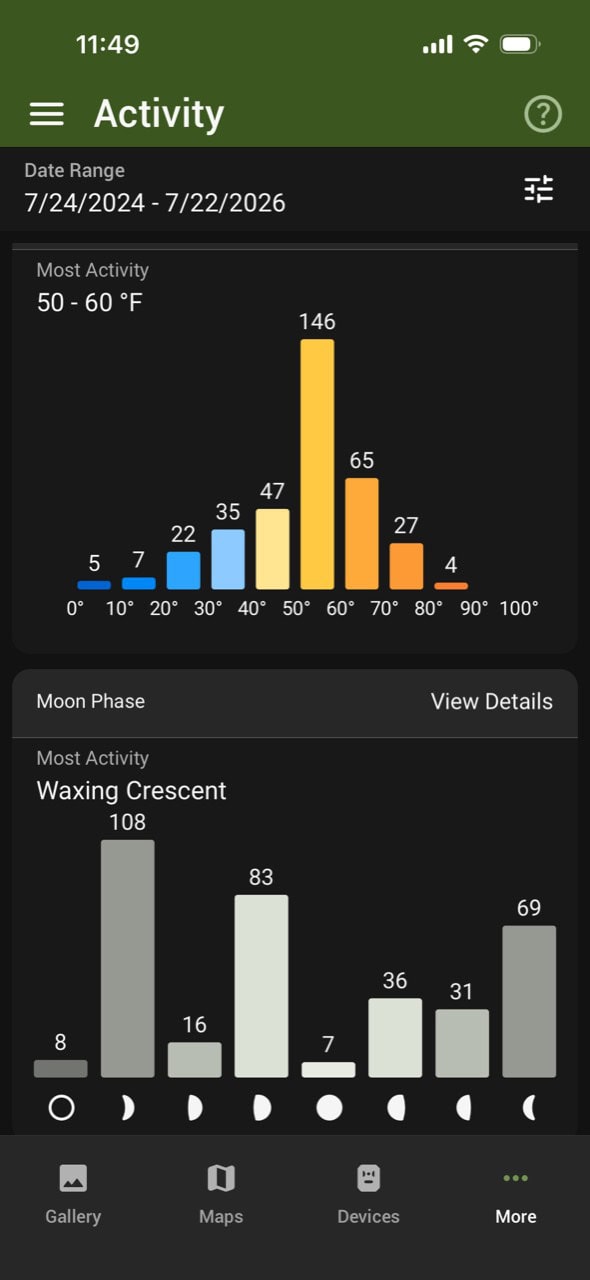
The raw phase totals were:
- New moon: 8
- Waxing crescent: 108
- First quarter: 16
- Waxing gibbous: 83
- Full moon: 7
- Waning gibbous: 36
- Third quarter: 31
- Waning crescent: 69
The waxing crescent produced about 15 times as many camera detections as the full moon and 13.5 times as many as the new moon in this data set. That is a big difference, and it is worth paying attention to. But it does not prove the moon caused the difference.
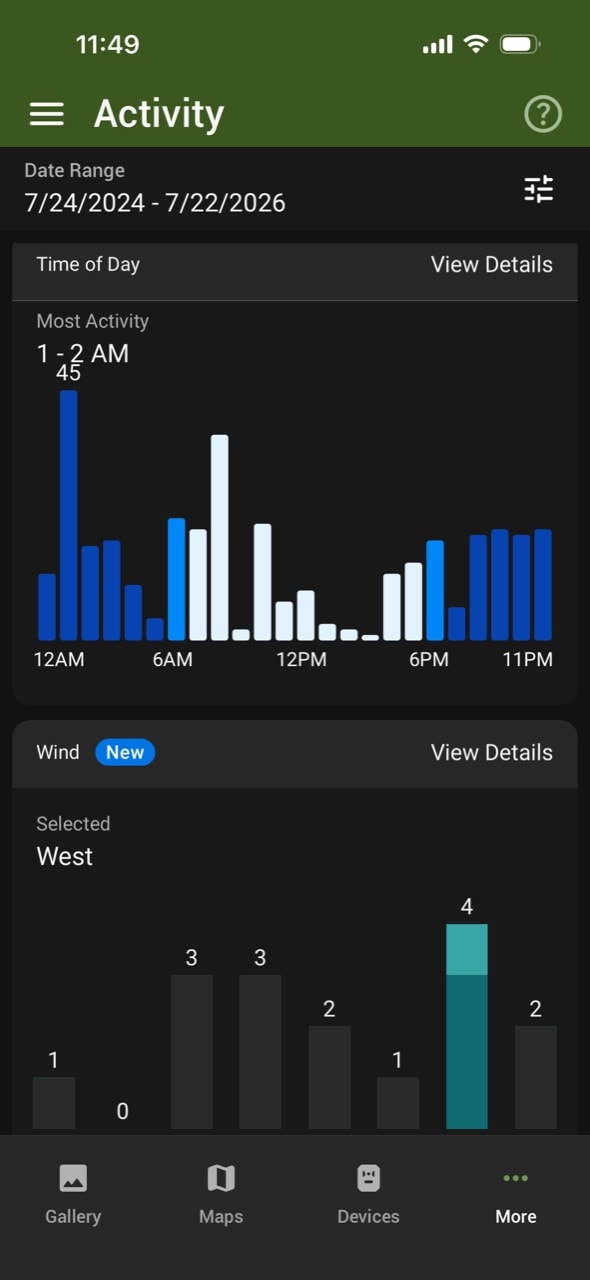
One deer can trigger a camera several times. Camera placement, seasonal food, rut timing, temperature, pressure, and the number of days in each sample can all affect the totals. My time-of-day chart also shows the largest peak from 1 to 2 a.m. A high camera count does not automatically equal a legal-light hunting opportunity.
The broader research on moon phase is mixed. A GPS-based study published in 2010 did not find a clear moon-phase effect on deer movement. Auburn research suggests lunar factors may affect some seasons or hours, but the signal is smaller and less dependable than normal daily movement patterns.
How I use it: The waxing crescent is a supporting clue in my planning, especially because my own cameras show a pattern worth watching. It does not override wind, access, pressure, fresh sign, or the current Hunt the Season phase. If those factors line up with a waxing crescent, my confidence goes up. I do not hunt a bad setup just because of the moon.
Weather Is Context, Not a Magic Number
Temperature drops, fronts, rain, snow, wind changes, and barometric pressure can all affect when deer move. The mistake is turning one number into a universal rule.
I do not believe there is one perfect barometric pressure that makes every buck move. A rising pressure after a front can be useful, but so can the temperature change, wind shift, cloud cover, and timing of the front. I look at the whole change, not one reading.
Rain can reduce visibility and wash away a blood trail after the shot, so recovery risk matters too. A good movement window is not worth taking a shot if the conditions will make an ethical recovery much harder.
A Simple Decision Test Before You Hunt
Before I choose a morning, evening, midday, or all-day hunt, I run through these questions:
- What phase are the deer in? Early season, October shift, Scrape Week, peak rut, post-rut, or late season?
- What is the freshest evidence? Tracks, beds, rubs, scrapes, camera daylight activity, or a direct observation?
- Where is the likely daylight movement? Near bedding, staging cover, a funnel, a scrape cluster, or food?
- Can I hunt the wind and thermals? Not just at the stand, but during entry and exit?
- Can I get in and out cleanly? Especially after an evening hunt?
- What has pressure changed? Are deer avoiding the easy route, moving later, or using thicker cover?
- What are my three options? My Primary plan, Pivot plan, and Wait/Observe plan?
If I cannot answer those questions, the best move may be an observation hunt instead of forcing a stand.
Frequently Asked Questions
What is the best morning time to hunt deer?
Be settled before first light and stay through at least 10 or 11 a.m. The best exact window depends on the route between nighttime food and daytime bedding, plus pressure and wind. Always wait until your state’s legal shooting time before taking a shot.
What is the best evening time to hunt deer?
Get settled before the main bed-to-food movement begins and hunt through the end of legal light. My Pennsylvania baseline is to be in position by 4 p.m., but earlier sunsets, longer access, and late-season patterns may require an earlier start.
Is midday a good time to hunt deer?
Yes, especially during the rut, near bedding cover, after other hunters leave, or when weather creates a short movement window. Midday is also useful for observation hunts and careful Scout-to-Hunt plans.
Does the moon phase determine the best time to hunt?
No. My cameras show much higher activity during the waxing crescent than during the full or new moon, but that is local evidence and does not prove cause. Use moon phase as one supporting clue after wind, access, pressure, current sign, and season phase.
What is the best barometric pressure for deer hunting?
There is no universal pressure number that guarantees movement. A rising pressure after a front can help, but the temperature change, wind, precipitation, cloud cover, and timing of the front matter too.
Should I hunt deer in the rain?
Light rain can produce movement and cover noise, but recovery risk must be part of the decision. Heavy rain can erase blood quickly. I become more conservative about shot distance and shot angle when conditions could make recovery harder.
Your Next Steps
- Hunt the Season: Match your strategy to the phase deer are actually in.
- Timing the Kill: See what my 10-year study found about when mature bucks move.
- Full 10-Year Deer Study: Review the larger pattern behind the timing recommendations.
- Build a 3 Hunt Plan: Create a Primary, Pivot, and Wait/Observe option before conditions change.
- Use Kill Zone Mapping: Connect bedding, food, travel, wind, access, and pressure to a huntable location.
The best time to hunt is not one hour for the entire season. It is the highest-odds window you can hunt without damaging tomorrow’s opportunity.
Want to see exactly what I’m carrying this season? Check out my Personal Bowhunting Gear List for 2026