
Deer Research Synthesis
Whitetail Deer Study Results: What GPS Research Teaches Bowhunters
What long-running GPS-collar research can teach us about buck movement, bedding, pressure, seasonal shifts, and hunt timing.
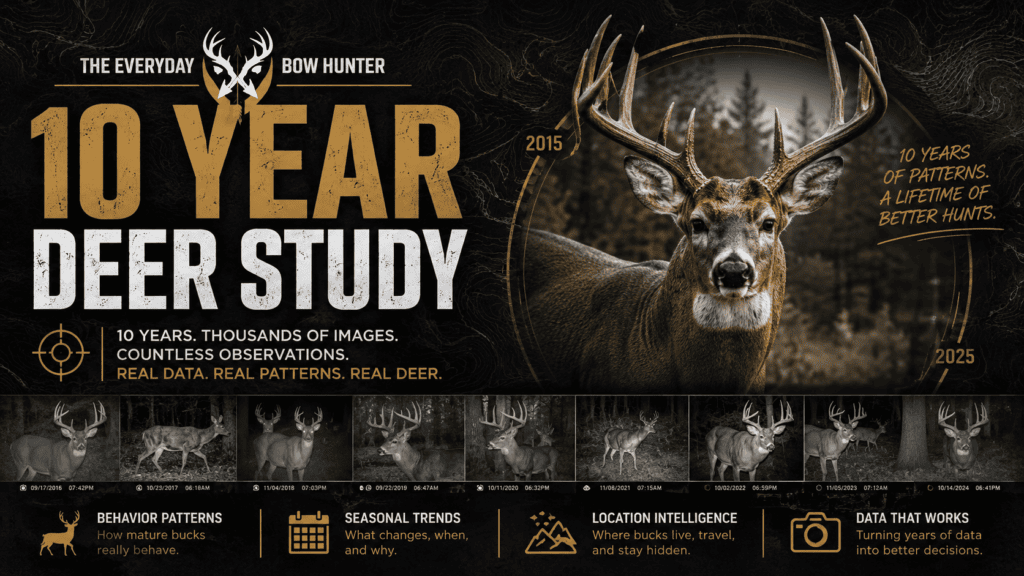
What This Research Can—and Cannot—Tell Us
Deer research is most useful when it helps you make a better decision in the woods. This guide brings together findings from university and agency studies on buck movement, bedding, home range, seasonal changes, hunting pressure, and hunt timing.
This is not one experiment that followed the same deer for exactly ten years. It is a synthesis of multiple studies completed in different habitats, seasons, and hunting conditions. Those differences matter because a result from one property or deer population may not transfer perfectly to another.
I use the research as a foundation, then compare it with the current sign, pressure, terrain, and deer behavior in front of me. The research can show useful patterns. It cannot tell you exactly what one buck will do on your property.
How to Read the Research Behind This Guide
This page is a synthesis of more than a decade of university and agency research, not one single 10-year experiment. Different projects studied different deer, habitats, seasons, and kinds of hunting pressure. I use the findings as a foundation, then compare them with the sign and behavior in front of me.
- Mississippi State University Deer Lab: Understanding Buck Movement
- Peer-reviewed Mississippi buck movement and partial migration research
- Penn State Deer-Forest Study: How deer respond to hunting pressure
- Penn State Deer-Forest Study: Wind and deer movement
- Mississippi State University: Moon phase and buck activity
- Whitetail Deer Study Results: What GPS Research Teaches Bowhunters
- What This Research Can—and Cannot—Tell Us
- Buck Behavior and Rut Patterns (What Science Confirms)
- Movement Patterns: Daily Routines and Weather Effects
- Feeding Preferences and Travel Patterns
- Buck Bedding and Habitat Use (Where Do They Hide?)
- Hunting Pressure: How It Changes Deer Behavior
- Best Times to Hunt – Month-by-Month and Hour-by-Hour
- Conclusion – Putting It All Together
- Next Steps: Turn the Research Into a Hunt Plan
Buck Behavior and Rut Patterns (What Science Confirms)
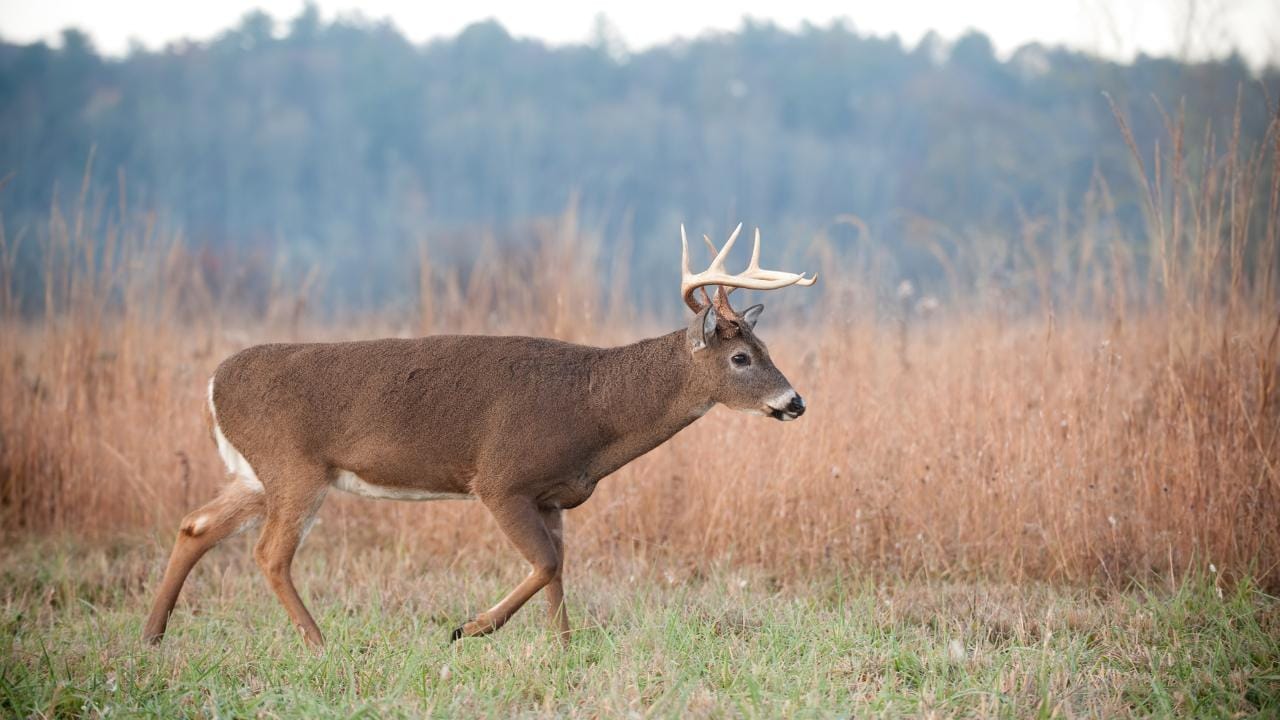
Social Patterns: Whitetails are social, but mature bucks are lone wolves for much of the year. In summer, bucks often hang out in bachelor groups, tolerating each other while food is plentiful. As fall approaches and velvet is shed, rising testosterone pushes bucks to break up those buddy groups (Mississippi State University Deer Lab).
They establish a dominance hierarchy through sparring and posturing – every buck finds out if he’s king of the hill or a subordinate. Research from Mississippi State confirms what hunters see: as early as October, bucks start “thinking like a buck” – focusing less on feeding and more on asserting dominance (rubbing, scraping) and seeking does (extension.msstate.edu). At this time, their home ranges may shift or expand as they prepare for the breeding season.
Territoriality: While not territorial in the strict sense (they don’t defend a fixed tract of land year-round), mature bucks do have core areas they practically live in. GPS studies show bucks spend most of their time in just a few preferred “focal areas” within their home range. T
These are usually areas with good cover and low disturbance where the buck feels safe. Some bucks are homebodies, sticking to one core area of a few hundred acres, while others are travelers with multiple home ranges miles apart. In one Mississippi study, about 30% of adult bucks had two distinct home ranges, essentially behaving like migratory deer moving between seasonal areas (msstate.edumsstate.edu).
If a buck disappears from your hunting property in mid-October, he might be one of those mobile ones shifting to a different range (or simply changing his patterns with the changing food and cover).
Rut-Related Shifts: The rut is the Super Bowl of whitetail behavior. As the breeding season kicks in, buck behavior shifts into overdrive. Studies document a sharp increase in daily movement once testosterone peaks. For example, researchers observed that bucks in pre-rut (early phase) traveled around 2.5–3 miles per day, but during the rut, they covered 4+ miles per day on average.
In other words, a buck might double his typical range when does are in heat. Bucks throw caution to the wind during this time – they’ll wander widely (sometimes even making “excursions” outside their normal home range) in search of receptive does. Excursion data show these side-trips peak during the breeding period and are likely bucks cruising for does outside their usual territory (extension.msstate.edu).
During peak rut, a mature buck’s daily routine is anything but routine. Instead of the familiar bed-to-feed pattern, he spends most of his time on his feet, trolling for does or tending one. Field research confirms that in the rut, bucks spend significantly less time bedding and more time on the move than at any other time of year.
They’ll check scrape lines, chase does, fight off rivals, and generally cover ground all day long. This is when normally nocturnal giants slip up and stroll past your stand at noon. A seasoned hunter knows the first two weeks of the rut (which, in many northern states, falls in early to mid-November) are pure magic, and the science backs that up with hard data on increased daylight movement and distance traveled.
Post-Rut and Second Rut: After the main rut flurry, bucks enter a recovery phase. They’re beat up, worn down (often having lost 20–25% of their body weight), and their behavior changes again. Research shows daily movement drops back toward pre-rut levels once the majority of does have been bred.
Bucks spend more time feeding and bedding in late fall to rebuild strength. However, a “late rut” or second estrus cycle can spark some renewed activity. If some does weren’t bred or fawns hit puberty late, a secondary rut about a month after the peak can get bucks up and moving again (albeit much less intensely).
In southern states, of course, rut timing varies widely – peak breeding might occur in December or even January, but the pattern of behavior (pre-rut, rut, post-rut) is similar, just shifted on the calendar. The key takeaway is that the rut is the driving force behind the most dramatic changes in buck behavior. When testosterone is high, bucks prioritize breeding over everything – food, safety, even sleep.
Bottom line for bowhunters: The rut is prime time to catch mature bucks letting their guard down. But don’t overlook the early pre-rut period when bucks are laying down sign (rubs, scrapes) and establishing dominance – a big boy might daylight on a scrape before the first doe comes into heat. And remember that not all bucks behave the same.
Individual personalities (homebody vs. wanderer, aggressive vs. timid) play a role in how they respond to the rut. Your target buck might be cruising 5 miles on the neighbor’s land, or he might still be hiding in a thicket waiting for does to come to him. Knowing there’s this variation, backed by research, can temper your expectations and strategies. One thing’s for sure: when the rut is on, every minute in the stand counts.
Movement Patterns: Daily Routines and Weather Effects
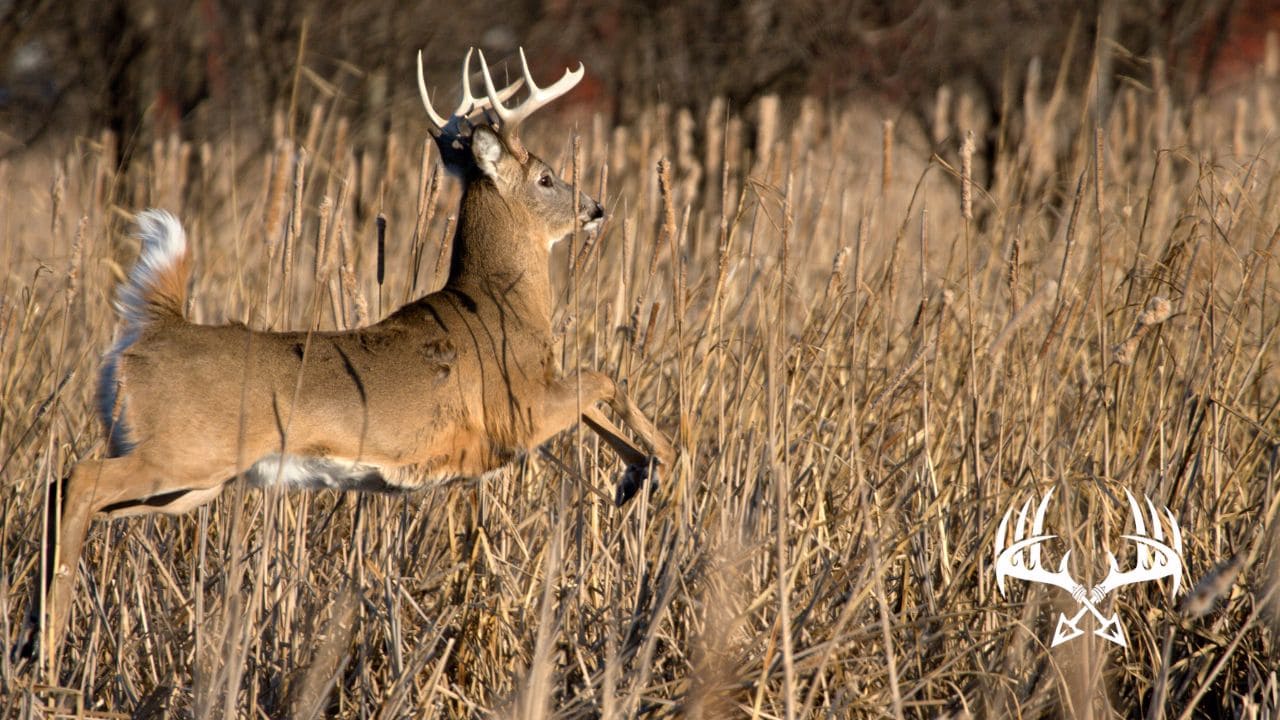
Daily Movement (Time of Day): Whitetails are crepuscular, meaning they are most active at dawn and dusk – that’s old news. GPS collar studies across multiple states confirmed that deer movement peaks at first light and last light, with up to 60% of a buck’s active behaviors (feeding or walking) occurring in those twilight periods.
Bucks bed more often during the middle of the day, but “slower” does not mean “stopped.” Mississippi State’s GPS-collar work found that adult bucks can move throughout the day, especially as breeding activity increases. Their guidance is practical: hunters who leave after two or three hours may miss real opportunities. Mississippi State University Deer Lab.
Think about that: if an older buck sneaks back to his bed at 5:00 a.m., he might wait until late morning to get up for a stretch or to browse, which could be your chance if you’re still on stand. Countless times I’ve seen hunters climb down at 9:00 a.m. and bump the buck that crept in at 10:30.
Research and experience agree: if you can endure an all-day sit during the rut, do it. Deer activity may spike at dawn and dusk, but studies (and my own humbled tales of bucks showing up at 1 p.m.) prove that being in the woods the whole day dramatically increases your odds. In short, dawn and dusk are best, but deer can move at any time – especially in November, so plan accordingly.
Seasonal Movement Patterns: Deer movement changes with the seasons and breeding cycle. In early fall (late summer into September), buck activity is still relatively patternable: they visit food sources routinely in the evenings and return to bedding areas before sunrise. As we hit October, several factors cause a so-called “October lull” in sightings, but it’s not that deer stop moving. Instead, bucks shift their patterns: crops are being harvested, acorns start dropping, and bucks begin ranging a bit more at night and less in open areas.
Collared deer in studies showed completely different daily patterns by early September than they had in late August, once velvet was shed and hormones started stirring (Mississippi State University Deer Lab). So that buck hitting the clover field at 7 p.m. in mid-September might switch to acorns back in the timber by October 1. It’s not a mysterious lull, just a change in routine and habitat use. By late October, movement (especially of bucks) starts climbing again as the pre-rut scraping and seeking begins.
The peak rut (again, timing varies by region) is the high point of deer movement in the fall. GPS data from Mississippi’s Deer Lab showed that bucks in peak rut moved the greatest total distances per day, covering 50% more ground than they did early in the season.
In northern states, that corresponds to early to mid-November. In the Deep South, that might be December or January. During this breeding frenzy, movement at all hours increases, which is why you hear about midday buck kills and see bucks chasing does across roads in broad daylight.
Post-rut (late November into December in the North), buck movement falls off. They go back to being more cautious and conserving energy, focusing on food in the cold. Does and fawns will shift to wintering areas if the habitat is harsh, and overall deer sightings can drop in late season (or become highly concentrated around remaining food sources).
Weather Influences on Movement: Weather matters, but the research does not support one simple rule that predicts every buck. Deer still have to feed, bed, avoid danger, and breed. Normal changes in temperature, wind, rain, pressure, or moon phase should be treated as context—not as a substitute for fresh sign, secure access, and the seasonal pattern.
- Temperature and fronts: A sharp change can shift where or when deer use cover and food, but a cold front is not a magic switch. Penn State analyzed GPS locations around winter storms and found mixed results from year to year. Read the Penn State Deer-Forest Study analysis.
- Wind: Do not assume a breezy day shuts deer movement down. In one Penn State October dataset, daytime movement increased as wind increased, while nighttime movement decreased. That does not guarantee action, but it is good reason to hunt a safe, steady wind instead of staying home. See the Penn State wind analysis.
- Rain: Light rain does not remove a deer’s need to move. Heavy rain and storms can change short-term activity, and they can make recovery harder for the bowhunter. Judge the whole situation instead of treating rain as an automatic yes or no.
- Barometric pressure: Pressure changes with the rest of a weather system. I would not use the barometer by itself to choose a stand. I would use the wind, access, current food, fresh sign, and the phase of the season first.
- Moon phase: Mississippi State researchers compared GPS data from 48 bucks and found little practical value in the common moon-based movement theories. Hunt the conditions and opportunity you actually have. Review the Mississippi State moon study.
My practical takeaway: The rut, hunting pressure, food, cover, and daily rhythm are usually stronger drivers than any single weather number. Use weather to refine the plan. Do not let it replace the plan.
Feeding Preferences and Travel Patterns
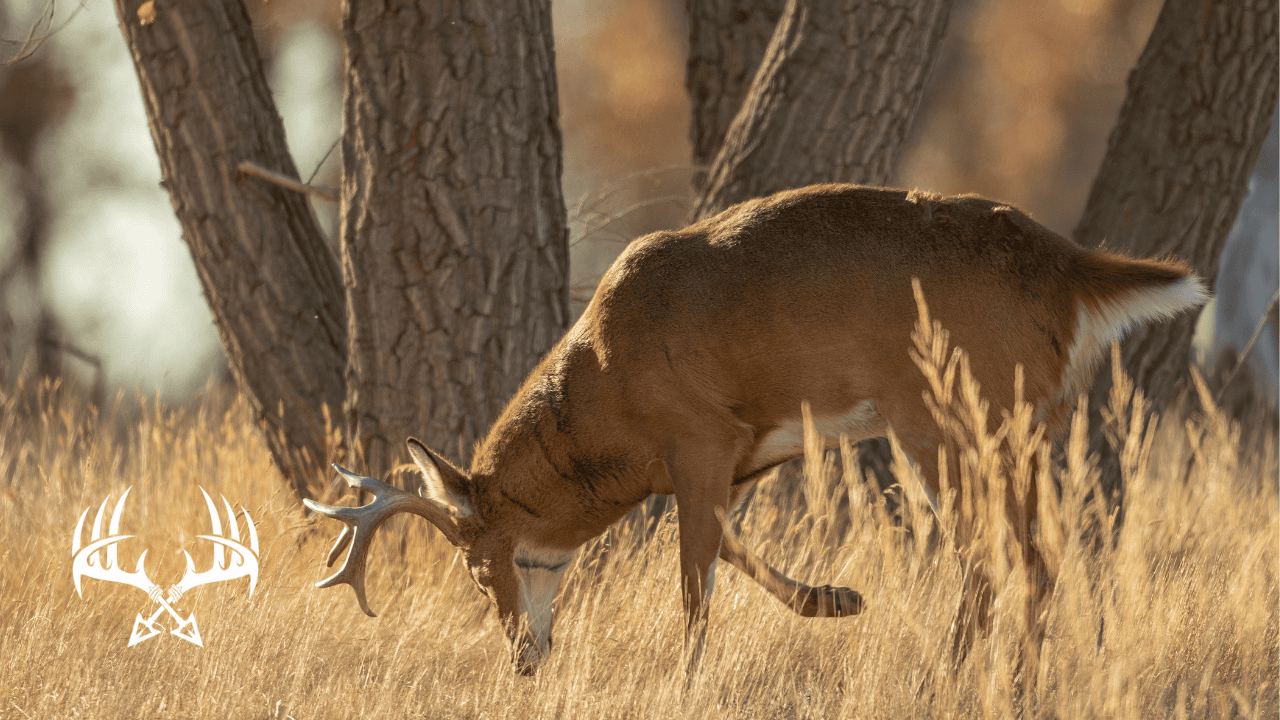
What Deer Eat and When: Whitetails are selective feeders, and their diet shifts with the seasons. Understanding what your deer are feeding on at a given time can help you predict their travel patterns. In early season (late summer into early fall), bucks often focus on high-protein foods to pack on weight: think soybean fields, alfalfa, clover, and tender browse.
Soft mast (apples, berries) can also be hotspots. As the season moves into mid-fall, acorns become king in many areas. If it’s a good acorn year, deer may abandon crop fields and hit the oak ridges day and night until the buffet is gone. I’ve seen it countless times: a property with minimal deer sign in early October can suddenly get hammered with tracks and droppings once the white oaks start raining acorns.
Scientific studies of deer diet confirm that acorns (especially white oak acorns) are a preferred food in autumn due to their high energy content. Once acorns are gone or rotten (late fall), deer shift again to other available foods: green browse (like honeysuckle or greenbriar in the South), remaining crops (corn, soybeans, picking through cut fields or food plots), and mast like persimmons or late-dropping red oak acorns.
By winter, in cold climates, deer rely heavily on woody browse – briars, twigs of hardwoods like maple or ash, and evergreen plants like laurel or cedar. Key point: deer will go where the food is best, right now. As a bowhunter, you need to anticipate these shifts. If the corn gets cut or the acorns drop, expect deer to adjust within a few days. Keeping tabs on food sources (and hunting near the hottest food of the week) is a proven strategy to see more deer.
Travel Routes and Patterns: Deer are habitual in how they move across the landscape. They tend to use the path of least resistance with adequate cover. Studies show that when deer move from bedding to feeding, they avoid areas with open understory or poor cover as much as possible, choosing routes that keep them concealed.
What does that mean for a hunter? It means those thick brushy draws, hedgerows, creek lines, and timber edges are gold, they are natural travel corridors that deer favor. In areas where forest meets field, deer often stage just inside the treeline before venturing out at dusk. If you can find a narrow strip of cover connecting bedding and feeding areas (for example, a brushy creek bottom between a bedding thicket and an oak flat), you have a prime location for an ambush.
Research from Mississippi State actually suggests that land managers create these covered travel corridors to guide deer movement. Bucks were found to almost always move through areas of continuous cover when available, rather than expose themselves crossing open ground.
As a bowhunter, I love setting stands on these “funnels” – places where geography or vegetation pinches deer into a specific path. It could be a saddle between two ridges, a beaver dam across a river, or a thin strip of woods between two neighborhoods – if it’s a funnel and has deer sign, a buck will use it sooner or later. And when he does, you’ll be waiting.
Bedding to Feeding (and Back): A classic daily pattern outside the rut is bed-to-feed-to-bed. In the late afternoon, deer rise from their bedding areas and travel to evening feeding sites. Come night’s end (predawn), they reverse course and head back to bed.
Research has shed light on how far and how long these movements can be. Many mature bucks will bed fairly close to prime food, often within a few hundred yards if cover allows, to minimize exposure. Others might travel a half mile or more to feed if that’s what it takes.
On average, a buck’s core area might be on the order of only 100–300 acres, within which he has multiple bedding and feeding spots. But during those feeding forays, they often revisit the same routes and even the same specific beds if undisturbed. In one study, a buck had about 10 different “focal areas” (likely bedding or feeding hotspots) that he used over a week, revisiting some frequently and others only once. The ones he preferred were those isolated pockets of cover where he felt safest.
This reinforces the importance of identifying a buck’s bedding area and preferred feeding area, then figuring out how he travels between them. Bowhunting 101, right? The science just confirms that bucks will choose the safest travel routes between needs (cover, food, water, does). If that route happens to skirt a field edge, great. If it goes up a steep, brushy ridge where few people tread, you might have to break a sweat to get there, but it could be worth it.
Feeding Behavior: When food is abundant, deer often exhibit a behavior called “site fidelity,” meaning they return to the same feeding location repeatedly. If you’ve got a hot oak tree or a productive food plot that deer are hammering, you can count on those deer to be back as long as the food lasts.
However, deer are also masters at detecting when a food source becomes dangerous. Overhunting a food plot and deer (especially mature bucks) will start entering only after dark, or avoid it for a while. Sometimes bucks will stage 100 yards downwind of a food source at last light, sniffing for danger (or for does during the rut) before committing.
So, even within a feeding area, think about where a cautious buck might hang back. Set up on those staging areas or travel routes leading in, rather than right on the food source, if mature bucks are your goal.
Habitats and Edges: Whitetails are creatures of edge habitats. Transitions like hardwoods to pines, thick cover to open hardwood, CRP field to woodline, these are travel magnets. Deer often walk the edge itself or just inside the cover on the downwind side, scent-checking the open area for does or danger.
I’ve watched does feed out in a hayfield while a buck paralleled them 30 yards inside the woods, using his nose to see who’s out there. Keep this in mind when setting up – a stand 20 yards inside the woods along an edge can intercept that buck scent-checking the field far better than a stand right on the field edge.
In summary, find the food and you’ll find the deer, but also figure out how they get to that food from their bedding cover. Hunt the trails, funnels, and staging areas along that path. And remember that deer will adjust their preferred foods with the season, so your hotspot in early October might go cold by Halloween as deer switch from clover to acorns, for instance.
Stay flexible and scout in-season if possible to keep tabs on these shifts. There’s no substitute for fresh sign – if you find rubs and tracks leading into a corner of standing corn or a white oak flat with cut acorn caps all over, you know where to be. Use the research-backed principles (deer like cover, repeat comfortable routes, avoid danger) to interpret that sign and set up accordingly.
An old bowhunter once told me, “Hunt deer where they want to go, not where you wish they’d go.” That advice holds true, backed by both instinct and science.
Buck Bedding and Habitat Use (Where Do They Hide?)
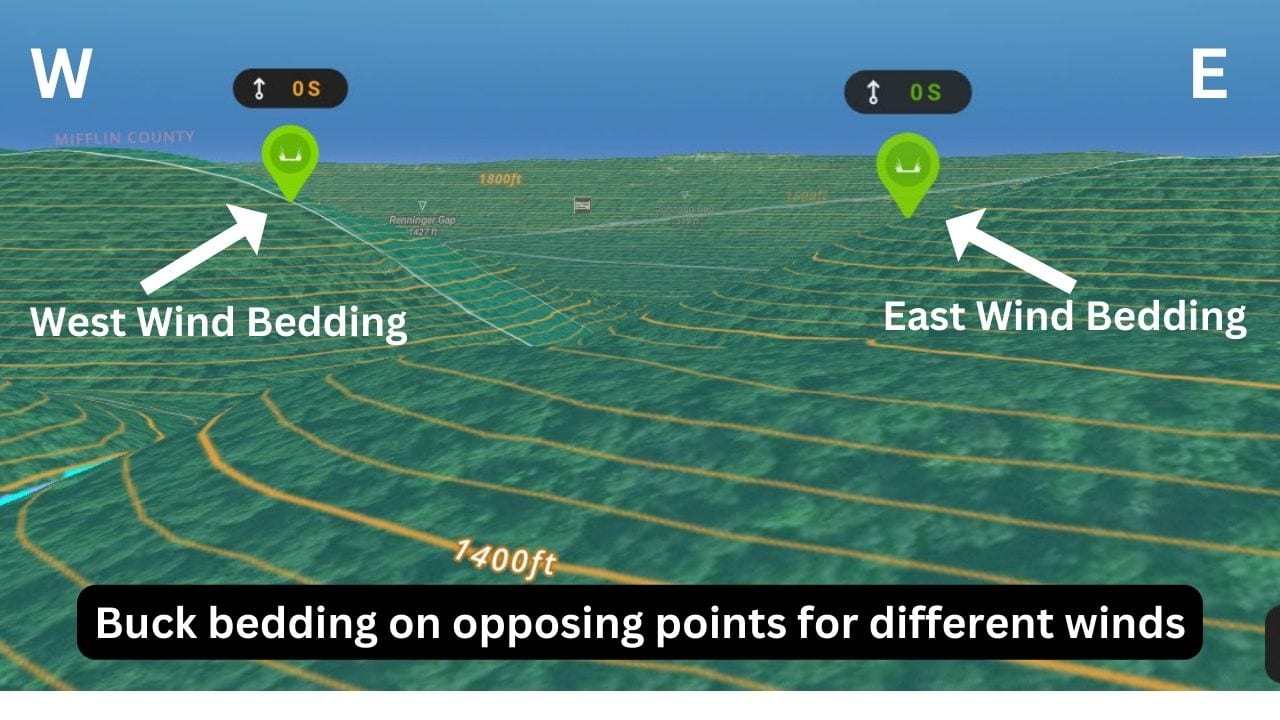
Every bowhunter dreams of sneaking up on a giant buck in his bed. While that’s a tall order, knowing how bucks choose bedding areas is crucial for setting up stands or still-hunting near bedding cover at the right time. Recent university studies have really dialed in what makes a spot prime bedding for deer, especially under hunting pressure.
Cover, Cover, Cover: The number one factor in buck bedding is security. Mississippi State researchers compared the two most-used likely bedding areas in each buck’s hunting-season home range with two unused areas. The used sites averaged 33% screening cover compared with 15% in the unused sites. They also contained about twice as much herbaceous growth and twice as much thicket-forming vegetation, so the same cover could provide concealment and browse. Read the Mississippi State GPS-collar findings.
Penn State’s separate Deer-Forest work gives hunters a useful habitat benchmark: security cover is vegetation dense enough to hide about 90% of a deer when viewed from 200 feet or less. That is a cover definition, not part of the Mississippi GPS bedding-site comparison.
In other words, if you dropped a beach ball in a buck’s bedding thicket, you probably couldn’t see it from 20 yards away. These areas often have brush, young saplings, and briars. Anything that provides visual screening. The research calls it “screening cover,” we hunters call it a thicket.
And bucks love it. The ideal bed for a buck is one where he can see or hear you coming from a long way off, but you’ll never see him until he explodes out of there.
Interestingly, the Mississippi study noted that not only do these bedding areas have great cover, but many also have some food value in that cover. Think about a clear-cut or brushy area that’s grown up, it’s thick for hiding, but it’s also full of blackberry brambles, green briar, and other deer foods.
A buck can lay up and chew his cud or nibble nearby plants without exposing himself. So the ultimate bedding habitat is thick AND has browse – like an overgrown cutover, a young pine plantation with weeds beneath, or a brushy swamp edge. As a hunter, if you find a spot where a deer can both hide and feed in cover, you’ve found a place a mature buck might spend daylight hours.
Terrain and Wind: While cover is paramount, bucks also use terrain to their advantage. In hill country, bucks often bed on the side of a ridge just below the crest, where they can see downhill and catch the wind coming over the top. In flat areas, they might bed in a brushy slough or the middle of a wide briar patch, sometimes facing downwind so nothing can sneak up from that direction.
There’s a lot of anecdotal discussion among hunters about bucks bedding with the wind at their back versus in their face; the truth is, they use the wind in some way most of the time, but it varies. Some research has attempted to analyze wind and bedding orientation, but results are inconclusive – deer seem to position themselves based on multiple factors (cover, wind, terrain, moisture, etc.).
It’s safe to say a mature buck will try to bed where he can see downwind and smell upwind, but the exact setup depends on the spot. For instance, he might bed on a knob where he can watch a valley below (downwind of him) while the wind carries scent from behind him over that knob. Or he might tuck into a cattail marsh where he can hear predators slogging through water regardless of wind.
Multiple Beds and Shifting Bedding: The GPS data showed a bedding network instead of one permanent sanctuary. Nearly all adult bucks revisited multiple focal areas, and 74% changed focal areas every 6–10 hours. One example buck used 10 focal areas in a single week during the rut. The researchers used the term focal areas because slow, concentrated movement suggested resting, but not every location was visually confirmed as a bed.
The tracked bucks were classified as bedded about 64% of the time during daylight, compared with 38% at dawn, 35% at dusk, and 47% at night. That does not mean there is no midday movement. It means most daylight locations are tied closely to secure cover, and the covered travel between focal areas can be more huntable than the bed itself.
On pressured public land, for example, a big buck might have one favorite hideout until a hunter walks near it, then he shifts to another spot that’s just as secure. This is why hunting bedding areas can be tough. You might set up on yesterday’s bed, while the buck is 200 yards away in a different brush pile today. However, they often recycle back through prime bedding spots when conditions allow (low disturbance, favorable wind, etc.).
Distance from Food/Water: How far do bucks bed from feed and water? That depends on the habitat. In rich environments, they don’t have to go far. I’ve seen bucks bed practically in a food source (like a standing cornfield or an overgrown food plot) if that food source provides enough cover.
More typically, a buck will bed a short distance from his primary food source – say 100 to 300 yards – if there’s thick cover available. If cover is sparse near food, he’ll choose cover over convenience and might bed 0.5–1 mile away and travel to the food. Water is usually abundant enough in the East that deer don’t need to bed near water, but in dry areas, they might factor it in.
During hot early-season days, bedding near a creek or waterhole (in the cool bottomlands) is common. In general, bucks want a bedding area where they won’t be bothered. If that’s next to a highway but people never walk there, a buck might bed 50 yards off the road (it happens!). If it’s in a remote cedar thicket on top of a mountain, that’s fine too. The common thread is security.
Effect of Hunting Pressure on Bedding: Research has documented that hunting pressure can actually change where deer bed. In a study of hunted bucks, as hunting pressure increased, bucks increasingly sought out areas with heavy cover for bedding (no surprise) and even shifted off properties with little cover to find refuge.
By the second weekend of a firearms season in one study, bucks were avoiding high-risk areas entirely and sticking to dense cover in daylight. In Oklahoma, collared deer increased their daytime use of thick cover by 240% once hunting got going, and hunters’ sightings of those bucks dropped by over 60% at the same time.
This tells us that pressured deer will abandon otherwise good habitat (like a lush food plot) if they feel unsafe, and hunker down in whatever hidey-hole keeps them away from humans. On public land, that might be a nasty swamp back by the boundary, or a steep laurel hell that hunters avoid.
On private land, it could be a designated sanctuary area that is never entered. Make no mistake: Bucks learn where we do and don’t go. One PA biologist noted some mature bucks were found bedded virtually under hunter parking areas – as if they figured out exactly where no one ever looks. Smart old deer find the overlooked spots.
Takeaways for Hunters: If you want to target a buck near his bedding area (a popular strategy for archery, especially early season), focus on areas of thick cover that are close to good food and have minimal human disturbance. Examples might be: an overgrown clear-cut adjacent to an oak flat, a brushy creek bottom 100 yards from a corn field, a patch of young pines on a hillside above an apple orchard, or a timbered swamp edge near acorns.
Get in during midday when the buck is likely bedded and stationary (and use the wind to hide your approach noise/scent). Set up on the downwind side of the bedding area if possible, so your scent blows away from where he’s bedded. Then be ready super early or stay super late, because these bucks often move right at the ragged edge of shooting light.
Also, consider multiple bedding areas. If you bust a buck or hunt a bedding stand and don’t see him, he might be using a different spot for a few days. Trail cameras can help identify bedding tendencies (catching a buck coming from a certain direction consistently at dusk suggests a bedding area that way).
But don’t over-pressure it; if a buck knows he’s been patterned in his bedding area, he’ll vacate to a new safe spot (and maybe not come back for weeks, if at all). The research on pressured deer hiding more on public land (Penn State Deer-Forest Study) and avoiding areas with human scent for days underscores that we should tread carefully around bedding areas.
Finally, if your hunting land lacks thick cover, consider improving it. Hinge-cut some trees, let an area grow up, or create brush piles. Managers have found that providing more screening cover keeps deer on the property even when pressure rises.
And if you can pair that cover with a food source (like natural browse or a small food plot tucked in the cover), you’ve created a buck’s dream bedding area. More bucks bedding means more daytime activity and more opportunities for you.
Hunting Pressure: How It Changes Deer Behavior
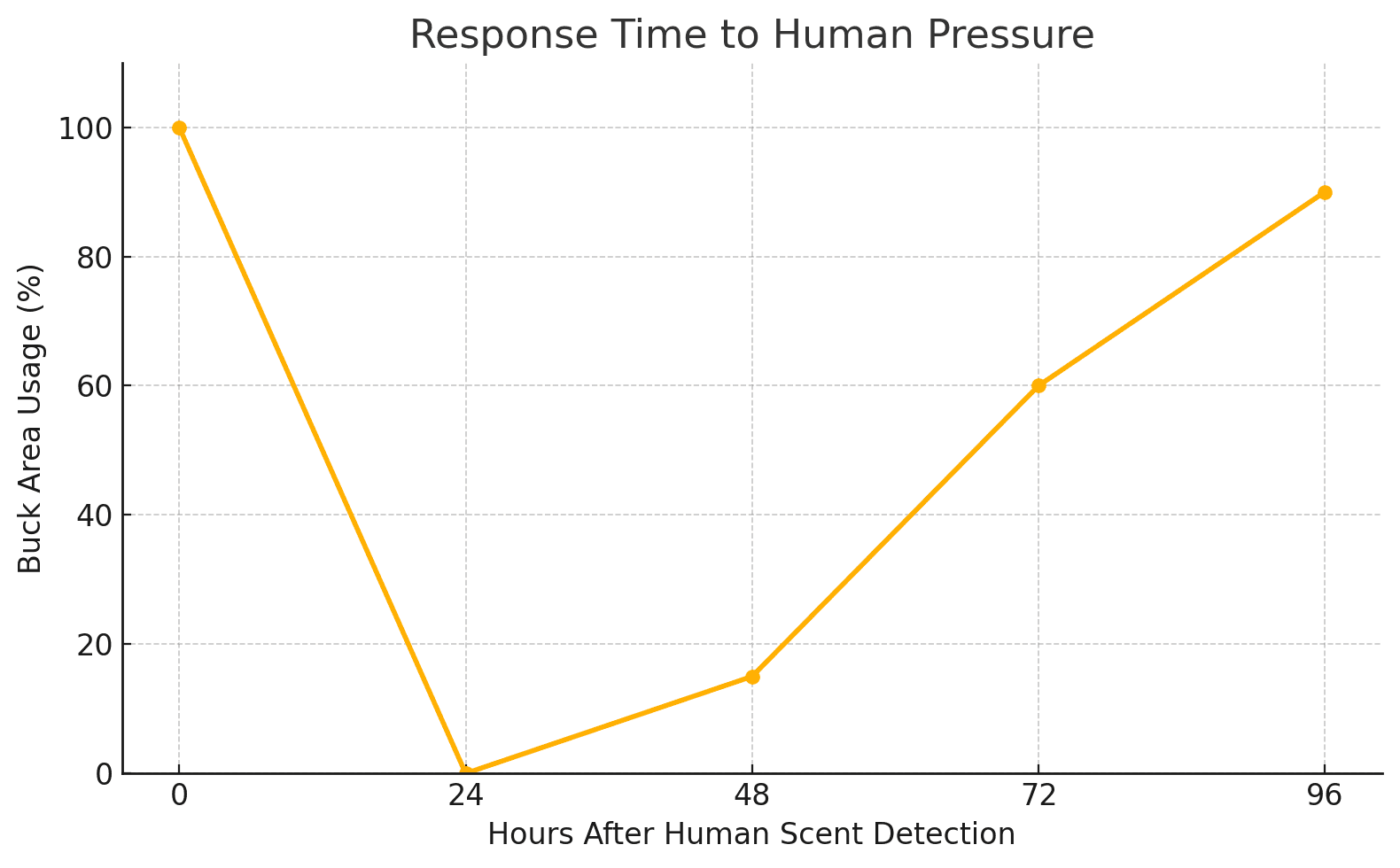
We’ve all heard it or experienced it: once the woods fill up with hunters, deer go nocturnal or vanish into the deepest cover. There’s a lot of truth to that, and now we have data to prove it. Hunting pressure – whether it’s a one-time intrusion or a season-long barrage – has a huge impact on deer movement and behavior. Here’s what the latest studies tell us about how deer respond to us hunting them:
- They Know We’re Coming: Amazingly, research in Pennsylvania found that deer actually altered their movement patterns the day before hunting season opened.
- It seems deer pick up on the increased human activity – scouting, setting stands, checking cameras – in the 24-48 hours before the opener and start adjusting immediately. So a buck that was moving in daylight on Thursday might switch to night movement by Friday evening if Saturday is opening day.
- If you’ve ever felt like the deer have a calendar, you might be right! The lesson: minimize disturbance even in the days leading up to the season. Sneak in and out when hanging stands or checking cameras, or set them weeks earlier, so you don’t telegraph the start of “human season.”
- Stand Pressure and Avoidance: A GPS study in South Carolina (Clint McCoy/Auburn University) delivered eye-opening numbers on how bucks avoid hunting stands.
- When a particular stand was hunted for 12 hours in a week, daytime deer activity within 150 yards of that stand was cut in half the following week. Even just one sit in a stand caused bucks to avoid that area for an average of 3 days afterward.
- If a stand was left alone for around 5-7 days, deer began to feel comfortable moving there in daylight again. What’s more, the deer didn’t have to actually see the hunter at the stand – they could smell that a person had been there and would steer clear based on that alone.
- This confirms what many savvy hunters have figured out: the first sit is often the best sit. The more you hunt a spot, the less chance you have of seeing a mature buck there in shooting light. Your scent lingers and educates them, even if you don’t spook deer at the moment.
- So, rotate your stands and give spots plenty of rest. If you can, save a prime stand for the perfect conditions and make your first hunt count, then back off. It’s hard to do, but the science says it pays off.
- Deer Go Nocturnal (When Pressured): Multiple studies show that as hunting pressure ramps up, deer shift more of their movement to nighttime.
- In the Oklahoma study mentioned earlier, by the second weekend of gun season, buck sightings plummeted 62% because those bucks were still there, but moving mostly at night or staying hidden in cover during the day.
- Similarly, research in heavily hunted areas finds deer “hunker down” in daylight once the shooting starts. They’ll move in thick cover or not at all until after dark, then venture out to feed. On public land or heavily hunted private land, you might get a flurry of action on opening day (as deer are pushed around), but then daytime deer movement drops off a cliff in the following days.
- This is why some of the best hunters actually take advantage of opening day chaos or, conversely, wait until things settle and hunt weekdays or late season when pressure is lighter. If you hunt pressured ground, consider focusing on low-pressure time periods – for example, hunt during a weekday when other hunters are absent, or be the only one willing to hunt in nasty weather when others stay home.
- Deer pattern us, so zig when everyone else zags.
- Deer Avoid People, Not Just Places: Research indicates deer don’t just avoid specific stand sites; they alter their whole use of an area based on how risky it is.
- In a controlled study, deer actively selected safe zones and avoided risky areas as hunter activity increased. For instance, on days hunters were few (low risk), bucks would roam through open hardwoods and even fields more.
- On high-risk days (lots of hunters out), those same bucks stayed in thick timber or didn’t move far from bedding at all. There appears to be a tipping point – when pressure gets high enough, mature bucks just won’t be in certain habitats in daylight at all. They’d rather bed down in a bush than step into a clover plot if they sense lots of human activity.
- However, research also showed a curious exception: in one study, bucks still visited food plots even under high risk, but they did so mostly at night. In other words, they wouldn’t abandon the groceries, but they waited until it was safe (after dark) to go chow down.
- So, deer will change when they use a food source based on pressure, even if they don’t abandon it entirely.
- Public vs. Private: Studies like the Penn State Deer-Forest project revealed that the percentage of collared deer harvested on heavily hunted public land was much lower than expected, not because those deer weren’t there, but because they became experts at avoiding hunters (Penn State Deer-Forest Study).
- They find the thickest hidey-holes on public and essentially let hunters walk right past them (or they move out of the way well in advance). On lightly hunted private lands, deer are a bit more relaxed and might show themselves more. It’s all relative to how much pressure they feel. This is why public land mature bucks are often considered a different breed – they are the survivors who learned to ghost around hunters.
- If you’re pursuing a public land trophy, you have to think like a pressured deer: seek spots other hunters overlook (nasty terrain, long walks, adjacent to human access points but not obvious, etc.), and capitalize on the first time you hunt an area.
How to Mitigate Hunting Pressure: As hunters, there are a few things we can do to lessen our impact. First is access strategy – approach your stands in a way deer won’t detect you. Use creeks, ditches, thick cover, or go midday when deer are bedded away from your route.
If deer don’t know they’re being hunted, you can get away with a lot more. Second, limit over-hunting any single spot as noted. The data says three days of avoidance after one hunt; so, have at least a few stand options and rotate them. Third, consider timing your hunts to catch deer off guard.
For example, some hunters only hunt specific stands during the rut or during a cold front, etc., essentially ensuring every time they go in is a surprise party for the deer. Fourth, scent control and stealth – while you’ll never be invisible, the less human scent you leave in an area, the better.
Use rubber boots, avoid touching too much vegetation, and don’t linger longer than necessary. Remember, deer can come by hours after you’ve gone and smell where you walked or sat, and that can educate them. I treat every entry like I’m leaving a scent mine that could blow up my spot later, so I try to minimize my footprints, literally and figuratively.
Lastly, don’t forget that hunter pressure can be dynamic. If you hunt a property that only gets pressured on weekends, deer might adapt a pattern of moving on weekdays in daylight and lying low on Saturdays. I’ve actually adjusted my hunting to hit spots on Monday or Tuesday after the weekend warriors have cleared out, and I’ve seen deer relax a bit.
Or, if you have a small property and your neighbors all start gun hunting in November, that might actually push deer onto your sanctuary if you keep it pressure-free. Be mindful of the landscape of pressure around you. And if everything blows up (e.g., opening day of rifle turns the woods into a war zone), sometimes the best strategy is to back out and wait for deer to resume a somewhat normal pattern after the disturbance dies down.
Alternatively, during a big drive or opening day, you could also use the pressure to your advantage by posting up in the thick escape cover where deer will flee to.
In the end, research just proves what a lot of seasoned hunters know: pressured deer are hard to hunt. They move less in daylight, avoid places they’ve encountered hunters, and generally act like the hunted animals they are. But with careful planning, treating each hunt like a chess move, you can still tag a mature buck even in a pressured area.
Hunt smart, not just hard: that means knowing when to strike and when to let things cool off. The data is on the side of those who exercise patience and precision.
Best Times to Hunt – Month-by-Month and Hour-by-Hour
Now let’s get down to the nitty-gritty of when to be in the woods. We’ve touched on time-of-day and seasonal trends, but here we’ll break it down into a practical month-by-month guide, with an eye on what bowhunters can expect during each phase of the season.
Keep in mind regional differences, for instance, the rut happens in November in much of the Midwest/North, but can be December or January in the Deep South. I’ll note where things might shift. This guide assumes a typical October to January deer season in an eastern U.S. state and that we’re targeting whitetails (which we are). Adjust as needed for your local timing.
September – Early Season Patterns
Overview: In many states, archery season opens in September (or early October). Deer, especially bucks, are still on late-summer routines for the first part of this month. Bucks may be in bachelor groups as velvet peel occurs early in the month. By late September, most bucks are out of velvet and starting to act a bit more independently.
Deer Behavior: Early September, deer are on feed-bed-repeat patterns. They hit food sources hard in the evenings and head back to bed before or by dawn. With foliage still thick and days warm, they favor shade and water in daytime. Bucks often haven’t been pressured yet, so some will show in daylight on regular schedules.
By late September, you’ll notice more rubs popping up – a sign that bucks are increasing testosterone and establishing territory. Bachelor groups might start breaking up around this time, especially for older bucks.
Best Hunting Tactics: In September, afternoons/evenings are typically best. You want to ambush deer as they head out to feed. Focus on food sources that are hot at this time: crop fields (soybeans are a magnet early, as are alfalfa/clover fields), orchards, food plots, or natural browse areas.
Pattern the deer with trail cams in summer if possible, then set up along their route to feed. It might be on the field edge or better yet, 20-50 yards back in the woods on a trail leading out to the field. Mornings in early season can be tough – deer are back to bedding by first light or shortly after, and you risk spooking them in the dark going in.
Many early-season bowhunters skip morning hunts or only hunt mornings in very specific situations (like a cold front or near a water source in a drought). Late morning (after 9-10 a.m.) in September is usually dead quiet as deer bed down, so I wouldn’t burn a lot of energy on midday sits now (save that for the rut).
One exception: if you find a buck bedding area very close to a feed (like 100 yards off a field) and can slip in early, you might catch him coming back at first light. But that’s a high-risk play. If you bump him, game over for a while. Generally, focus on afternoons in September. Also, waterholes can be great in hot weather. A secluded pond or creek crossing on route to feed is a great ambush on a warm September evening when deer will drink after rising from bed.
October – Transition and Pre-Rut
Overview: October can be split into early, mid, and late for clarity. Early October often sees that “lull” in visible movement. Mid-October, food sources change (acorns!), and pre-rut sign increases. Late October, especially the last 7-10 days, is pre-rut in many northern states, a fantastic time as bucks start seeking and chasing the first estrous does.
Deer Behavior Early-Mid October: Early in the month, bucks might seem to disappear. In reality, some are shifting to oak flats for acorns and moving more after dark, partly due to food and partly due to increasing wariness. If your area has a heavy mast crop, deer could be almost entirely in the woods feeding on acorns, and you won’t see them in fields until those acorns are gone.
Mid-October, you’ll see scrape lines appear. Bucks and does both visit scrapes (licking branches and ground pawings) as a pre-rut communication. They’re mostly done at night at this stage, but a surge in scraping activity often happens just after a cold front or under new moons in mid-October (even if science says the moon isn’t huge, hunters note a “scrape week” mid-month).
By late October, testosterone is surging; big boys that have been ghosts may slip up in daylight checking scrapes or cruising a bit for the very first hot doe. Does are still mostly in family groups focused on feeding, but as they approach estrus the last days of October, they’ll start drawing buck attention.
Best Hunting Times: Early October – focus on evenings still. Key in on whatever food is currently prime. Often, that’s acorns in the hardwoods. I’ve had much better luck hunting in the timber near oak trees during this period than sitting over field edges.
If you find fresh rubs and dropping acorns, hang a stand there and hunt the afternoon to catch bucks coming to feed before dark. Morning hunts can start to become viable again as temperatures cool, but be careful. If oaks are near bedding, a morning sit could work if you get in super early and the deer are still out feeding elsewhere.
But generally, the afternoon is safer. Midday activity is still low in early October.
Mid to Late October – things start heating up, and you can expand your hunting hours. By the third week of October, I like to start doing the occasional all-day sit or at least sit until noon, especially in areas with a lot of buck sign. Why? Because around Oct 20-25, you often get the first mature buck on his feet in daylight checking a scrape or poking into a doe bedding area mid-morning.
It’s not full rut chaos, but those one-off chances can happen now. If you have a cold snap in late October, definitely consider a morning hunt. In fact, late October mornings can be great – bucks that were out prowling at night might head back to bed a little later than normal, scent-checking along the way.
Setting up downwind of a known doe bedding area in a funnel (like where multiple trails converge) on October 25th in the morning could yield that “cruiser” buck trolling for early does.
Late October evenings are still excellent for classic stand sites – field edges where does feed (bucks scent-check the does there), oak ridges, and scrape lines. Scrapes are like buck social hubs. I like to hunt over a primary scrape area (several scrapes together) in the last days of October during the afternoon or evening.
It’s one of your best chances to arrow a mature buck before the rut kicks into full gear. Data from GPS collars often shows a small bump in buck movement around this pre-rut period as well, not as high as the rut, but higher than the early October lull.
Time of day: Late October, I’d say mornings and evenings are equally good, depending on your setup. Midday is still relatively slow (that will change in November), but I wouldn’t rule out catching a distracted buck moving at 1 p.m. even now, especially around Oct 28-31. So if you’re hardcore, go ahead and pull an all-dayer on Halloween, you might just get a treat instead of a trick!
November – Peak Rut Action
Overview: November is the month bowhunters live for in much of the country. This is the rut (breeding period) for most of the whitetail’s range (with local variation). Roughly from the end of October through late November, bucks are on the move at all hours, and anything can happen. It’s high risk (they could be anywhere) but high reward (movement is way up).
Deer Behavior: The first week of November is often the seek-and-chase phase. Does that haven’t been bred yet are still acting normal (feeding, etc.), but bucks are frantically searching for the first does coming into heat. This is when you see a lot of chasing, grunt calls work well, and bucks are covering their whole home range and then some.
Bucks often make long excursions now. Telemetry shows spikes in movements outside their normal areas during the breeding season. By the middle of November, many does are in estrus, and the lockdown phase can occur, where a buck finds a hot doe and sticks with her for a day or two, moving very little and staying in thick cover.
During lockdown (often around Nov 10-20), it might get a bit quieter in the woods (seems like “where did all the bucks go?,” they’re holed up with girlfriends). But then, as each doe finishes her 24-48 hour estrus, that buck is back on the prowl for the next one.
Late November has the post-rut flurry, a second round of seeking if a few late does or fawns come into estrus, and generally bucks shifting back to feeding a bit.
Best Hunting Times: All day, every day – that’s November for you. If I had to pick, I’d say November 5th through 15th are my absolute favorite days to be in a stand from dark to dark. Radio-collar studies confirm that bucks move the most during the peak breeding phase of the rut (for example, in one study peak rut movement was ~4 miles a day vs ~2.5 miles pre-rut).
And crucially, a lot of that movement occurs in daylight now because bucks aren’t as cautious when they’ve got one thing on their mind. I recall one research tidbit: collared bucks had no detectable pattern related to moon or weather during the rut – they moved irrespective of those factors.
Translation: just go hunting. Morning, midday, evening – it’s all good in the first half of November.
If you want specifics: Mornings in early November can be dynamite. Bucks that have been searching all night often keep going past sunrise. Many mature buck kills happen between 9 and 11 a.m. in the rut – a time many hunters are back at camp.
Science backs this up in a way, noting that hunters who stay on stand all day increase their odds (since movement can happen anytime). Afternoons are also excellent, especially near doe feeding areas, because come evening the does get up to feed and the bucks will be right on their heels.
I’ve observed a lot of chasing right at dusk in fields as does try to grab a bite, and bucks harass them. Midday (11 a.m. to 2 p.m.) in early-mid November is actually better than midday at any other time of year. Many big bucks have been taken at noon on a cold November day, often by hunters who decided to still-hunt or just stayed put while everyone else left.
It’s not that midday is as good as dawn/dusk on average (it isn’t, deer still move a bit less than), but the difference now is that bucks don’t mind moving midday if a doe’s involved. Also, if most hunters are out of the woods at noon, a smart old buck might use that quiet time to sneak from one bedding area to another searching.
So yes, hunt all day if you can stomach it. If not, at least extend your morning sit to 11-ish and get back in the afternoon earlier than normal (I’ve had bucks cruise by at 2:30 p.m. on a November afternoon).
During the lockdown phase (when many does are tending bucks, usually around Nov 10-15 give or take), sightings of cruising bucks can dip. Don’t be discouraged; things can go from zero to sixty real quick if an unbred doe steps out.
One strategy during lockdown is to hunt thick cover bedding areas. The idea is maybe you catch a buck that’s locked down with a doe or another buck still trolling through. But honestly, I stick to my funnels and doe areas and wait it out, knowing any moment could produce.
By late November (Thanksgiving timeframe), in northern areas, you start seeing the rut wind down. Bucks look strung out. Some younger fawns might pop into estrus now (secondary rut), and you’ll see a little bump in activity around late Nov/early Dec.
It’s not nearly as intense as early November, but it can present one more chance at a moving buck in daylight before winter patterns set in.
December – Post-Rut and Late Season
Overview: December in the North means post-rut recovery and the onset of winter conditions. In the Midwest and Northeast, gun seasons are often over or winding down by early December, and archery late seasons kick in. In the South, December can actually be rut (e.g., Alabama, Mississippi) or pre-rut, so adjust accordingly. I’ll focus on the post-rut scenario typical of the North/Midwest.
Deer Behavior: By December, most breeding is done (aside from the odd late breeder). Bucks are worn out and their priority shifts hard back to food and survival. They need to replenish body fat and heal. Does and fawns, having been harassed for weeks, also settle back into feeding-focused patterns, often in larger winter groups.
Deer at this time can yard up in areas with good feed and cover. Their movement becomes more predictable again: bed, then feed heavily in late afternoon, then bed. Cold weather can actually get deer moving earlier in the day, on bitterly cold days, I’ve seen deer feeding by mid-afternoon or even around noon in fields, trying to keep calories up. If snow covers food, they’ll be digging for mast or visiting crop fields more regularly.
One interesting pattern: after the chaos of November and the pressure of firearms season, some mature bucks become nocturnal ghosts in December, you might only catch them on trail cam at night. But others, especially if not pressured in December, will resume daylight visits to prime food sources once things calm down.
It really depends on pressure. If your property is quiet after gun season, you could have bucks showing up at 4 p.m. in the plot again like it’s early season, except now they have a rack with a few tines broken off from fighting!
Best Hunting Times: Afternoons/evenings reign supreme again in late season. Whitetails in December are very food-focused, and the best ambush is intercepting them on their way to feed in the late afternoon. Find the hottest food source in your area: standing corn or beans, cut corn fields with waste grain, food plots with brassicas or grains still green, or natural browse like clear-cuts or cedar thickets if that’s what they have.
Then set up on the downwind edge of that food or on the trail from the bedding to that food. Deer often bed closer to food in late season to conserve energy, so you might be surprised how early they show up if undisturbed. I’ve watched December deer step out with 45 minutes of shooting light left, which in late season feels “early” compared to them creeping out at last light in October.
Mornings in late season are usually not as productive and can be tricky. Deer often feed under the cover of darkness and are back to bed at or before dawn (especially if hunting pressure is still present). If you have a very secure bedding area and think you can catch a buck returning late after a night of feeding, a morning could pay off.
But more often, a morning hunt in December means you’re bumping deer off the food in the dark on your way in, which can spoil that spot. Many hunters (myself included) largely stick to afternoon hunts in the late season for that reason. One exception might be a warm front; oddly, a sudden warm, sunny morning after a deep freeze might get deer up from their beds to browse a bit in mid-morning. But again, afternoons are a safer bet.
Midday in December is mostly dead time. Deer are bedded, chewing cud, soaking up what sun they can in sheltered spots. If you have limited time, spend it in the afternoons.
One more tip: weather fronts in late season can drastically impact deer movement. Before a big snowstorm or deep cold front, deer often have a feeding frenzy. That afternoon or the day before a storm can be phenomenal. During severe weather (blizzard, heavy rain/ice), they’ll hunker down.
And right after a storm breaks, they’ll be out quickly to feed. Time your late-season hunts around these events if you can. The cold doesn’t bother a deer as much as hunger does – if it’s 10°F, they need to eat, and they’ll be on the move earlier and more often (even if that movement is just staging closer to food until dark). Dress yourself warmly and take advantage of their need to feed.
Late Late Season (January & Beyond)
In northern states, by January, most hunting seasons are closed or just about. In some states, though, archery goes into January (Ohio, Illinois, etc.), and in the far South, January can be peak rut (Alabama, Mississippi) or post-rut (South Carolina Lowcountry has rut in October, etc.). I’ll touch briefly:
- January Northern: If you can still hunt, it’s pure survival mode for deer. Focus on any remaining food. Deer might be concentrated in green briar thickets or cutovers, eating brambles, or hitting any crop residue. They yard up, so you may see large groups. Bucks that made it through are slim and may have shed antlers by late Jan/Feb. Time of day: afternoon again, unless extreme cold extends feeding times.
- January Southern: In parts of the South, January is rut time (e.g. Alabama, Mississippi Christmas rut, into January). If you’re hunting there, treat it like the November rut guidance – all day sits, focus on travel corridors and doe groups.
- Fun fact: Mississippi State’s data in a December/January rut showed bucks doubled their walking activity in January (rut) compared to October, so Southern hunters get their “November” later. Meanwhile, in places like South Carolina or Florida, January could be post-rut and similar to December patterns of food focus.
- February: Very few places have seasons in February (parts of Alabama do). At this point, most bucks have either shed or will soon. Behavior is completely food and survival.
- If you’re still chasing deer now, it’s the toughest of hunts because deer have been pressured for months. But find the bed-to-feed pattern, and you can still fill a tag on a late-season doe or a buck that hasn’t shed yet.
Time-of-Day Summary: To wrap up the timing discussion, here’s a quick recap: Dawn and dusk are always key times to hunt, with dusk (afternoon) being consistently productive in all phases for deer hitting food. Midday is usually slow, except during the rut when it can be unexpectedly good.
Mornings are deadly in the rut and late pre-rut, solid in early season for careful setups, and less effective in late season unless conditions are perfect. If you can only hunt afternoons, you’ll do fine overall. If you can hunt mornings too, focus on those in the rut or pre-rut or on colder days. And if you’re hardcore, those all-day marathons in early November are worth it – data and anecdotes both say so.
Conclusion – Putting It All Together
We’ve covered a ton of ground – from how bucks behave socially, to how they move daily and seasonally, to what they eat and where they bed, and how they respond to our presence. The past decade of whitetail research has essentially armed us with information that can make any bowhunter more effective. But knowledge alone doesn’t fill a tag – it’s how you apply it in the field.
So, here are a few parting thoughts from a “seasoned hunter” voice, backed by science:
- Hunt Smart: Use the research insights to plan your hunts, but always adapt to real-time sign. If studies say bucks love thick cover, and you scout and find a bedding thicket full of rubs – bingo, you have a plan. If data says deer move after 10 a.m. during a full moon, don’t be afraid to linger longer in your stand on those days. Basically, let the science tips complement your woodsmanship.
- Be Patient and Stealthy: We confirmed that hunting pressure is a deer’s kryptonite. So take a page from the GPS studies – less is often more. Don’t over-hunt your best spots. Slip in and out like a ghost. The deer that don’t know they’re being hunted are the ones that will show up in daylight.
- Timing is Everything: We saw how timing (both time of day and time of season) hugely influences success. Align your vacation or heavy hunting days with the rut peak or cold fronts in late season. If you can only do weekends, consider those midday sits or quick hunts after work in the rut when any moment could be the moment.
- Expect the Unexpected: For all the patterns and averages, deer are individuals with “personalities,” as researchers say. That means there will always be exceptions. A buck might do something completely off-script, like travel 18 miles to a new range or bed in a relatively open spot because of some quirk. Use the general rules, but adjust to the deer in front of you.
- Keep Learning: The beauty of being a hunter in this era is we have technology (trail cams, GPS studies, online data) that our grandfathers could only dream of. But those old-timers had a PhD in deer from sheer time in the woods. Combine both approaches. Never stop observing and learning from the deer themselves. Maybe even keep a journal of what you see and when – you’ll likely find patterns that match what we discussed here.
At the end of the day, remember that hunting isn’t an exact science. It’s part art, part science. The deer don’t read the studies, but they do the same things the studies document. I hope this guide gave you some concrete, research-backed nuggets to chew on and put to use.
I’ve tried to relay it in a straightforward way, as if we were sitting around the campfire talking about what we’ve seen deer do, adding in, “and researchers proved it by tracking a bunch of deer with GPS.”
Now it’s up to you to take this knowledge to the woods. The next time you’re perched in a tree overlooking a funnel at 11:00 a.m. on November 7th, you’ll know why you’re there (because bucks are trolling then). When you decide not to hunt a stand two evenings in a row, you’ll know why (because bucks avoid over-hunted stands for days.
When a cold December wind blows, you won’t worry – you’ll sneak into that thick cover between bedding and feed, knowing the deer will be up and moving despite the gusts (Penn State Deer-Forest Study). That’s the blend of book smarts and field smarts that consistently punches tags.
Good luck out there, hunt safe, and may the deer behavior odds be ever in your favor this season. Here’s to hunting smarter and making the most of what a decade of deer research has taught us – straight from the scientists to the stand, with a pit stop at a bowhunter’s brain. Shoot straight and enjoy the hunt.
Next Steps: Turn the Research Into a Hunt Plan
Research matters only when it changes the next decision you make in the woods. Use these resources to turn what you learned here into a plan you can execute.
- Work Through the 10-Year Deer Study Series: Go deeper into movement, home range, bedding, October shifts, and hunting pressure.
- Use Deer Intelligence: Learn how to interpret sign, food, cover, pressure, and seasonal timing together.
- Build a Kill Zone Map: Layer terrain, access, sign, camera intel, pressure refuge, wind, and timing on one map.
- Build Your Hunt Plan: Turn the intelligence into a mission, access route, setup, backup option, and clean exit.