

At 26.7 ounces and without a windproof membrane, the Pnuma Cascade Puffy did not look like a jacket that should run with heavier late-season systems. Then it reached 84.2°F in my controlled heat-retention test.
The heat source was turned off at 60 minutes, but the temperature kept climbing. The Cascade reached 84.2°F at the 75-minute reading and stayed there through the 105-minute reading before it began to cool. That put a light, packable puffy in the same thermal conversation as several much heavier jackets I have tested.
That result got my attention. It does not, by itself, make the Cascade a proven late-season bowhunting jacket. The unanswered question is whether that controlled thermal performance comes with the quietness, weather protection, mobility, and durability a hunter needs in the field.
This is a first-look review based on controlled testing. I had not hunted in the Cascade when I wrote it. I will show you what the measurements support, how the jacket compares with the other cold-weather jackets I tested, and which conclusions still need field time.

What This Test Can—and Cannot—Tell Us
I tested the Cascade with the same mannequin, heat source, probe placement, closures, and timing used for the other jackets in this comparison. Holding those variables steady gives me useful data on how quickly each jacket gains heat and how well it holds that heat after the source is turned off.
This is a controlled thermal comparison, not a substitute for hunting in the jacket. It does not reproduce wind, rain, sweat, changing activity levels, brush contact, repeated packing, or the movements of drawing a bow. Until I have that field experience, my conclusions about those parts of the jacket remain preliminary.
With those limits clear, the next step is to look at the Cascade’s construction, packability, and noise to see what may explain the numbers—and where the design may require a tradeoff.
Construction, Packability & Noise
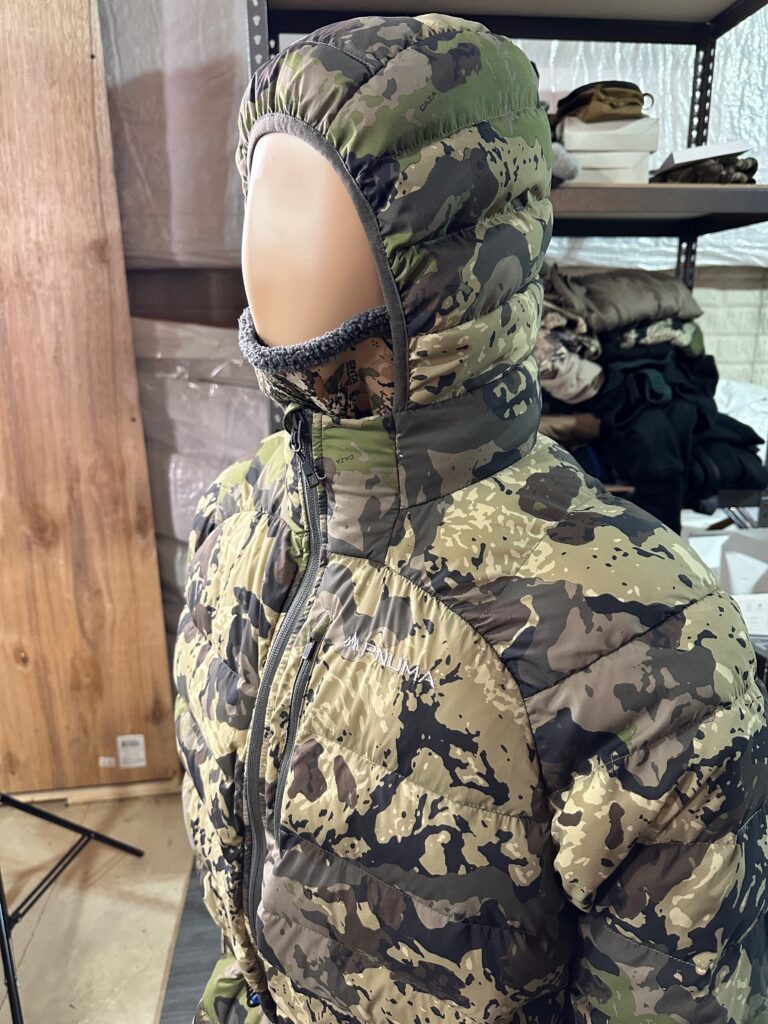
The Cascade Puffy is more than a casual puffy. It’s designed for hunters.
- Insulation: 260 gsm PrimaLoft® Black ThermoPlume®, loose-fill synthetic plumes designed to mimic down clusters, stay warm when wet, and resist clumping.
- Shell: 85% nylon / 15% spandex with DWR finish, soft, quiet, slightly stretchy.
- Weight: 26.7 oz (size L).
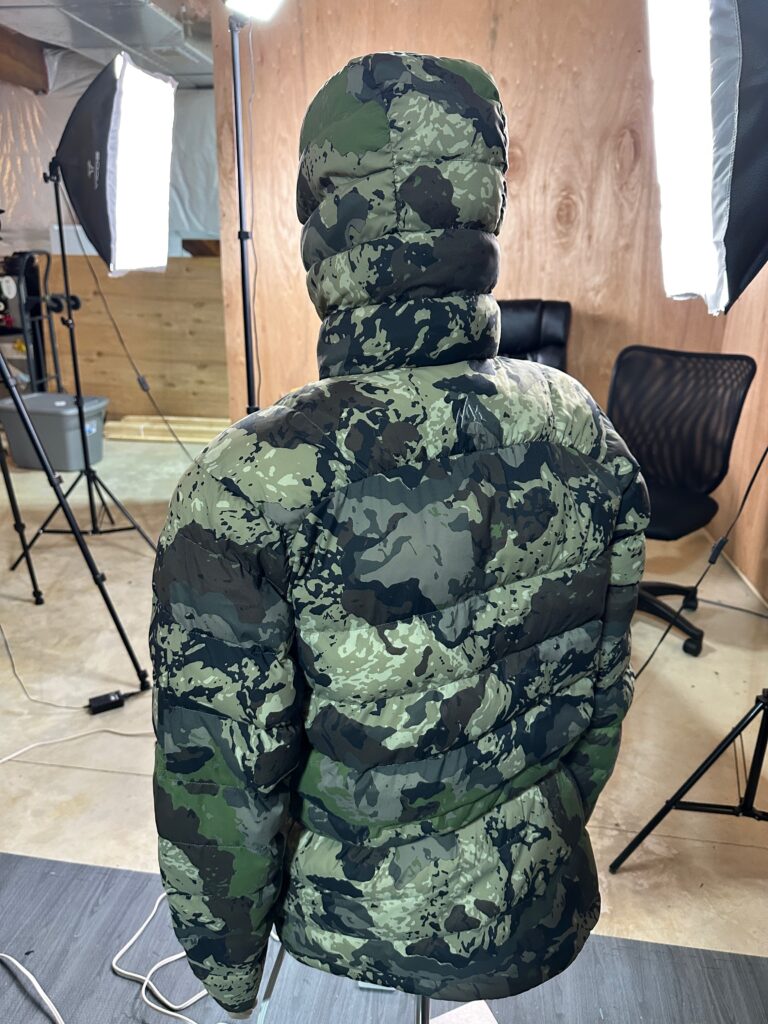
- Design: Sewn-through baffles, cinchable hem to trap heat, tapered sleeves for clean bow-hand clearance, and multiple zippered pockets inside and out.
- Scent Control: Treated with Polygiene StayFresh™ (antimicrobial treatment to slow bacterial growth) and Polygiene OdorCrunch™ (odor-absorbing treatment that traps and neutralizes smells).
Where this jacket really stands out is packability. It compresses small enough to throw in your saddle pouch or day pack, making it a perfect “heat booster” piece for mobile hunts. And unlike most puffies that swish when you move, the Cascade is surprisingly quiet.
Pro Tip: Wash it twice in cold water, hang dry both times, then run a no-heat tumble cycle in the dryer. This breaks in the fabric and knocks down the fresh-off-the-shelf “crinkle,” giving you a jacket that’s quiet enough for bowhunting.
My Heat-Retention Test Protocol
To keep every jacket comparable, I run the same three-hour test:
- Mannequin: Full torso, dressed in a 150 g synthetic base layer.
- Heat Source: Heating pad from chest to waist, constant output.
- Probe: Under the arm, exact same spot every run.
- Closures: Zipped to the chin, hood up, neck gaiter on.
- Timing:
- 60-minute heat-up (readings every 10 minutes)
- 120-minute cool-down (readings every 15 minutes)
This doesn’t simulate wind, sweating, or motion, but it gives a controlled look at which jackets trap and hold heat best.
Full 3-Hour Test Results
| Time | Temp (°F) |
|---|---|
| Start | 68.9 |
| 10 min | 69.3 |
| 20 min | 70.7 |
| 30 min | 73.4 |
| 40 min | 76.1 |
| 50 min | 81.5 |
| 60 min (heat off) | 81.5 |
| 75 min | 84.2 (peak) |
| 90 min | 84.2 |
| 105 min | 84.2 |
| 120 min | 81.5 |
| 135 min | 78.8 |
| 150 min | 78.8 |
| 165 min | 77.4 |
| 180 min (end) | 76.1 |
Key Metrics:
- Peak Temp: 84.2 °F (+15.3 °F from baseline)
- Drop @ 60 min post-off: −2.7 °F (still 81.5 °F)
- Drop @ 120 min post-off: −8.1 °F (finishing 76.1 °F)
The Cascade Puffy flat-lined at peak for 45 minutes before dropping, which is excellent for a non-membrane puffy.
Does the Test Back Up PrimaLoft’s Claims?
PrimaLoft markets their ThermoPlume insulation as “down-like warmth with synthetic performance.” Here’s how my test stacks up against those claims:
| PrimaLoft Claim | Test Result | Takeaway |
|---|---|---|
| Down-like warmth / peak thermal efficiency | Hit 84.2 °F, competing with my warmest jackets. | ✔ Confirms the claim: it delivers parka-level warmth despite being a puffy. |
| Maintains warmth when damp | Not tested — mannequin test is dry. | Needs field testing in wet snow/rain. |
| Compressible and fast to loft | Reached peak within 15 minutes of heat-off. | ✔ Good loft recovery and fast heat trap. |
| Equivalent to ~550 fill down | Peak and retention nearly match heavy late-season jackets. | ✔ Supported — at least in calm, dry bench testing. |
So far, the numbers back PrimaLoft’s marketing, but I’ll confirm moisture performance and real-world loft retention during field testing.
Comparison Against Other Cold-Weather Jackets
These aren’t all technical parkas, but they behave like them in the deer woods: insulated, windproof, and built for long sits.
READ: I Tested 7 Cold Weather Hunting Jackets – See the Results
| Jacket | Peak (°F) | Drop @ 60 min | Drop @ 120 min | Takeaway |
|---|---|---|---|---|
| Pnuma Cascade Puffy | 84.2 | 2.7 | 8.1 | Best warmth-to-weight performer; packs small for mobile hunts. |
| Pnuma Highpoint | 85.1 | 2.7 | 8.1 | My pick for most versatile bowhunting outer — excels in wind. |
| Sitka Fanatic | 83.1 | 3.6 | 6.6 | Legendary quietness; excellent for all-day sits. |
| ASIO Late Season | 83.0 | 3.0 | 6.0 | Dead-quiet jacket, trim fit, very warm. |
| Coldfjall Sub-Xtreme (See the Test Results Here) | 83.3 | 3.3 | 6.1 | Natural wool and heavy insulation — built for brutal cold. |
Use code BOWHUNTER10 for 10% off at Code of Silence.
What This Means for Bowhunters
- As an Outer: Perfect for November sits in the 30s–40s, calm late-season evenings, and any hunt where you want warmth without bulk.
- As a Mid-Layer: Put it under the Highpoint or any windproof shell and you’ve got a modular system that rivals one-piece late-season jackets, but with better heat management.
- For Mobile Hunters: Keep it in the pack, throw it on at the tree, and let your body heat bring it up to temp quickly.
READ: Mesh Base Layers: The Best Base Layers for Hunting?
Final Verdict (First Look)
The Cascade Puffy is the best warmth-to-weight winter hunting jacket I’ve tested so far. It heats up fast, holds peak heat for nearly an hour, and stays warm deep into the cool-down window.
If you already own the Pnuma Highpoint, adding the Cascade creates a two-layer system that outperforms most heavyweight jackets and lets you stay cool on the approach, warm on the sit, and mobile the whole way through.
Field testing is next: I want to see how it handles brush, sweat, and wind. But based on the data, this piece belongs in a late-season bowhunter’s pack.
CONTINUE THE CLOTHING SYSTEM
Your Next Steps
 BUILD
This content fits BUILD because it adds adaptable warmth without forcing unnecessary bulk into the system.
Use this review to decide what job the piece should perform, then build the rest of the system around it.
1. Learn the BUILD Role
See where base layers, fleece, active insulation, and packable warmth belong.
2. Build a Cold-Weather Layering System
Put the layers together in the right order for changing conditions.
3. Review My Current Gear List
See the clothing and equipment I am actually carrying.
Part of the Everyday Bow Hunter System
Want to see exactly what I’m carrying this season? Check out my Personal Bowhunting Gear List for 2026
