
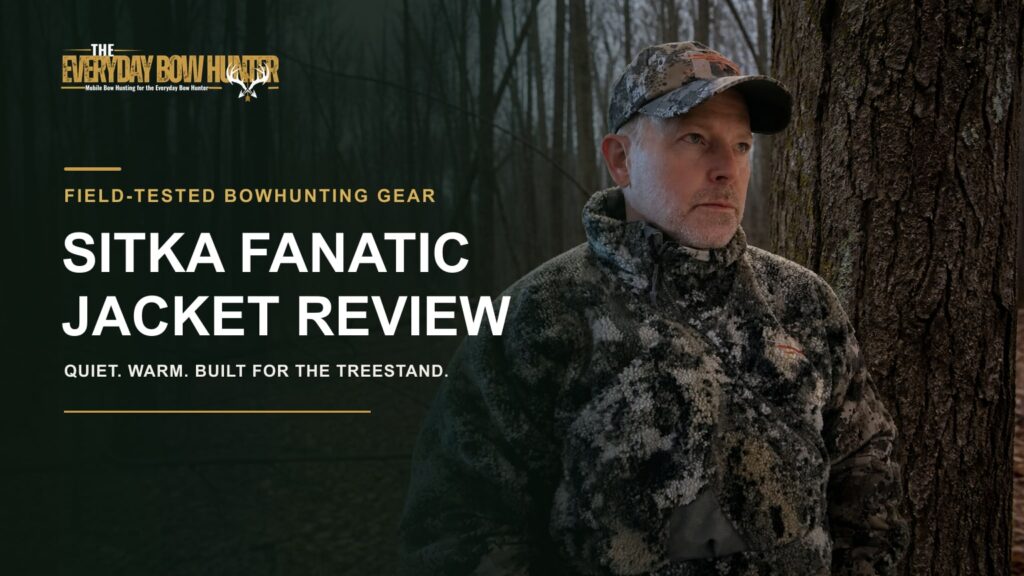
I have tested warmer jackets than the Sitka Fanatic. I have not tested one I trust more when a deer is close and I need to draw my bow without making unnecessary noise.
That is what keeps the Fanatic in my cold-weather system. During a four-hour sit at about 23 degrees, I wore the jacket and bibs together with good layers underneath. The system kept me comfortable for most of the hunt, moved extremely well, and never made me feel like I was fighting my clothing when I drew my bow.
The Fanatic is not the warmest system I have tested, and the soft Berber fleece is not built for pushing through thick brush. But when quietness and freedom of movement matter most, it is still one of the best cold-weather bowhunting systems I have used. In this review, I will show you where the jacket and bibs work best, what the system gives up, and whether it is worth the full price.
My Sitka Fanatic System at a Glance
| Decision factor | My assessment |
|---|---|
| Owned and used | Two seasons and five or six late-season hunts |
| How I got it | I bought the jacket and bibs with money from ArcheryHunting.com. Sitka did not supply either piece. |
| Best use | Stationary, close-range cold-weather bowhunting |
| Strongest advantage | Exceptional quietness with good warmth and mobility |
| Best field example | About four hours at approximately 23 degrees with the jacket, bibs, and good layers |
| Main tradeoff | Berber fleece can collect jaggers and is not built for heavy clear-cut travel |
| Walk-in strategy | Wear the bibs with the side zippers open and carry the jacket |
| Full system MSRP | $1,000: $500 for the jacket and $500 for the bibs |
| Value verdict | A little overpriced at full MSRP, but darn close to being worth it for a serious cold-weather bowhunter |
What the 12-Jacket Test Tells Me
The Fanatic was part of my 12 cold-weather hunting jacket study, built from three seasons of controlled warmth testing and field use. The test does not assign a temperature rating to a jacket. It helps show how each jacket holds heat under the same process, then I compare that evidence with real hunting use.
The Fanatic belongs in the mid-to-late-season group, not the extreme-cold group. Its 120-gram PrimaLoft Silver body insulation and 80-gram sleeve insulation give it less late-season reserve than heavier systems such as the First Lite Thermic, Pnuma Highpoint, and ASIO Late Season Jacket. The Fanatic gives up some insulation to stay quiet, reduce bulk through the sleeves, and make the bow draw feel more natural.
The important point is not that one jacket “wins” every test. The right jacket has to match the job. The Fanatic pairs useful warmth with the best close-range bowhunting fabric I have used. That is why it remains one of the easiest jackets to recommend for a hunter who needs to draw a bow without announcing the movement.
The Fanatic is a quietness-first system that works great when the temperature drops below freezing. That is a strength when you use it for the job it was built to do.
Why It Is So Good for Bowhunting
The Berber fleece outer is the reason the Fanatic is special. It is soft, quiet, and forgiving when you turn, reach for your bow, or draw at full arm length. A lot of hunting jackets are called quiet. The Fanatic feels quiet in the moments that matter.
It is also made for a hunter who spends long periods sitting still. The jacket has a purpose-built cut, a large chest area, and a design that works around a safety harness and a bow. The hand muff is useful on cold sits, and the hood adds warmth without making the jacket feel like a bulky parka.
For an eastern whitetail bowhunter, that combination is hard to beat. When a deer is inside bow range, the difference between a quiet jacket and a merely quiet jacket becomes very real.
How the Fanatic Is Built for Bowhunting
The Fanatic is not covered in Berber fleece from top to bottom. Sitka uses the quiet fleece across most of the jacket, then adds smoother soft-shell material in key wear areas on the arms and lower jacket. Those panels sit where brush is most likely to grab when you walk, climb, or reach. They do not make the Fanatic a brush-busting jacket, but they help keep every jagger, burr, and branch from hanging directly on the Berber fleece.
The sleeves also have fitted inner wrist gaiters under the outer cuffs. They wrap closely around your wrists and help stop cold air from moving up the sleeves. I like this feature when I am sitting in wind or reaching for my bow because the jacket stays sealed without a bulky cuff getting in the way.
The diagonal front zipper is a tradeoff. Moving the zipper off center gives Sitka room for a full kangaroo pocket across the front. That pocket is excellent for warming your hands, holding hand warmers, and keeping both hands together during a cold sit.
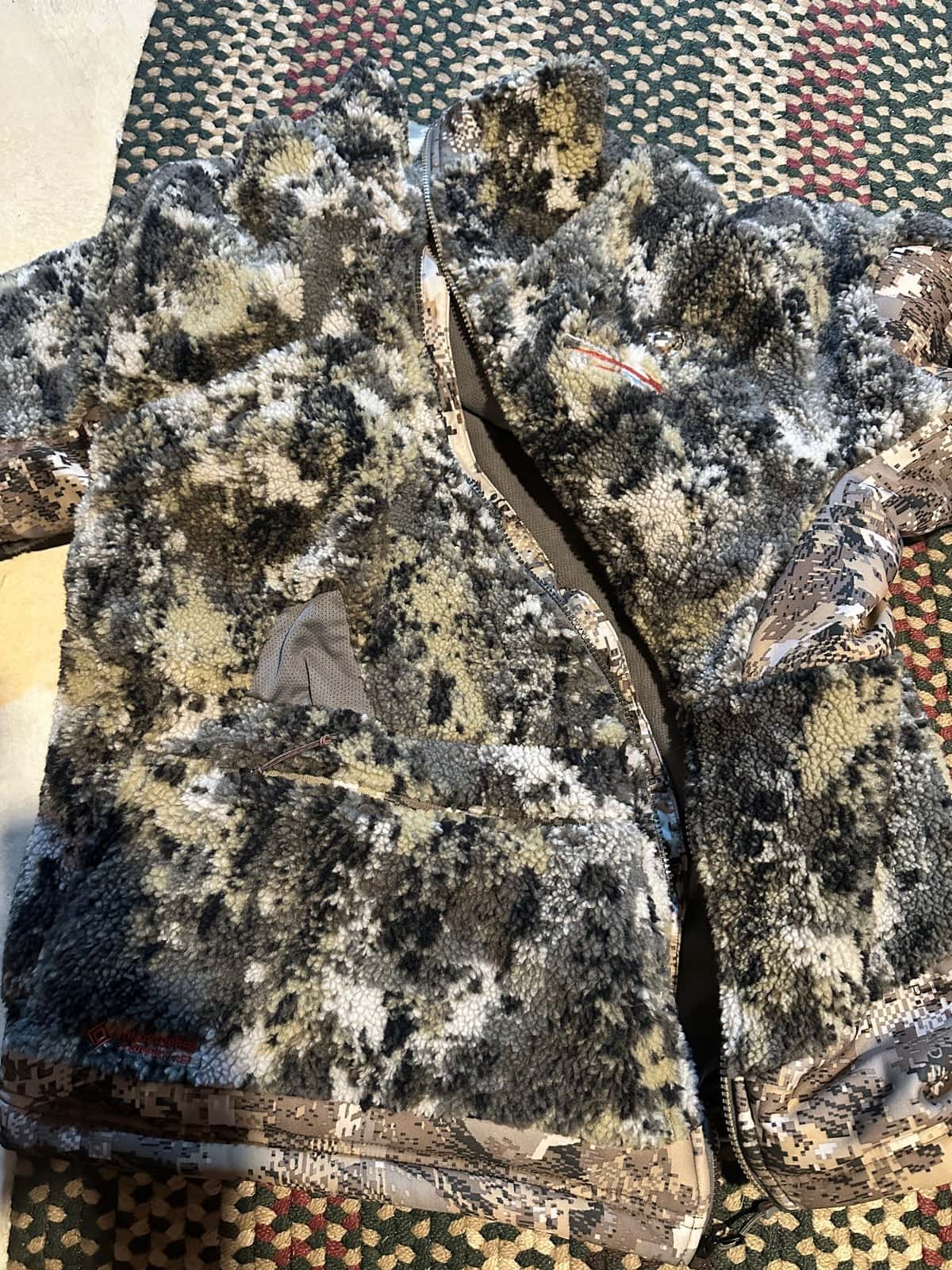
But the zipper is not my favorite part of the jacket. You have to reach across your body to start and pull it, and the angle can feel awkward around your neck and chest. The ScentLok BE:1 Divergent solves a similar problem with a half zip and side zippers so it can keep a full front pocket. Both designs protect the hand-warmer pouch, but both make getting into the jacket less simple than a normal center zipper.
These details help explain why the Fanatic works so well for bowhunting. It is extremely quiet and comfortable, seals out wind at the wrists, protects the fleece in key wear areas, and gives you a useful hand-warmer pocket. It is still one of the best all-around mid-to-late-season bowhunting jackets I have used.
How the Fanatic Bibs Complete the System
I have owned the Fanatic Jacket and Bibs for two seasons and worn them together on five or six late-season hunts. I bought both with money from ArcheryHunting.com so I could test them. Sitka did not provide either piece.
The bibs are one of the reasons the Fanatic works so well as a complete system. The Berber fleece continues through the upper part of the bibs and sits underneath the jacket. That gives you a warm, quiet layer covering most of your core instead of leaving the jacket to do all the work.
Sitka uses tougher stretch fleece and burr-resistant material lower on the legs and around the gusset. That helps in the places most likely to hit brush, jaggers, and other debris when you walk. The bibs also move well when I climb, step onto a platform, or settle into the tree.
The full-length side zippers are one of the best features. They make it easy to get the bibs on and off over your boots, but I use them mostly for ventilation. These bibs get warm fast when you are moving, so I open the leg zippers during the walk and let as much heat escape as possible.
I normally wear the bibs into the tree instead of trying to strap both the jacket and bibs onto my pack. Carrying both pieces takes up a lot of room. When I know I need more insulation, I carry my Minus33 zip-off merino base-layer bottoms instead. Once I get to the tree, I can drop the bibs, zip on the merino layer, and pull the bibs back up. That is easier than trying to carry the entire Fanatic system on my pack.
The lower-leg material helps with durability, but it does not protect every piece of Berber fleece on the bibs. Jaggers are not always limited to the bottom of your legs. If you work through a thick clear-cut or taller brush, the fleece farther up the bibs can still get hung up and collect debris.
That is the main tradeoff with the Fanatic system. First Lite Thermic and ASIO late-season bottoms use tougher outer materials and are better suited for moving through heavy cover. The Fanatic Bibs are built more around warmth, quietness, and sitting still. If I am hunting from a stand or saddle without fighting through a nasty clear-cut, there is very little I dislike about them.
Warmth, Layers, and the Right Temperature Range
The field test that best defines the Fanatic’s range came during a sit at about 23 degrees. I wore the Fanatic Jacket and Bibs together with good base layers. The system performed extremely well for about four hours. It was comfortable, easy to move in, and effortless to draw my bow without fighting bulk or noise. Near the end of the sit, I started to feel a little cold.
That experience lined up with my controlled heat-retention testing of the jacket. The Fanatic system is very good in the low 20s, but it does not have much extra reserve when the temperature drops farther unless you start stacking heavier base and mid layers. I use about 20 degrees as the point where I start getting more serious about the layers underneath it.
I consider the Fanatic Bibs a must-have for getting the full benefit of the system. The jacket works by itself, but the bibs protect your lower body and continue the warmth around your core. Together, they are nearly ideal for November bowhunting and for the milder days you get in December and January.
I would not call it an extreme-cold system. If you routinely hunt long, windy sits well below 20 degrees, or you simply run cold, look at the heavier options from the study. More insulation, better wind protection, and more loft matter when the weather turns severe.
The right way to use the Fanatic is to manage your walk in. I start comfortably cold, open the bib zippers for ventilation, and carry the jacket to the tree. That keeps sweat from stealing warmth later. A great outer layer cannot fix a base layer that is already damp.
What the Fanatic Jacket and Bibs Give Up
The fleece outer is not friendly to thick brush, jaggers, or hard travel. It can collect debris, and it is not the system I want to wear while pushing through nasty cover. I normally carry the jacket and vent the bibs during the walk. If I know I am going through a thick clear-cut, I would rather have a tougher outer material.
The other tradeoff is price. The jacket and bibs are $500 each at full MSRP, putting the complete system at $1,000. I think that is a little higher than it should be. At the same time, the quality, warmth, quietness, and bowhunting-focused design get it darn close to being worth the full price. On sale, it becomes much easier to recommend.
If you want one system to do everything from scouting to thick-cover travel to extreme late-season sits, this is not it. The Fanatic is made for a more specific job: staying warm, quiet, and mobile while you wait for a close-range shot.
My Sitka Fanatic Jacket and Bib Verdict
The Sitka Fanatic is not the warmest system I have tested, and it is not the toughest. It does not need to be. It is one of the quietest cold-weather bowhunting systems I have ever used, and it has enough warmth to cover the part of the season where many eastern bowhunters need the most help.
If your hunting is built around close-range deer, stillness, and deliberate shots from a stand or saddle, the jacket and bibs are an excellent one-two punch. Carry the jacket, vent the bibs during the walk, build the right layers underneath them, and let the system do the job it was designed to do.
The jacket can work with other cold-weather bottoms, but I consider the Fanatic Bibs a must-have if you want the full benefit of the system. They continue the warmth and quietness around your core, move well when you climb, and give you full-length zippers for ventilation. There is very little I dislike about them outside of the Berber fleece in thick cover and the $500 price.
Sitka Fanatic Jacket and Bib FAQ
What temperature is the Sitka Fanatic good for?
I consider the Fanatic a strong mid-to-late-season system. During a sit at about 23 degrees, the jacket and bibs kept me comfortable for most of four hours with good layers underneath. Around 20 degrees, I start adding heavier base and mid layers. Wind, moisture, activity, and how warm you run will change the practical range.
Do you need the Fanatic Bibs with the jacket?
I consider the Fanatic Bibs a must-have for getting the full benefit of the system. The jacket works alone, but the bibs protect your lower body and help seal warmth around your core. Together, they make a much better setup for long November sits and colder days in December or January.
Is the Sitka Fanatic quiet enough for bowhunting?
Yes. Quietness is the Fanatic’s biggest strength. The Berber fleece outer is one of the quietest materials I have used for close-range bowhunting, and the jacket lets me draw without fighting noisy or stiff fabric.
Should you wear the Fanatic while walking to the stand?
I carry the jacket, but I normally wear the bibs with the full-length side zippers open for ventilation. If I need more warmth underneath them, I carry my Minus33 zip-off merino bottoms and add them at the tree. That takes up less room than trying to strap both the jacket and bibs onto my pack.
Does the Berber fleece collect burrs?
Yes. Sitka uses tougher material across the lower legs and other key wear areas, but the Berber fleece higher on the jacket and bibs can still collect jaggers and grab against thick brush. I treat the Fanatic as a stand or saddle system instead of something I want to push through a clear-cut.
Is the diagonal zipper awkward?
It can be. The diagonal zipper creates room for the full kangaroo hand-warmer pocket, which is a useful feature on a cold sit. The tradeoff is that the zipper takes an awkward reach across your body and is not as natural to operate as a normal center zipper.
Compare the Sitka Fanatic With Other Cold-Weather Jackets
The Fanatic’s biggest advantage is quietness, but that does not make it the right jacket for every cold-weather hunt. These head-to-head comparisons show what changes when warmth, wind protection, durability, or a broader late-season range becomes more important.
- First Lite Thermic vs. Sitka Fanatic: Choose the Thermic for more warmth, late-season reserve, and hard-use durability. Choose the Fanatic when close-range quietness and an easier draw matter more.
- Sitka Fanatic vs. Pnuma Highpoint: Choose the Highpoint for more insulation and the stronger all-around quiet late-season balance. Choose the Fanatic when absolute quietness is the first requirement.
- Sitka Fanatic vs. ASIO Late Season: Choose the ASIO for more warmth, wind protection, and rough-cover durability. Choose the Fanatic for quieter movement and less bulk through the draw.
Continue the Clothing System
- Compare the Fanatic with all 12 cold-weather hunting jackets I tested.
- Build the layers underneath your jacket with the Thermal Layering System.
- Learn why a good jacket may still leave you cold.
- Use mesh base layers to help manage moisture.
- Return to the Everyday Bow Hunter Clothing System.
Want to see exactly what I’m carrying this season? Check out my Personal Bowhunting Gear List for 2026