
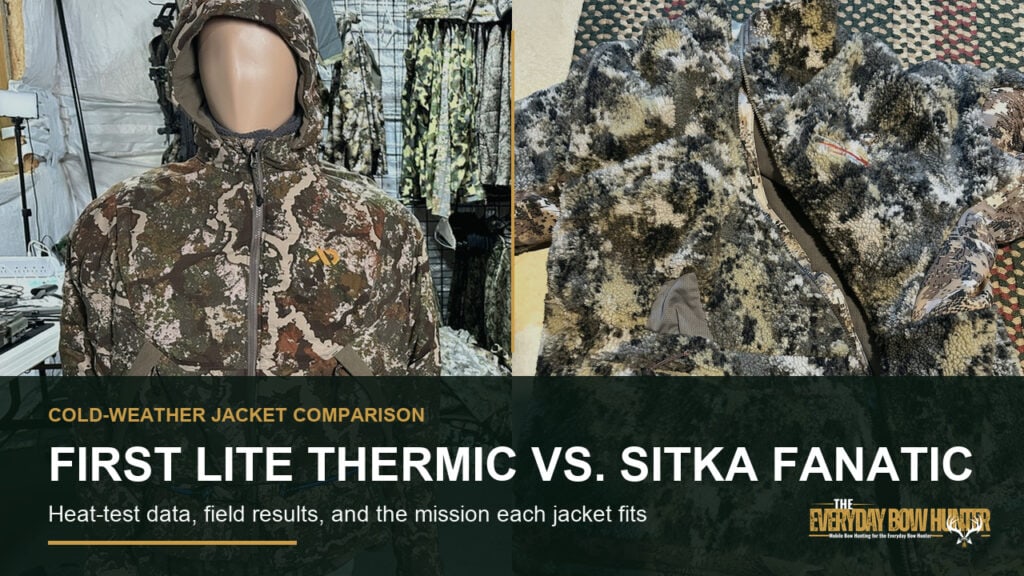
I have hunted in both the First Lite Thermic and Sitka Fanatic, and I included both jackets in my controlled 12-jacket heat-retention study. They are both premium cold-weather bowhunting jackets, but they solve different problems.
My judgment comes from wearing these systems during real eastern whitetail hunts, comparing their construction, and testing them under the same controlled 210-minute heat process. I also bring 21 years of Special Forces experience to the way I evaluate cold-weather clothing. Gear has to match the job, manage moisture and wind, hold up to hard use, and still let the hunter move when it matters.
The First Lite Thermic is the warmer, more protective late-season jacket. The Sitka Fanatic is the quieter, easier-moving mid-to-late-season bowhunting system. If I expect a long, cold sit, hard wind, or rough cover, I want the Thermic. If a deer may be inside close bow range and silence is the first requirement, the Fanatic still has the advantage.
My Verdict
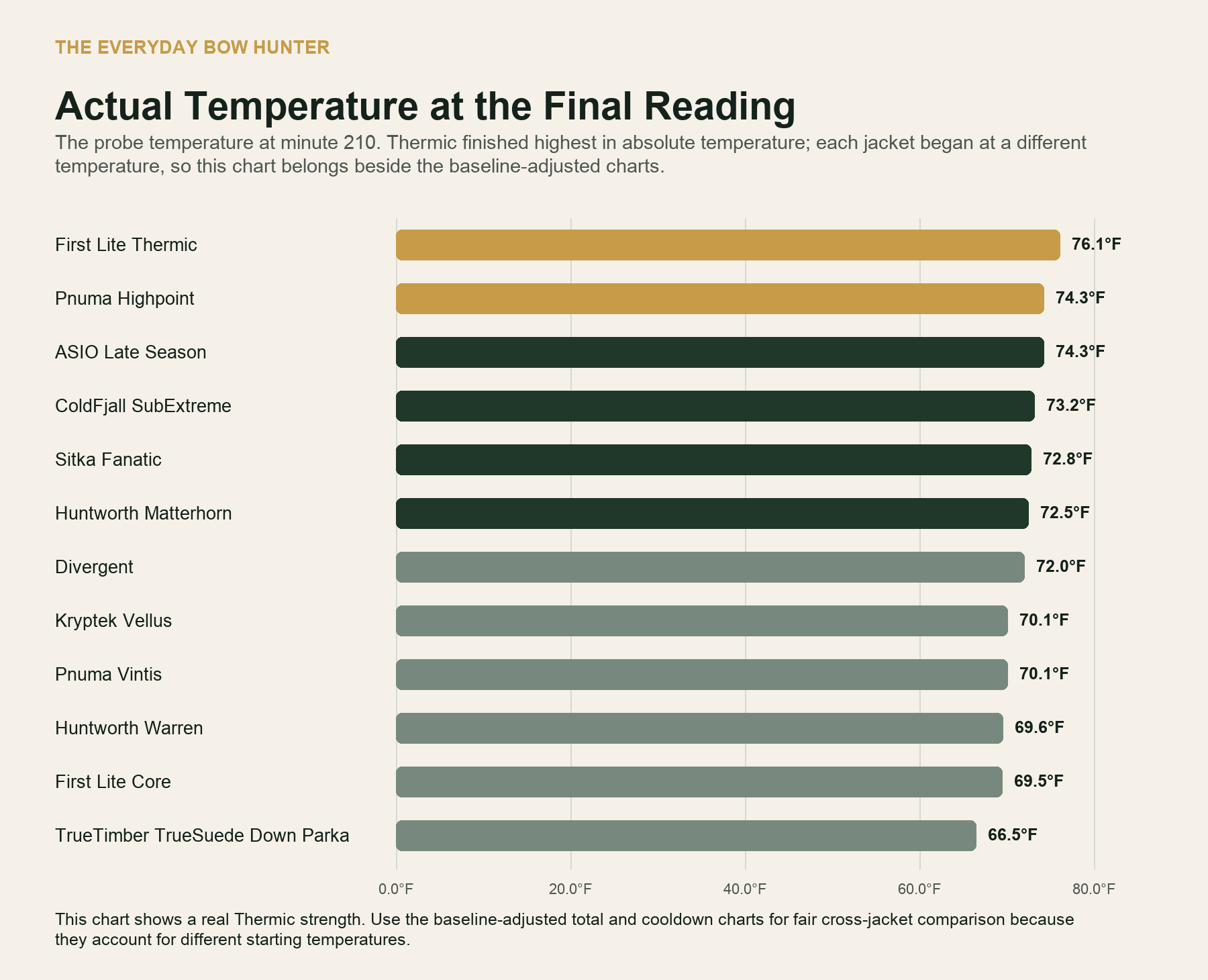
Choose the Thermic for real late-season warmth. It heated higher during testing, finished with the highest final temperature of all 12 jackets, uses much more insulation, and performed better for me in the field than the combined score alone suggests.
Choose the Fanatic for the quietest close-range bowhunting setup. It is warm enough for much of the mid-to-late season when paired with the Fanatic Bibs and good layers, but I do not put it in the same pure late-season warmth class as the Thermic.
Thermic vs Fanatic at a Glance
- Warmer jacket: First Lite Thermic
- Lighter jacket: Sitka Fanatic
- Quietest jacket: Sitka Fanatic
- Best for long late-season sits: First Lite Thermic
- Best for close-range whitetail bowhunting: Sitka Fanatic
- Better in brush and rough cover: First Lite Thermic
- Better draw-cycle feel and hand-warmer design: Sitka Fanatic
- Best used as a complete jacket-and-bib system: Sitka Fanatic
- Best choice when warmth is the deciding factor: First Lite Thermic
Thermic availability update: First Lite has discontinued direct website sales of the Thermic and moved the jacket to retail-only distribution. The purchase links in this article now go to the current Scheels listing. Pricing, sizes, and availability may change.
Why the Heat Test Is Not a Simple Tie
In my 12 Cold Weather Hunting Jackets study, the Thermic and Fanatic finished close on the combined Warmth Over Time Score. That score measures heat held above each jacket’s starting temperature through the complete test. It is useful, but it does not make two jackets equal.
The individual results matter. The Thermic heated to a higher level and finished the full test at 76.1°F, the highest final temperature of any jacket in the study. It also carries substantially more insulation. Those results match what I felt in the field: the Thermic acted like a true late-season jacket and provided more cold-weather reserve than the Fanatic.
I would place the Thermic closer to the warmth class of the ASIO Late Season and Pnuma’s heavier late-season system than to the Fanatic. The Fanatic did well in the controlled test, but its real strength is the balance of warmth, silence, comfort, and an easy bow draw. It is a mid-to-late-season jacket that can be pushed colder with the right layers and bibs. The Thermic starts as a pure late-season jacket.
The study used the same mannequin, base layer, heat source, seals, probe location, 90-minute heat-up, and 120-minute cooldown for each jacket. I use the results to compare jackets under the same conditions, not to promise that every hunter will be warm at a certain temperature. Wind, moisture, base layers, metabolism, and time on stand still matter.
The Insulation Shows Their Different Jobs
First Lite Thermic
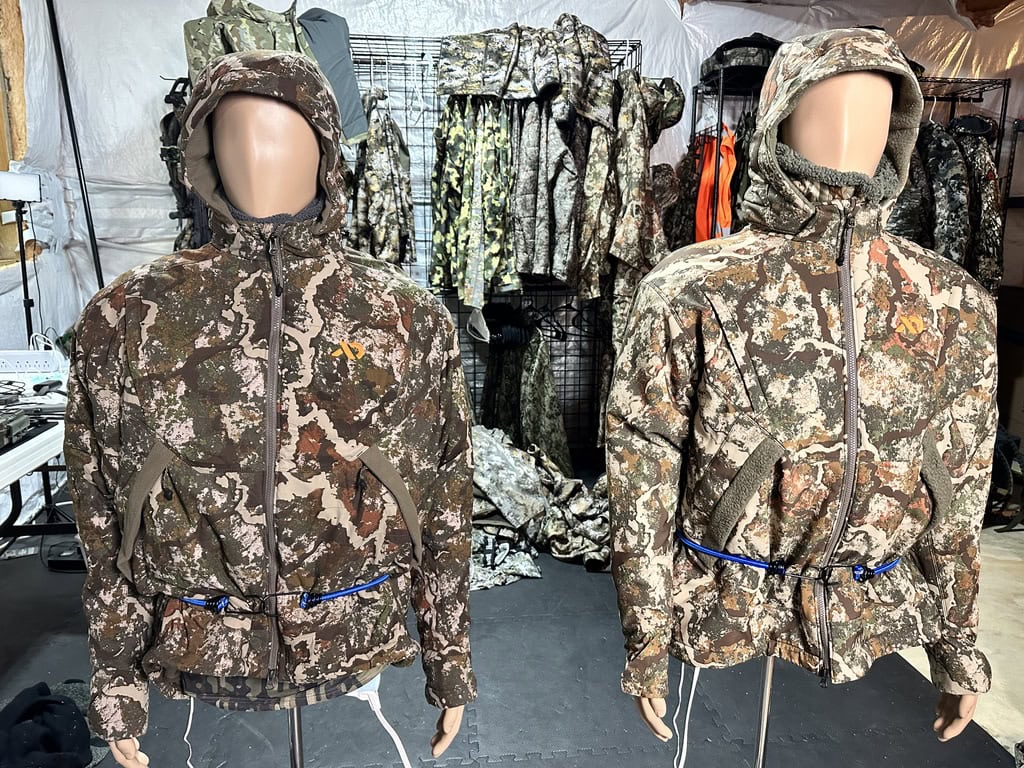
The Thermic uses 170 gsm PrimaLoft Gold through the body and 133 gsm through the sleeves and hood. It also has a sherpa-style interior, a quiet windproof softshell, and a durable water-repellent finish. That is a serious insulation package for a bowhunting jacket.
The result is more warmth, more wind protection, and more reserve after you stop moving. It is also a heavier jacket. First Lite lists the Thermic at 66 ounces. That weight is not wasted material. It comes from the insulation, lining, weather protection, and hard-use construction that make it a true late-season piece.
The Thermic takes body mapping beyond simply placing one insulation weight in the torso and another in the arms. First Lite builds the complete system to protect the core while reducing unnecessary bulk where a bowhunter needs movement. The contoured archery collar, mapped sleeve insulation, and bowhunting-specific layout make a thick late-season jacket more usable through the draw than many coats in this warmth class. It is still heavier and thicker than the Fanatic, but it remains a bowhunting jacket instead of feeling like a general winter coat. I would carry it during a hard walk, then put it on before settling into the stand.
For more detail on the Thermic’s construction, heat-test results, and where it fits against First Lite’s lighter jacket, read my First Lite Thermic vs Core field and heat-test comparison.
Sitka Fanatic
The Fanatic uses 120-gram PrimaLoft Silver in the body and 80 grams in the sleeves and hood. It weighs about 46.2 ounces in a size Large, roughly 20 ounces less than the listed Thermic weight. That is a meaningful difference, but it is largely explained by the lighter and lower grade insulation package. It is enough insulation for a strong mid-to-late-season system, but it is clearly less than the Thermic.
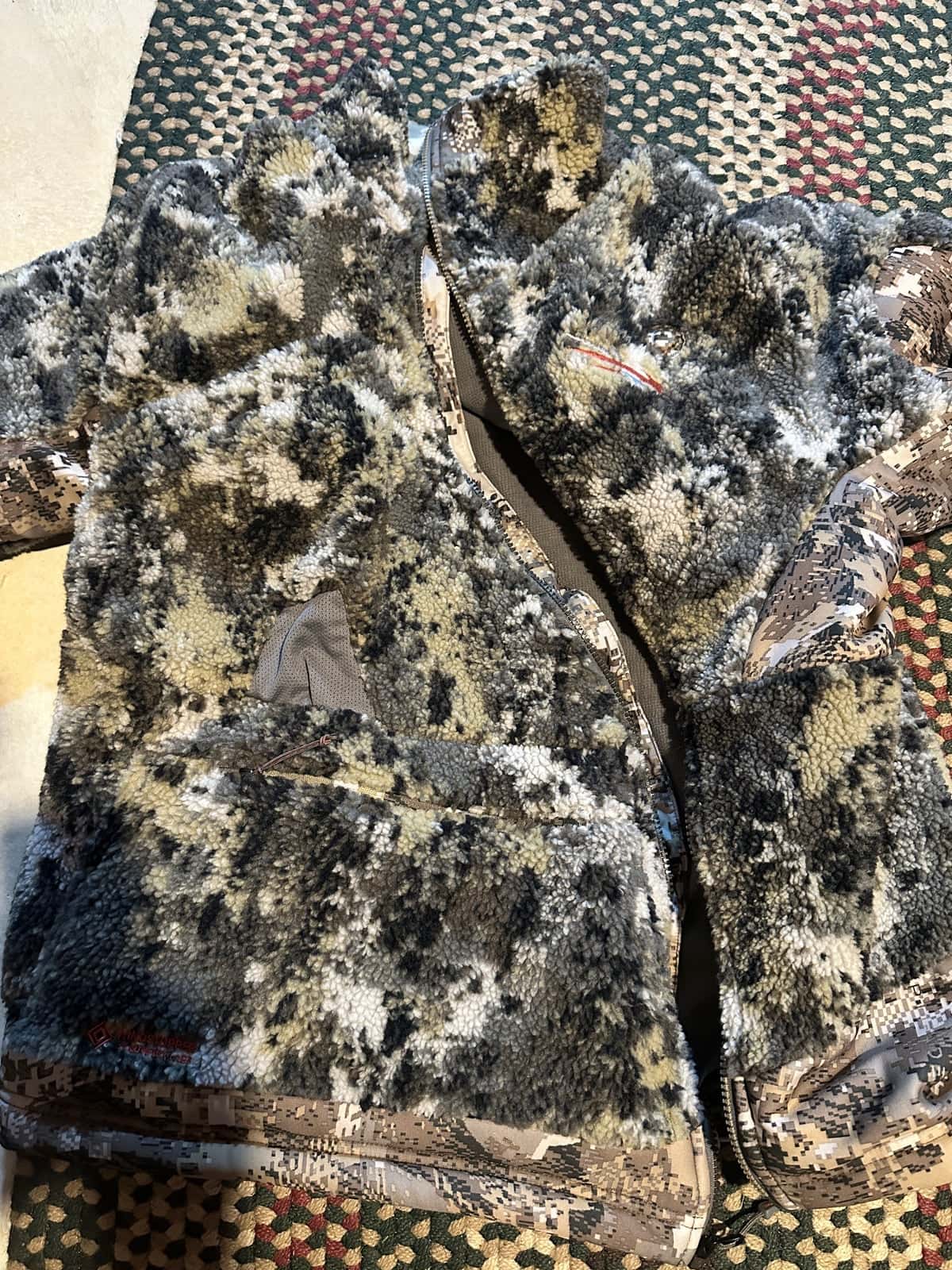
The Fanatic is also body mapped for bowhunting. Sitka reduces bulk through the sleeves, adds bowstring clearance along the left arm, and shapes the right draw-arm elbow for movement. That gives the Fanatic the easier draw-cycle feel. The Thermic takes the harder route: it carries much more insulation and still uses smart mapping and an archery-specific layout to remain bowhunting capable.
The Berber fleece outer is extremely quiet. Soft-shell panels cover key wear areas to reduce snags and burr collection. Inner wrist gaiters help seal out wind. The diagonal zipper makes room for a full kangaroo hand-warmer pocket, although the cross-body zipper is more awkward to operate than a normal front zipper.
For my complete construction notes, the 23-degree field sit, and how the jacket works with the bibs, read my full Sitka Fanatic Jacket review.
Which One Is Quieter for Bowhunting?
The Fanatic wins on absolute quietness. Its Berber fleece is still one of the quietest cold-weather outer fabrics I have used. When a deer is close and I need to turn, reach, or draw without fabric noise, the Fanatic gives me more confidence.
The Thermic is still quiet enough for serious bowhunting. It is impressive for a jacket with this much insulation and weather protection. However, a tougher windproof softshell cannot feel exactly like the Fanatic’s fleece. If your first priority is silence, choose the Fanatic. If you need more warmth and can accept a small step down in quietness, choose the Thermic.
Does the Extra Thermic Weight Hurt the Bow Draw?
Not the way I expected from a 66-ounce late-season jacket. The Thermic is heavier and thicker than the Fanatic, but its body mapping keeps the extra insulation from turning it into a stiff, oversized winter coat. It still gives a bowhunter usable arm movement and string clearance.
The Fanatic is lighter and feels more effortless through the draw. That remains an advantage. The Thermic’s achievement is different: it gives me substantially more late-season insulation while staying quiet and bowhunting capable. That balance is unusual in a jacket this warm.
Which One Is Warmer in the Field?
The Thermic is warmer. That is my conclusion from its insulation, its individual test results, and my field use. The close combined score does not change that.
I hunted in the Fanatic Jacket and Fanatic Bibs at about 23°F with good base layers. The system performed extremely well for about four hours. After that, I started to feel a little cold. That field experience matched my view of the Fanatic: the low 20s are a strong working range when the complete system and layers are right, but below about 20°F I need to increase the insulation underneath it.
The Thermic gave me more late-season confidence. It felt more like the heavier ASIO and Pnuma late-season class than the Fanatic. I would choose it first for a long stationary sit when the temperature, wind, and time on stand are all working against me.
Do You Need the Fanatic Bibs?
For cold-weather use, I consider the Fanatic Bibs a must-have with the jacket. The bibs protect your lower body, overlap the jacket, and help keep cold air from entering around your waist. The jacket alone does not tell you what the full Fanatic system can do.
That does not mean the bibs turn the Fanatic into the Thermic. They make the Fanatic a complete and very effective bowhunting system. The Thermic still gives me more jacket-level warmth and late-season reserve.
Which One Handles Brush and Weather Better?
The Thermic is the better rough-cover jacket. I pushed through some seriously thick cover while wearing the Thermic Jacket and Bibs, and I came away impressed by how well the complete system handled it. I did not feel like I had to baby the fabric or stop every few yards to pull burrs from it. Its tougher softshell is more resistant to brush, snags, and hard use, and it gives me stronger wind protection when the weather turns.
The Fanatic adds soft-shell panels in high-wear areas, and those panels do a good job of protecting the jacket where they are used. The problem is the exposed Berber fleece. In tall weeds, jaggers, thorns, and heavy brush, that fleece can collect burrs and get caught. I prefer the Fanatic on cleaner access routes and in the stand. If I know I may have to push through thick cover, the Thermic Jacket and Bibs are the hardier system.
How I Would Choose for a Real Hunt
Choose the Sitka Fanatic if:
- You hunt whitetails at close bow range.
- Absolute quietness matters more than maximum warmth.
- You want a jacket that feels natural while drawing a bow.
- You plan to use the Fanatic Bibs as part of the system.
- Most of your hunts fall in the mid-to-late season instead of severe late-season cold.
Choose the First Lite Thermic if:
- You sit for long periods in true late-season cold.
- You want more insulation and a higher warmth ceiling.
- You face more wind, rough cover, or brush.
- You need a jacket-and-bib system that can handle pushing through thick cover.
- You are willing to carry a heavier jacket during the walk in.
- You want a jacket that belongs with the heavier late-season systems.
The Bottom Line
The Thermic is my winner for warmth and true late-season use. Its higher heat buildup, study-leading final temperature, heavier PrimaLoft Gold insulation, wind protection, and field performance support that decision.
The Fanatic remains my winner for close-range quietness. It is comfortable, easy to draw in, and excellent with the Fanatic Bibs. I simply see it as a mid-to-late-season system instead of a pure late-season jacket.
Thermic vs Fanatic FAQs
Is the First Lite Thermic warmer than the Sitka Fanatic?
Yes. The Thermic uses more insulation, heated higher during my controlled testing, and finished at the highest final temperature of all 12 jackets. It also felt warmer and more capable during late-season field use.
Why did the combined test score put them close?
The Warmth Over Time Score combines readings across the full test. Two jackets can finish with similar totals while building and holding heat differently. That is why I also look at heat buildup, final temperature, insulation, construction, and field use.
Which jacket is quieter?
The Sitka Fanatic is quieter. Its Berber fleece is made for close-range whitetail bowhunting. The Thermic is quiet for a heavy late-season jacket, but the Fanatic remains the silence benchmark.
How cold can I hunt in the Sitka Fanatic?
I used the Fanatic Jacket and Bibs at about 23°F with good layers and stayed comfortable for roughly four hours before I started to feel cold. Around 20°F is where I begin adding heavier layers. Your wind, moisture, metabolism, and time on stand can move that point.
Do I need the Fanatic Bibs with the jacket?
For cold stationary hunts, yes. I consider the bibs a key part of the Fanatic system. They protect the lower body and close the gap around the waist better than ordinary hunting pants.
Should I wear either jacket on the walk in?
Not on a hard walk. I want to start comfortably cold, carry the heavy jacket, and put it on before I stop moving. That reduces sweat and helps the insulation work when I need it.
Which jacket is better in brush?
The Thermic. I pushed through seriously thick cover in the Thermic Jacket and Bibs and was impressed by how well the system held up. The Fanatic has useful soft-shell panels, but its exposed Berber fleece can still collect burrs and snag in thorns.
Continue the Clothing System
- Compare all 12 cold-weather hunting jackets and see the complete test method.
- Read my full Sitka Fanatic Jacket field review.
- See how the Thermic compares with the lighter First Lite Core.
- Build the layers underneath either jacket with the Thermal Layering System.
- Return to the Everyday Bow Hunter Clothing System.
Disclosure: This post contains affiliate links. If you buy through one of these links, I may earn a commission at no extra cost to you. My recommendation is based on my field use and controlled comparative testing.
Want to see exactly what I’m carrying this season? Check out my Personal Bowhunting Gear List for 2026