
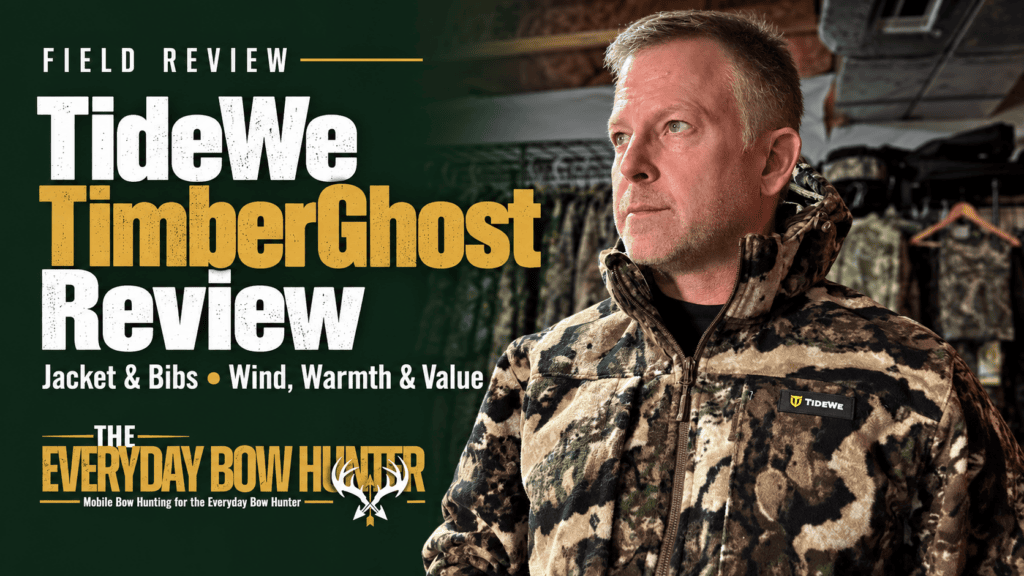
The part of me that got cold on my first hunt in the TideWe TimberGhost was my head. I'd forgotten a beanie. The jacket and bibs were cutting the wind, and I was warm underneath them. I pulled the hood up, adjusted it around my head, and that took care of the problem.
That's a pretty good start for a jacket that was the lowest-priced option in my ten-jacket windproof comparison. I'd already weighed it and tested how much noise it made. Now I had it in the woods, in the wind, with the matching bibs.
For bowhunting, I need a jacket that blocks the wind, sheds light rain, and stays quiet when I move. The TimberGhost did all three on that hunt, and it was warmer than I expected. Here's how it worked with the layers I wore underneath it.
A windy morning in the TimberGhost jacket and bibs
I wore the set hunting in Juniata County, Pennsylvania, on October 17. I walked in around 5 a.m. and came out around 11. It was roughly 45 degrees during the hunt, and I recorded 48 degrees in my field log near the end of the morning.
The wind was enough that the other hunters with me were talking about it. I wasn't feeling it come through the TimberGhost. That's what I want from a windproof hunting layer. Once I'm sitting still, I don't want the wind taking away the warmth I've built underneath it.
My layers were straightforward:
- Brynje merino mesh next to my skin, top and bottom.
- A TideWe Merino 200 top over the mesh.
- The TimberGhost jacket and bibs on the outside.
That combination kept me warm and comfortable. It was warmer than I expected, too. That really surprised me. I wasn't wearing a big insulated midlayer underneath the jacket, and I didn't have a second merino layer under the bibs.
The layers matter when you're deciding what to buy. A jacket isn't working by itself. I explain why I wear mesh next to my skin in my mesh base-layer guide. For a closer look at how I put those pieces together, read my Thermal Layering System guide.

If you want to look at the available sizes and prices while reading, here are the TimberGhost jacket and matching bibs. Use ARCH18 for 18% off eligible TideWe purchases. Compare the final total with any current promotion; the code may not combine with sale offers.
Why the jacket works in the wind
TideWe uses three-layer fleece construction with a TideShell membrane between the outer and inner materials. The membrane is the wind barrier. The fleece gives the garment its soft feel and contributes warmth, while the outer DWR finish helps water bead and run off. TideWe's jacket details describe that construction.
What matters to me is how that construction worked when I wore it. The wind stopped at the jacket. Moving my arms didn't give me that loud fabric noise I don't want around deer, and the jacket felt comfortable rather than stiff.
My son wore the Sitka Stratus 2.0 on the same hunt and was comfortable in the wind, too. The TimberGhost's wind protection felt just as effective as what I've experienced wearing the Stratus 2.0. That's a meaningful part of the value here. A lower price didn't leave me wishing I'd worn something else that morning.
The hood and vents are useful features
The hood has an adjustment around the face and another at the back of the head. I could pull it in where I needed it instead of leaving a loose opening for the wind. I appreciated that more after forgetting my beanie.
The jacket also has underarm vent zippers. They're tucked out of the way enough that I initially overlooked them. That's an important feature in a windproof garment, especially when you have a walk before you settle in. Some more expensive jackets don't give you that option.
The wrist adjustments use Velcro. They work, but they're noisy when you pull them apart. I'd get them set before deer are close. That isn't unique to TideWe, but it's still something I pay attention to in a bowhunting jacket.
The jacket's pocket layout works well
The jacket has a pretty standard setup: a zippered left chest pocket and an adjacent rangefinder pocket with magnetic closures and a lanyard to hook onto your rangefinder. I have no complaints about the placement. It works well.
I particularly like the magnetic rangefinder pocket. You can get into it without peeling open Velcro, and the lanyard gives you a way to keep the rangefinder attached. My pocket-placement criticism is with the bibs, not the jacket.
The zippers themselves are more audible than the fleece. The fabric is quiet; operating every closure isn't equally quiet. That's a difference worth understanding before you judge a garment by rubbing the sleeve alone.
How quiet is the TideWe TimberGhost?
Moving my arms in the woods, I thought the TimberGhost was very quiet. I'd already tested the jacket alongside nine others with a sound meter, and those numbers give you something more useful than taking my word for it.
| Movement in the sound test | TimberGhost result |
|---|---|
| Slow simulated draw movement | 37.7 dBA |
| Faster simulated draw movement | 40.0 dBA |
| Elbow contact with the jacket fabric | 45.2 dBA |
I used a Tadeto SL720 meter about 24 inches away in a quiet room, with ambient sound around 30 dBA or below. I simulated the draw movements without a bow so bow hardware wouldn't become part of the clothing measurement. The elbow-contact movement tested fabric rubbing against fabric.
Those are three different movements, not three attempts at the same test. Lower readings mean less sound recorded in that setup. They're useful for comparing the jackets tested the same way, not predicting an exact distance at which a deer will hear you.
The TimberGhost stayed close to several much more expensive jackets in that comparison. That's why I don't dismiss a jacket because of the price on its tag. The fabric needs to be tested, and it needs to be worn.
You can see the complete sound chart and all ten jackets in my windproof bowhunting jacket comparison.
The measured weight is 2.10 lbs, not 0.68 lbs
My size-L TimberGhost jacket weighed 2.10 lbs. That's the number I'd use to plan a clothing setup or compare it with the other jackets I've weighed.
TideWe's listing shows a 0.68 lb figure. That doesn't match my jacket. The Stratus 2.0 I weighed was 1.98 lbs, so the TimberGhost wasn't lighter than it on the scale.
It does wear comfortably, and it doesn't feel heavy on me. But feeling light and weighing less are two different things. I don't want you buying it expecting a jacket that weighs well under a pound.
Is the TimberGhost waterproof?
I had light rain during the hunt, and the surface shed it well. Later, I held the jacket arm under running water at the sink. The water ran off, and the outer fabric wasn't wet afterward. That's solid water shedding from the finish.
TideWe's construction graphic describes the TideShell membrane as highly waterproof. That membrane sits inside the fabric sandwich. DWR is the treatment on the outside that helps water bead rather than soak into the face fabric.
Those are different jobs. My light-rain experience and sink check give me confidence in the water-repellent surface. I haven't put the complete jacket through sustained rain, including the seams and zippers, so I wouldn't call it a proven rain-jacket replacement yet.
For the damp, windy morning I hunted, it did what I needed.
The TimberGhost bibs: good fabric, a few frustrating details
The bibs gave me the same things I liked about the jacket: quiet material, warmth, comfortable fit, and effective wind protection. The suspenders worked well, and I liked how the bibs fit and zipped up.
The problems weren't with the basic fabric. They were with the waist-high cargo pockets and the short vents. The thigh pockets are well placed and work well.
The waist-high cargo pockets are the problem
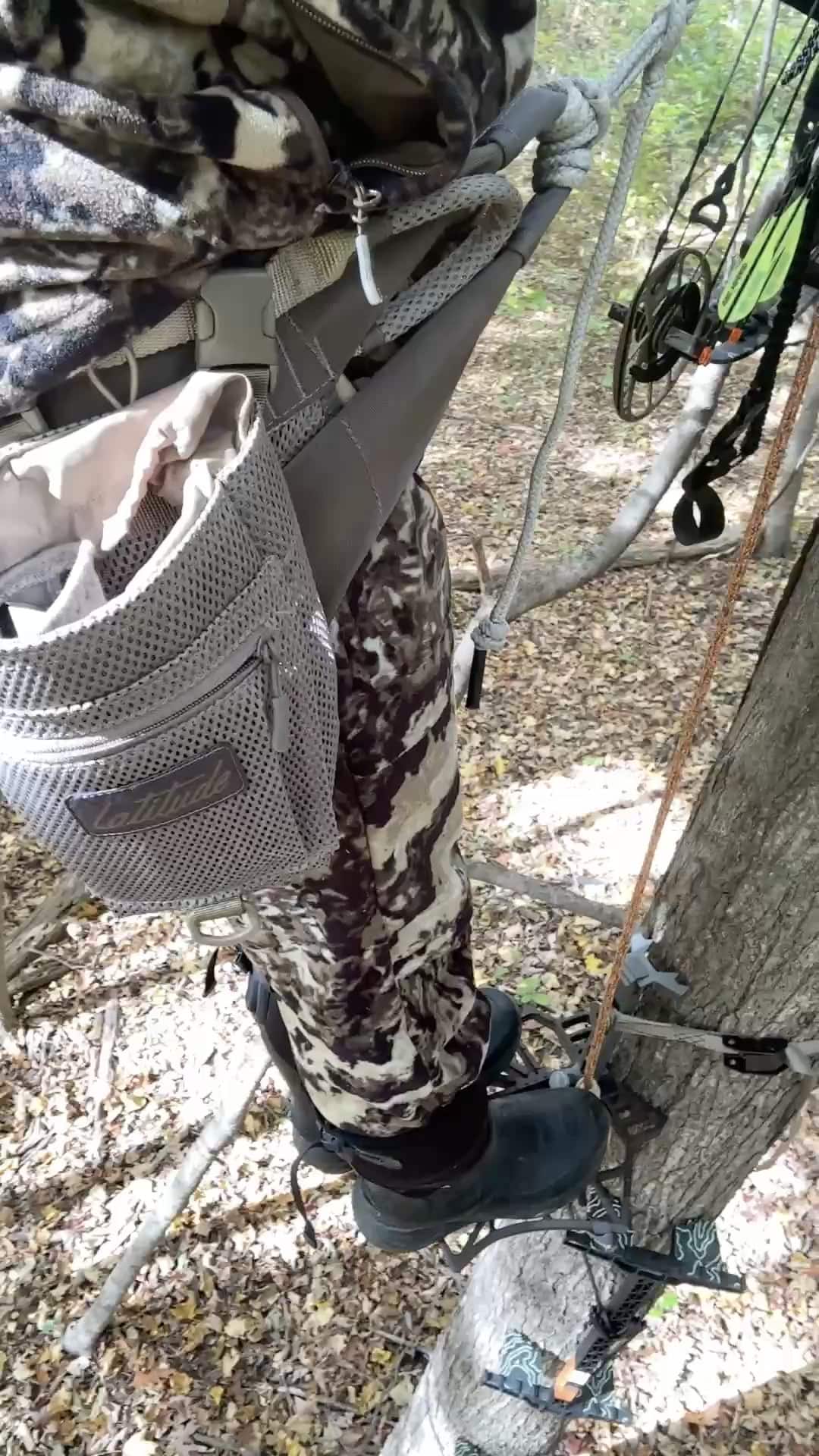
The bibs have front-facing cargo pockets at waist height, with Velcro closures on the pocket flaps. Those are the pockets I'm talking about when I criticize the placement. With my saddle over that area, access was blocked. A safety harness can create the same problem, depending on where its straps fall.
Even without that obstruction, I don't want to keep ripping Velcro open to reach something in the woods. Magnets like the jacket uses would improve the noise issue, but they'd still need to address the pocket placement.
If you hunt from a saddle, put the bibs on with your actual setup before deciding what you'll carry in those pockets. A pocket that looks useful standing in the house may not be useful once you're attached to the tree.
The side-zip thigh pockets work well
The separate pockets on the thighs have side zippers. They're well placed and work well, especially when I'm sitting. I can reach into them across the front of my leg rather than trying to reach down the leg. I have no placement complaint with those pockets.
That's the sort of detail I want in hunting bibs. Think about the position you're in when you need the pocket, not just how much it holds.
The bibs' upper chest pocket is useful, too, until the jacket covers it. I'd keep the items I need most often in pockets I can reach with the whole clothing setup on.
I'd like longer side vents
I opened the bib side vents for the walk in, and they helped. But they're short, and I had to pay attention to keep the zippers from catching the material. I prefer a longer opening, ideally a full side zip, for getting heat out and making the bibs easier to manage.
The lower boot zippers are separate and useful. They open up the calf area, and the ankle snaps let you adjust the fit at the bottom. TideWe's bib listing shows the closure and adjustment layout.
The bibs work, but this is where I can point to specific changes that would make them better. Longer, easier-to-use vents and better access to the waist-high cargo pockets would be high on my list.
Brush, camouflage, and scent control
I took a thicker route out of the woods on purpose to see how the fabric handled brush. It behaved much like other microfleece-faced clothing I've worn. I'd put it in the middle: not something I'd choose specifically for busting through heavy brush, but not bad either.
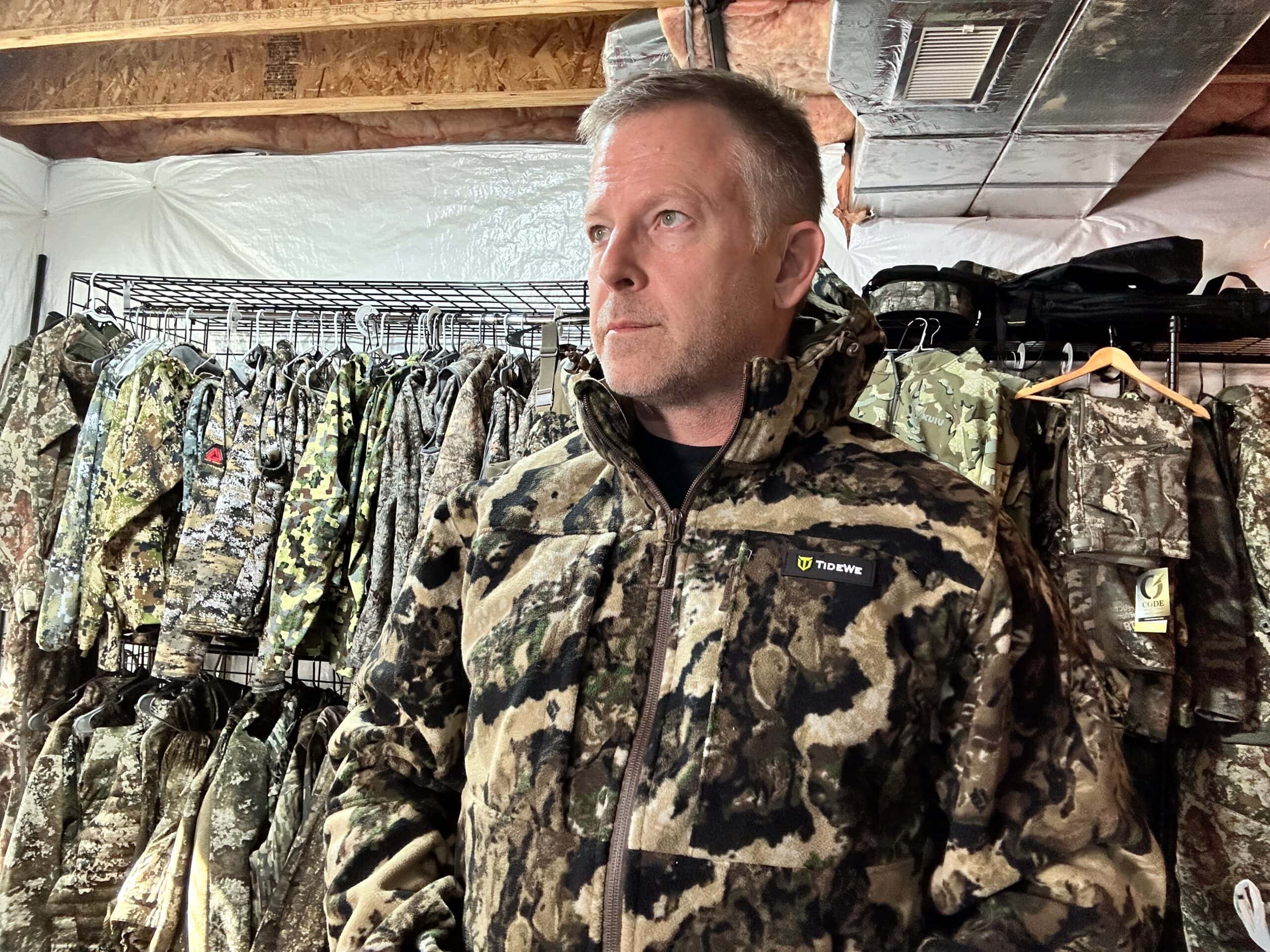
My set is in Veil Whitetail. The photos here show that pattern on the actual clothing, both in the gear room and in the woods. That's more useful than judging it from a small pattern swatch.
TideWe also lists a ProTecht PAO odor-control treatment and advertises performance through 40 washes. I haven't tested that treatment's odor reduction. It's a listed feature, not a reason for me to change how I hunt the wind.
My verdict: the TimberGhost jacket is an easy recommendation
If you handed me this jacket without telling me who made it, put it in Elevated II camouflage, and said it was a new Sitka jacket, I'd tell you it was a great jacket. That's how impressed I am with the TimberGhost.
It cut the wind, stayed very quiet, and was warmer than I expected. It was comfortable, the hood worked well, and the jacket's pockets are where I want them. Based on what I experienced in the field, its performance is just as good as or better than a lot of the leading-brand jackets I've reviewed. I'm not calling it good enough because it's inexpensive. I'm saying it's a very good windproof midseason jacket.
The price makes that recommendation even stronger. At the $159.99 regular-price reference from my comparison, there's already a lot of value here. With the sales TideWe runs and my ARCH18 code for eligible purchases, I'd check the available offers before paying full price. You can often get into this jacket for considerably less than its regular price, which makes the gap between it and a $400 Stratus even harder to ignore.
The matching bibs, with their $179.99 regular-price reference, deliver the same quiet fabric, warmth, and wind protection. Their side-zip thigh pockets work well, too. TideWe could improve the waist-high, front-facing cargo pockets, their Velcro flaps, and the short vents. Those are specific design complaints with the bibs, not reasons to dismiss what the jacket does so well.
For a hunter shopping for a quiet, windproof midseason jacket, I strongly recommend the TimberGhost. Don't pass it over because it says TideWe instead of a premium brand. I was impressed by what it did in the woods. At the prices this jacket sells for, the value is outstanding.
Check the current TimberGhost jacket price, bib price, or matching jacket-and-bibs bundle. Use ARCH18 for 18% off eligible purchases. Compare the final total with TideWe's other offers and choose the better deal; don't assume codes combine.
For the measurements behind the comparison, see my ten windproof jackets tested side by side, or watch me handle and compare them in the video below.
Want to see exactly what I’m carrying this season? Check out my Personal Bowhunting Gear List for 2026