
Most hunters find a bed on a ridge, bench, or point and assume they have found the answer. They have found a clue. In hill country, the bed matters because of what it tells you about wind, thermals, cover, terrain, pressure, and the buck’s exit options. The next question is harder: can you get close enough to hunt the security edge without teaching that buck you are there?
Where this fits in my system: This is part of the Deer Intelligence layer of The Everyday Bow Hunter system. Bedding does not stand alone. It has to connect to Kill Zone Mapping, your 3 Hunt Plan, and the way you protect access on the day of the hunt.
This guide explains how I read hill-country bedding without turning every ridge into a universal rule. A mature buck may use the same terrain feature for a different reason when the wind, season, food, or hunting pressure changes.
Hill Country Changes the Bedding Decision
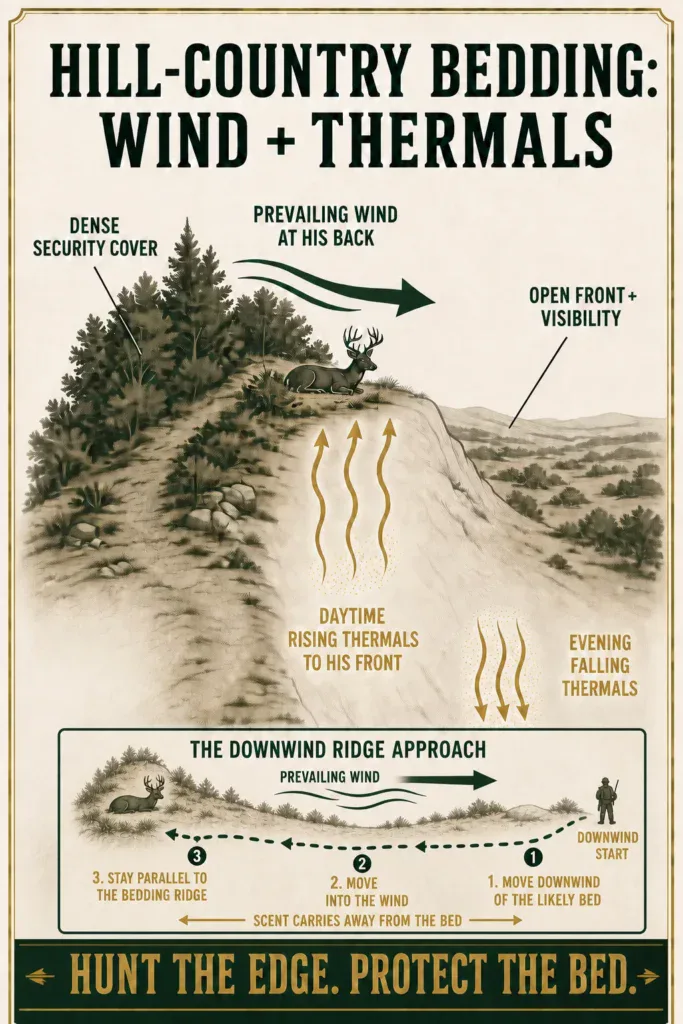
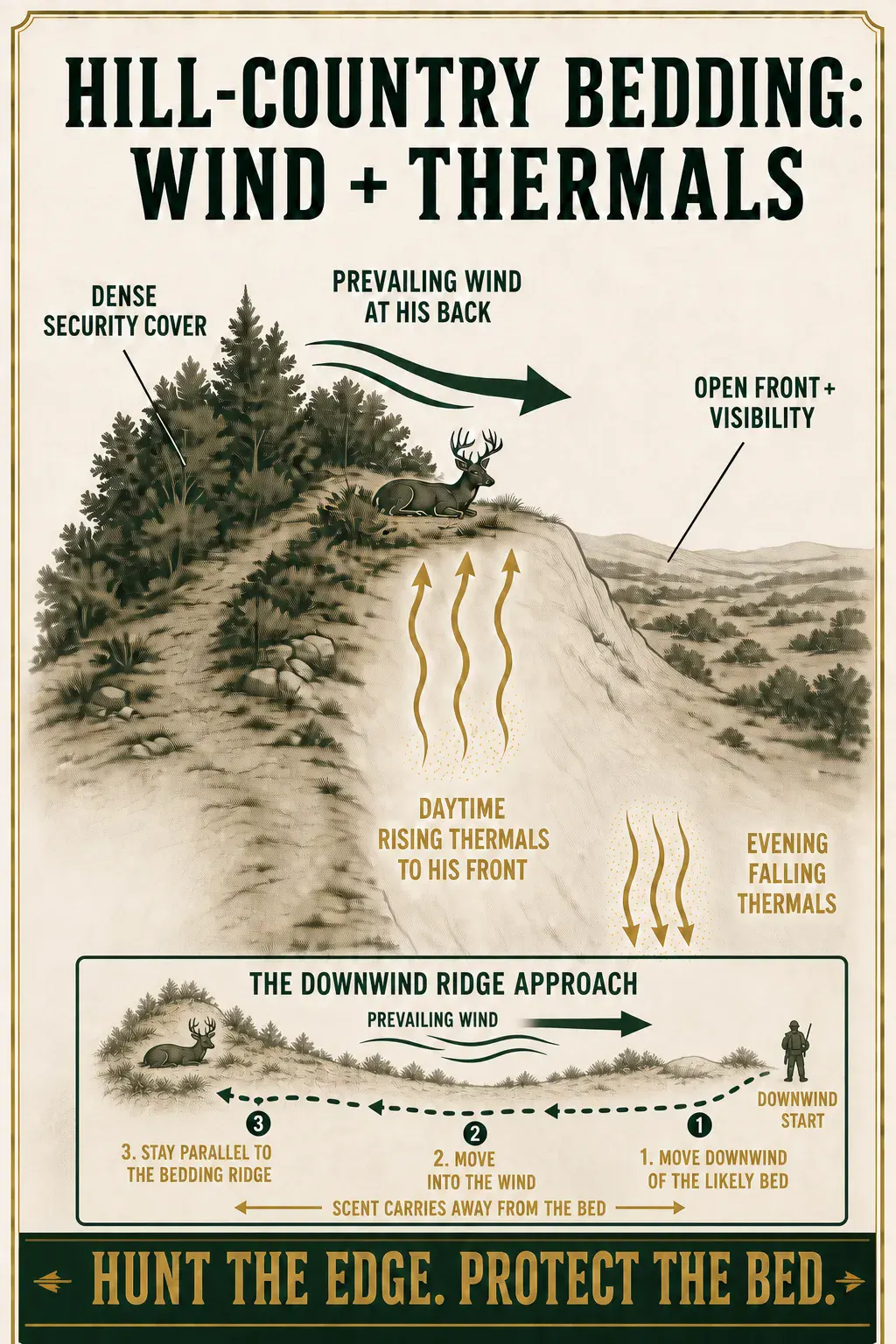
Hill-country bucks can use terrain to protect more than one side of their body at a time. A bed near the upper third of a ridge may give a buck wind from behind, a view down the slope, and fast escape routes through cover. A bench, point, knob, or sidehill pocket can do the same job in a different way.
That is why the upper third of a ridge deserves attention. It is not a rule that every mature buck beds there. It is a starting point for reading the country.
When I find a bed, I want to know what problem it solves for the deer. Does it protect the downwind side? Does it give a view of a likely approach? Does cover hide the buck from above? Does it sit near a trail that lets him leave without crossing open ground?
Terrain Features That Often Matter
Start with terrain that gives a buck an advantage, then confirm it with sign and current conditions. These features commonly deserve a closer look.
- Upper-third sidehills: Often provide a mix of wind, sight, and escape cover.
- Leeward ridge sides: Can let a buck smell danger coming from above or behind while watching downhill.
- Ridge points and knobs: Create several travel choices and can collect wind from more than one direction.
- Benches and terrain shelves: Offer level ground on a steep slope and may connect bedding cover with travel routes.
- Terrain transitions: The edge where mature timber meets young cover, a cut, a ditch, a bowl, or a thick sidehill can offer security without looking obvious on a map.
One Appalachian study discussed in the existing site content found many mature buck beds on downwind ridge sides. That supports a useful pattern, but it does not make every leeward slope a bedding spot. Cover, access, pressure, and the way a local wind actually moves through the terrain still matter.
Wind and Thermals Work as One System
The common explanation is simple: a buck beds with the wind at his back so he can watch downhill. Sometimes that is true. It is also incomplete.
In hill country, a daytime wind can cross a ridge one way while a thermal moves uphill or downhill underneath it. In the morning, warming air often rises. In the evening, cooling air often falls. The exact timing changes with shade, clouds, slope direction, cover, and weather.
That means a bed may make sense because the buck can use more than one air current. He may smell above or behind him, watch the open side, and leave through cover if something feels wrong. Your approach has to beat the whole system, not just the wind shown by a weather app.
Field rule: A favorable wind is not enough if your thermal carries scent into the bed or across the trail the buck uses to enter it.
Use the forecast to make a plan, then verify it in the field. Milkweed, wind powder, or another wind indicator can show you what the air is doing at the actual slope and elevation where you plan to hunt.
One hill-country approach I use is to first move to the downwind side of the ridge where I expect the buck to be bedded. From there, I move into the wind on a line that stays parallel to the bedding ridge, using terrain and cover to stay out of sight. Done right, that keeps my scent traveling away from the bed and takes away the buck’s normal wind and thermal advantage.
This is not a blind rule. It only works when the actual wind, thermal, cover, and exit route stay in your favor from start to finish. If the air starts carrying your scent toward the bed, the plan is over.
For a deeper breakdown, read How to Time Thermals for Bowhunting in October and November.
Do Not Hunt the Bed. Hunt the Security Edge.
A bed is usually the most protected part of a mature buck’s day. Walking straight into it, hanging a stand too close, or trying to force a setup because the sign looks perfect can cost you the deer before you ever hunt him.
The better target is usually the security edge: the place where the buck must leave the bed, stage, or use a trail before he reaches the next protected area. This could be a sidehill trail, a bench, a cover transition, or a route that lets him check wind before moving toward food.
That is the difference between finding bedding and hunting bedding. Finding it is information. Hunting it requires a clean entry, a clean exit, the right wind and thermal, and a reason to believe the buck will move through a shootable spot.
My Last 200 Yards approach applies here. The final approach should be quiet, controlled, and planned before you move. If you cannot enter and leave without crossing the buck’s likely scent cone or exit route, the location is not ready.
How Close Should You Hunt a Hill-Country Bed?
There is no magic distance. A close setup only works when the wind, thermal, access, cover, and exit all line up.
In the 10-Year Deer Study content on this site, the strongest group of mature buck kills happened roughly 75 to 150 yards from bedding. That is not a command to set up at 75 yards from every bed. It is a reminder that huntable daylight movement often happens close to security when a hunter can get there without being detected.
The October behavior work on this site also showed that many mature bucks stayed within roughly 300 to 400 yards of their bed during daylight. That makes bedding and nearby security cover worth understanding, but it does not remove the need for a low-impact plan.
A 150- to 300-yard setup may be smarter when access is weak, the wind is marginal, the bed has several exits, or the deer are already pressured. Beyond 300 yards, you may still kill a buck, but you are often relying on more movement and more variables outside your control.
Read the Bed Without Ruining It
Scouting should answer questions, not satisfy curiosity. Every extra trip into a bedding area adds scent, noise, and pressure.
- Look for the bed’s sight line, wind advantage, cover, and likely exits.
- Separate old sign from fresh use. A rubbed tree beside a bed may tell you where a buck was, not where he is today.
- Use maps and aerial photos first, then confirm only what you need on the ground.
- Notice whether several beds work together as a network. A mature buck may shift beds with wind, food, season, leaf cover, or pressure.
- Plan your stand tree, entry route, and exit route before returning to hunt.
For the foundation behind this process, start with Buck Bedding: How Mature Bucks Choose Their Bedding Areas. For a field-focused look at pressure and terrain, read Where Bucks Bed and How to Hunt Them Without Blowing It.
Use a Green-Light Checklist Before Moving In
A bed can look perfect and still be a poor hunting setup. Before you hunt close, ask these questions.
- Is the forecasted wind right for the stand and the entry route?
- What will the thermal do during the time you expect the buck to move?
- Can I get in without crossing the bed, a likely exit, or a key staging trail?
- Can I get out without blowing scent through the area after dark?
- Does the terrain give the buck an escape route I cannot cover?
- Do I have a second and third hunt ready if conditions change?
If one answer is no, do not force the location. The 3 Hunt Plan exists for this exact reason. A good hunter does not need one perfect spot. He needs several plans that let him pivot when the conditions change.
Common Hill-Country Bedding Mistakes
Assuming every leeward slope holds a mature buck
Leeward terrain can be useful, but cover, food, pressure, and access decide whether a buck actually uses it. Let sign and current conditions confirm the map feature.
Trusting one wind direction
A steady ridge-top wind can hide a bad thermal below you. Check the air where the deer will travel, not only where you parked.
Hunting one bed as if it is the buck’s only bed
Mature bucks often use more than one bedding location. A shift in wind or pressure can move him to another part of the same cover system.
Getting aggressive before the plan is ready
Getting close is valuable only when you can do it cleanly. A rushed entry can turn a strong bedding observation into a dead spot for the rest of the season.
Put the Terrain Into a Complete Hunt Plan
Bedding is one part of a larger decision. Pair what you learn here with Deer Intelligence to understand the deer, then use Strategic Hunting to decide when and how to hunt the opportunity.
The goal is not to prove that a buck uses one specific bed. The goal is to create a hunt that gives you a realistic chance to get close without letting him know you are there.
Frequently Asked Questions
What part of a ridge do mature bucks bed on?
Many mature bucks use upper-third sidehills, leeward slopes, points, benches, and other spots that give them wind, sight, cover, and escape options. The upper third is a useful place to start, not a universal rule.
Do bucks always bed on leeward slopes?
No. A leeward slope can give a buck an advantage, but bedding choices also depend on cover, food, pressure, terrain, and the way wind and thermals behave in that exact location.
Are thermals more important than the prevailing wind?
Neither should be ignored. In hill country, thermals and prevailing wind can work together or fight each other. The best setup accounts for both where the deer is bedded, traveling, and likely to exit.
How close should I hunt a hill-country buck bed?
Hunt as close as you can while still protecting the bed from your scent, noise, and access. A 75- to 150-yard setup can work under the right conditions, while a more conservative distance is often smarter when the terrain or access is less forgiving.
Bottom Line
Hill-country bedding is not about memorizing one terrain rule. It is about understanding the advantage a buck gets from the bed, then deciding whether you can hunt the edge of that security without giving yourself away.
Read the terrain. Verify the air. Protect the entry and exit. Keep another hunt ready.
Want to see exactly what I’m carrying this season? Check out my Personal Bowhunting Gear List for 2026