

Finding a mature buck bed is not the hard part. Learning enough without teaching the buck you are there is the hard part. Bedding cover can hold the best information on a property, but it can also be the fastest place to ruin a hunt with scent, noise, and repeated pressure.
Where this fits in my system: This is part of the Deer Intelligence layer of The Everyday Bow Hunter system. Bedding does not stand alone. It has to connect to Kill Zone Mapping, your 3 Hunt Plan, and the way you protect access on the day of the hunt.
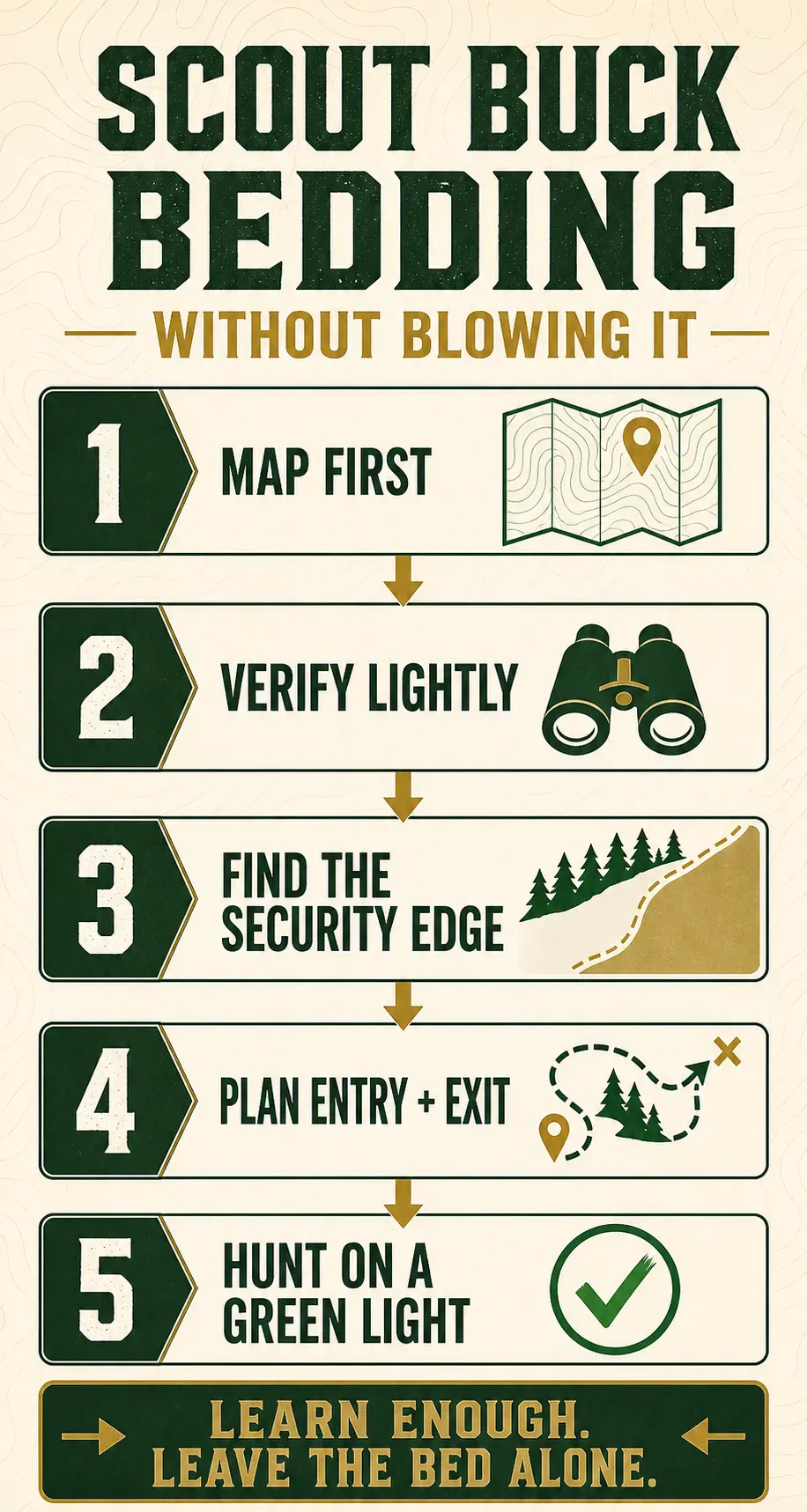
This guide is about scouting for a huntable bedding opportunity. It is not about walking every thick patch until you find a bed. The goal is to understand the bedding system, choose a safe edge, and leave the core area as undisturbed as possible.
Start With the Question You Need to Answer
Do not walk into bedding cover without a reason. Decide what you need to learn before you go.
- Where is the most likely bedding cover?
- Which terrain feature gives the buck a wind, sight, or escape advantage?
- What trail connects that cover to food, water, doe bedding, or another secure area?
- Can I enter and exit without crossing a likely deer route?
- Is there a stand location on the security edge that works with a real wind and thermal?
If you cannot explain what information the trip will change, the trip may be curiosity instead of scouting. Curiosity is expensive around mature bucks.
Use Maps Before You Use Boots
Maps, aerial photos, topographic layers, and property boundaries can narrow the search before you add pressure on the ground. Look for thick cover, terrain points, benches, sidehill transitions, ditches, islands, overlooked pockets, and routes that connect security to food.
Map work will not tell you that a bed is fresh. It does help you make a short list of places that deserve a careful look. That is a much better starting point than wandering through every piece of cover.
For map-specific help, use How to Find Buck Bedding Areas Using Maps and Apps.
Confirm the Bedding Advantage
When you do enter a likely bedding area, slow down and read the location before you focus on the bed itself.
Ask what the deer gains from being there. In hill country, a bed may sit on an upper-third sidehill, point, bench, or leeward slope where a buck can smell behind him and see downhill. In flatter country, the advantage may come from a small island of cover, a ditch, a swamp edge, a brushy transition, or a pocket that keeps people away.
The bed alone does not prove a current pattern. The terrain, cover, wind, nearby trails, and freshness of the sign help you decide whether the location is still worth hunting.
Fresh Sign Matters More Than an Old Story
Old rubs, old beds, and old trail-camera photos can teach you where a buck has lived. They do not always tell you where he is living now.
Look for current tracks, fresh droppings, freshly used trails, new rubs, current browse, and sign that fits the time of year. Then compare that evidence to the food, cover, pressure, and wind conditions you have today.
This is where hunters make a common mistake: they find a strong bed in March, then hunt it in October without checking whether the conditions that made it useful still exist. Seasonal shifts and pressure can move a buck to another bed in the same network.
Stop Short of the Bed When You Can
You do not need to stand in every bed to know it exists. Many bedding areas can be understood from a nearby trail, a transition, a ridge feature, or the edge of the cover.
When a close look is necessary, make the visit count. Enter on a safe wind, move quietly, avoid the middle of the cover, and leave without looping through every possible exit. One focused scouting trip is usually better than several casual ones.
Low-impact rule: The closer you scout to a mature buck’s bed, the more certain you should be that the information will change your hunt plan.
Find the Security Edge, Not Just the Bed
The bed is protected ground. The security edge is where the buck may be huntable before he reaches a more open travel route or food source.
Look for a trail that leaves the bedding cover, a bench that lets a buck sidehill, a cover edge where he stages, or a route that allows him to check wind before moving. These are often better places to hunt than the bed itself because they give you a little more room to manage your entry and exit.
That is the core of The Last 200 Yards: get close enough to matter without making the deer feel hunted.
Plan Your Access Before You Hang a Stand
A good tree does not make a good setup if you cannot reach it cleanly. Before you hang anything, walk the route you will use in daylight and think through the route you will use after dark.
In hill country, I will often begin downwind of the ridge where I expect a buck to be bedded. Then I move into the wind on a route that stays parallel to the bedding ridge. That can keep my scent moving away from the bed while terrain and cover help me stay out of sight.
The condition matters: the real wind and thermal must stay right along the whole route. If they do not, do not force the approach. Use another plan.
- Will your entry cross the buck’s likely route to bed or food?
- Can your scent reach the bed, staging area, or exit trail?
- Will evening thermals fall into the cover below you?
- Can you leave without walking through the main movement route?
- What happens if the wind shifts after you are set up?
If the answer creates doubt, build another option. The best bedding setup is the one you can hunt without announcing yourself.
Use the Right Time to Scout
Late winter and early spring can be useful for finding beds, trails, rub lines, and terrain features while the woods are open. In-season scouting can be more accurate, but it carries more risk because the deer are using the area now.
There is no one correct scouting season. The right choice depends on what you need to learn and how much pressure the area can handle. A small property with one mature buck may require more restraint than a large piece of public ground with several access options.
Turn Scouting Into a Hunt Plan
Every scouting observation should lead to a decision. Do not leave with only a pin on a map.
- Name the bedding feature. Identify the cover and terrain that make it useful.
- Identify the likely wind and thermal setup. Decide when that bed may be safe for the buck.
- Find the huntable edge. Choose a trail, transition, or staging area outside the bed.
- Plan entry and exit. Do not rely on the stand location alone.
- Create alternatives. Use the 3 Hunt Plan so one bad wind does not ruin the week.
For the larger decision framework, connect this guide with Deer Intelligence and Strategic Hunting.
Common Scouting Mistakes Around Buck Bedding
Walking the whole bedding area to feel certain
More scouting is not always better scouting. Once you know enough to build a safe plan, leave the area alone until conditions give you a reason to return.
Hanging a stand where the sign is strongest
The strongest sign may be inside the place the buck expects to be safe. Hunt the nearby route you can access without giving him a warning.
Ignoring the exit route
Hunters often plan the walk in and forget the walk out. A good morning hunt can become a bad season if you blow scent through the bedding cover after dark.
Believing a bed is current because it looks good
Good beds can go cold. Use fresh evidence and current conditions before you risk an aggressive setup.
Frequently Asked Questions
Should I walk into a buck bedding area to scout it?
Only when the information is worth the pressure. Start with maps and edges, then make one focused visit if you need to confirm the bedding advantage, freshness, or huntable exit route.
How do I know if a buck bed is fresh?
Look for current tracks, droppings, fresh nearby sign, and trails that fit the current food, cover, wind, and season. An old bed can still be useful information, but it is not proof of current use.
Where should I set up near buck bedding?
Look for the security edge: a trail, transition, bench, or staging area the buck may use when leaving the bed. The setup must also allow a clean entry, wind, thermal, and exit.
Is it better to scout bedding in spring or in season?
Spring can reveal terrain and old sign with less risk. In-season scouting can show current use but carries more pressure. Use the least intrusive method that answers your question.
Bottom Line
The best bedding scouting does not end with a bed found. It ends with a low-impact hunt plan that gives you a chance to get close without changing the buck’s behavior first.
Use maps to narrow the search. Confirm only what matters. Hunt the security edge. Protect your entry and exit.
Want to see exactly what I’m carrying this season? Check out my Personal Bowhunting Gear List for 2026