

An ethical bow shot begins before the broadhead ever reaches a deer. It begins when I decide which shots I will take, and which shots I will pass, before a deer walks into the lane.
My Take: If you want to know where to shoot a deer with a bow, start with a calm broadside or slightly quartering-away deer inside your proven range. Aim through the center of both lungs and picture the full arrow path, not just the spot where it enters.
I have hunted whitetails for decades, and I have helped track and recover deer after clean hits, poor hits, and shots that were hard to read. The longer I hunt, the more certain I become of one thing: having a legal shot does not mean I have to release the arrow.
My first choice is simple. I want a calm deer inside my proven distance, standing at an angle that gives my arrow a clear path through both lungs. The arrow has to fly right, but it also has to hit the right place. If I cannot explain the entire path through the deer before I draw, I do not shoot.
My basic rule: Double lung is the best general shot for an everyday bowhunter. Heart shots and unusual angles can work in the right hands under the right conditions, but they are exceptions—not the foundation I teach.
My Ethical Bowhunting Shot Rules
I set my rules before the season so I do not have to invent them while my heart is pounding. These are my limits, based on my equipment, experience, and the way I hunt:
- Thirty yards is my normal maximum.
- I may stretch to 35 yards only when the deer is completely still, calm, unaware of me, and exactly ranged. I also need enough time to dial my sight and make a controlled shot.
- I will not shoot past 35 yards.
- I want a clear path through the heart-and-lung area. I do not shoot through brush or hope an arrow can beat heavy shoulder bone.
- I do not shoot an alert or moving deer. A deer ready to react can change the angle while the arrow is in the air.
- I will not shoot the only adult doe with fawns. Even with a valid doe tag and a clean opportunity, I will not leave those fawns without the only adult doe in their group.
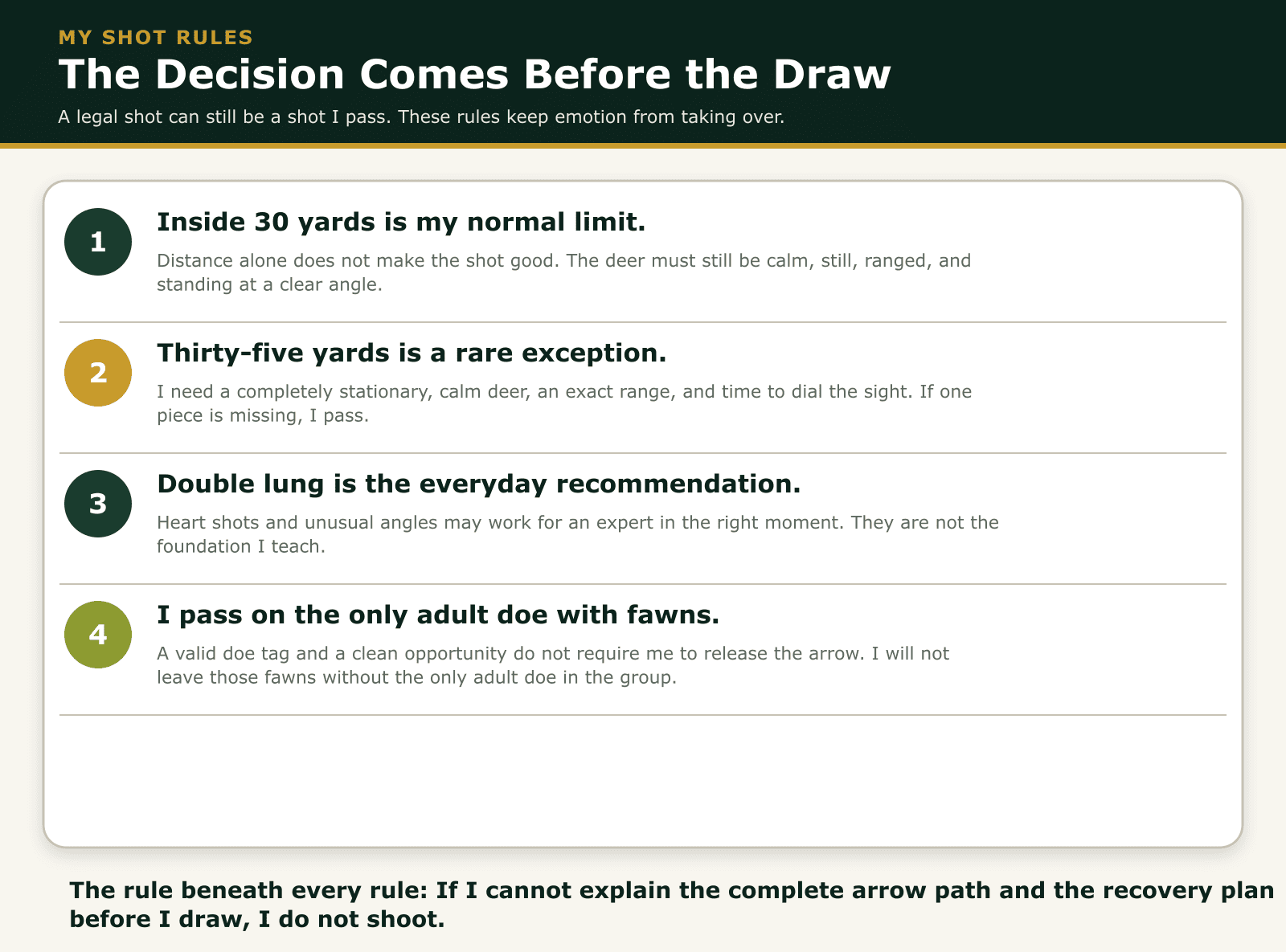
I understand that fall fawns are not newborns and that deer-management goals are different from place to place. This is still a personal line I will not cross. If that doe is the only adult with those fawns, I pass. A tag gives me permission to take a legal deer. It does not force me to take every legal opportunity.
Why I Keep My Normal Shots Inside 30 Yards
A bow is a short-range hunting tool. Practice groups on a target are important, but they do not recreate a live animal, a changing angle, cold muscles, bulky clothes, an elevated stand, fading light, or the pressure of the moment.
An Ohio Division of Wildlife survey included 1,686 reported archery attempts. The average shot was 25 yards. Hits averaged 22 yards, while misses averaged 31 yards. Reported accuracy for compound bows and crossbows stayed above 80 percent through 25 yards, then fell below 40 percent at 40 yards and beyond.
A Penn State controlled-hunt study found that field accuracy was 20 percent lower than the accuracy hunters showed during their pre-hunt test.
That supports what I have seen in the woods. Distance does not fail by itself. It adds time of flight, more drop, more room for range error, and more time for the deer to move. Those risks stack on top of each other.
My 35-yard exception is not a new normal. It is a rare shot that requires a calm, stationary deer, a known range, a clear angle, and time to dial the sight. If one part is missing, I pass.
Deer Shot Placement Chart: Aim Through the Center of the Lungs
For most bowhunters, the center of the lungs is the best target. The lungs fill a large part of the chest and sit around the heart and major blood vessels. That gives you more useful margin than trying to pick the heart by itself.
Official bowhunter education describes the broadside angle as the best chance for a double-lung hit. Illinois Learn to Hunt also recommends the center of the lungs because it gives the hunter the most room for a small aiming error.
On a calm broadside deer, I want the near front leg forward. Then I picture the arrow entering behind the shoulder and crossing the center of both lungs. I am not aiming at a brown spot on the hide. I am aiming through the animal.

Heart Shot or Double Lung?
A heart shot can be very effective. I have taken one after studying the deer and the angle. The deer was about 15 to 20 yards away, broadside but slightly quartering toward me. I aimed directly above the near-side front leg, placed the arrow through the heart-and-lung area, and the deer dropped almost at once.
That experience does not make the heart my general recommendation.
The heart sits low and forward in the chest. It is a smaller target with less room underneath it. A small error can put the arrow into the leg, brisket, or shoulder area. The lungs give an everyday bowhunter more room in every direction.
If you have the technical skill, a calm deer at 15 to 20 yards, a clear broadside or very slight angle, and a complete understanding of the anatomy, a heart shot may be available. But even an experienced archer should pass when the picture does not make sense. For most hunters, most of the time, center lungs is still the right answer.
Quartering Away: Pick the Exit Before the Entry
A quartering-away deer can offer an excellent bow shot because the near-side shoulder moves out of the way. The mistake is thinking only about the visible entry point.
I first pick the place where I want the arrow to leave the far side. Then I work backward to the entry point. As the deer turns farther away, the entry may move back on the near side, but only because that creates a line through both lungs toward the far-side chest.
That does not mean blindly aiming farther back. A poor path can enter the stomach and never reach the second lung. The entire line matters.

Shots That Have Worked for Me, but Are Not My First Recommendation
Experience matters, but it has to be explained honestly. A shot working once or twice does not make it a high-percentage shot for every bowhunter.
A Very Slight Quartering-Toward Shot
I have taken a quartering-toward shot that worked, but the deer was much closer to broadside than to a hard quartering-toward angle. I could see a path into the chest without trying to drive through the heavy shoulder.
I treat that as a field exception. Texas hunter education tells bowhunters to avoid quartering-toward shots because the shoulder creates a much greater bone risk. That remains the right general advice. If the angle closes the chest or puts the near shoulder in the way, I wait or pass.
A Steep, Close Shot on a Deer Facing Away
I have also taken two steep shots from above at roughly five to 10 yards. The deer were facing away, but the body was turned slightly left or right. That offset let me place the arrow beside the spine and angle it down into the heart-and-lung area. Neither deer went more than about 25 yards.
Those shots worked because of the exact angle, close distance, and path through the chest. I am not telling hunters to aim between a deer’s shoulders or to shoot straight down through the back. Official bowhunter education warns that a deer directly beneath the stand gives a poor angle, and steep shots can reduce the visible vital area or catch only one lung.
If I cannot see a clear path that stays off the spine and reaches the chest, I pass. This is not a primary shot and it is not a beginner’s shot.
My test for an advanced shot: Can I explain the entry, the organs the arrow will cross, the intended exit, the major bone I must avoid, and what I will do if the hit is not where I expected? If not, I do not draw.
Shots I Pass On
I will not take a shot just because I can see hair and have an open lane. These are the shots I pass:
- A deer beyond my distance limit.
- An alert deer that is staring, tense, or ready to leave.
- A walking, trotting, or running deer.
- A hard quartering-toward shot with the shoulder covering the chest.
- A head-on or straight rear-end shot.
- A deer directly below me without a clear path through the chest.
- A shot through brush, branches, or grass that may turn the arrow.
- Any angle I cannot explain from entry to exit.
- The only adult doe traveling with fawns.
Technical ability does not turn every available shot into a good shot. Sometimes the most skilled decision is still not to shoot.
My Four-Inch Window Does Not Make a Shot Ethical
In my 25-yard bow-sight system, I use a practical path window of four inches high to four inches low. That helps me understand trajectory and bracket common whitetail shots.
It is not an eight-inch permission slip.
A deer’s visible chest is not the same as a guaranteed vital target. The body angle, shoulder, near leg, elevation, deer movement, and exact organ path still matter. The trajectory window helps me plan the shot. It does not replace anatomy, range, or judgment.
My string-jumping and reaction-time analysis explains why an alert deer and a longer flight window can change an otherwise sound aiming picture before impact.
You can use the Hunting Arrow Trajectory Calculator to see what your own speed and sight zero do to the arrow path. Then verify every result on the range from hunting positions.
How to Tell Where You Hit a Deer
When a shot goes bad, diagnose the hit before you track. Even good hunters make bad shots. Once that happens, the job changes. I stop trying to prove that the hit was good and start collecting evidence.
I use the apparent entry and exit, deer angle, reaction, arrow, blood, hair, tissue, smell, tracks, and first trail sign together. No single clue proves the hit.
A mule kick does not prove lungs. Dark blood does not prove liver. No blood does not prove a miss. A broadhead can cut inside the chest while the entrance or exit plugs. It may also take several yards before blood reaches the ground.
This table is meant to help you make the first recovery decision after a questionable hit. For my complete waiting, blood-trailing, tracking, and recovery process, read my After the Shot guide.
| Possible Hit | Evidence That May Fit | My Starting Decision |
|---|---|---|
| Heart or double lung | Bright, frothy, or bubbly blood may support lung involvement. The angle and observed impact still matter. | Wait at least 30 minutes. Stay alert and verify the evidence. |
| Single lung or uncertain chest | A hard angle, steep shot, shallow penetration, or sparse blood may hide the real path. | Add time. Do not let one good-looking clue rush the recovery. |
| Liver | Dark blood can fit liver, muscle, or venous bleeding. It does not prove liver by itself. | Back out and give the deer 8–12 hours when conditions allow. |
| Stomach or intestines | Green or brown material, partially digested food, and a foul smell may support an abdominal hit. | Back out and give the deer 8–12 hours when conditions allow. |
| Shoulder, leg, muscle, or high hit | Hair, fat, tissue, little blood, or an arrow with poor penetration requires careful judgment. | Wait at least two hours before a controlled recovery attempt. |
| Low graze or possible miss | White hair, little blood, or no visible sign may fit a low graze or miss—but does not prove either one. | Search the hit site and line of travel carefully before calling it a miss. |

These waits are starting decisions, not guarantees. Rain, snow, heat, predators, darkness, and property lines can change the plan. If the deer is visible and offers a clear, safe shot into the vitals, I take the finishing shot.
The Recovery Decision Is Part of the Shot
The ethical responsibility does not end when the arrow leaves.
- Watch the impact and the deer. Do not drop your bow or celebrate.
- Listen. A crash, stumble, or quiet stop is useful information, but it is not proof.
- Mark three places. Mark where you were, where the deer stood, and where you last saw it.
- Reload. Be ready for a safe finishing shot.
- Wait and classify. Use all the evidence before choosing when to follow.

My full After the Shot guide explains the complete process for evaluating blood and hair, protecting last blood, organizing a tracking team, handling a bumped deer, and making a controlled recovery.
The basic rule is simple: when the evidence becomes less certain, the recovery decision becomes more conservative.
My Final Shot Checklist
Before I draw, I want to answer every one of these questions:
- Is the deer inside my proven distance?
- Is the range exact?
- Is the deer calm and still?
- Is the angle broadside or safely quartering away?
- Can I picture the arrow crossing both lungs?
- Is the shoulder out of the path?
- Is the lane clear from bow to deer?
- Do I know the intended far-side exit?
- Am I willing to pass if any part changes?
- If it is a doe, is she the only adult with fawns?
If the answer is no, I let down.
The draw is part of the decision. Rule 15 in Mike’s Rules explains why I draw when the safe window is open, then let down when the angle, lane, or deer no longer supports the shot.
Frequently Asked Questions
What is the best bow shot on a deer?
For most bowhunters, a calm broadside deer with a clear path through the center of both lungs is the best shot. A quartering-away angle can also be excellent when you choose the far-side exit and keep the arrow path through both lungs.
Should I aim for the heart or lungs?
The lungs are the better everyday target because they give you more room for a small aiming error. A heart shot can work quickly, but it is smaller, lower, and closer to the leg and shoulder. I reserve it for a short, calm, very clear shot when I fully understand the angle.
How far is an ethical bow shot?
There is no single ethical distance for every hunter. My normal limit is 30 yards, with a rare 35-yard exception under strict conditions. Your limit should be based on your verified field accuracy, equipment, hunting position, deer behavior, and ability to place the first arrow—not your best group on a perfect practice day.
Is a quartering-toward shot ethical with a bow?
A hard quartering-toward shot puts heavy shoulder bone in the path and is a shot bowhunters should avoid. I have taken one very slight angle that was closer to broadside and had a clear chest path, but I treat that as a personal exception, not a general recommendation.
How can I tell if I gut-shot a deer?
Green or brown material, partially digested food, a foul smell, and minimal dark blood may support a stomach or intestinal hit. No single clue is final. Use the observed impact, angle, arrow, hair, tissue, tracks, and trail sign together. When conditions allow, I back out and give a suspected abdominal hit 8–12 hours.
Bottom Line
A hunting arrow has two jobs. It has to fly accurately enough to reach the right place, and it has to cut a lethal path when it gets there.
For an everyday bowhunter, that usually means a calm deer, a short known range, and a broadside or quartering-away path through both lungs. The more the distance, angle, deer behavior, or anatomy moves away from that picture, the more willing I am to pass.
I have made advanced shots that worked. I have also been hunting long enough to know that success does not turn an exception into a rule.
Know the path. Know your limit. Know when to let down.
Your Next Steps
Build the shot before the season: Use my Bowhunting Shooting System to connect range, sight setup, practice, and field execution.
Understand your arrow path: Run your setup through the Hunting Arrow Trajectory Calculator.
Prepare for the recovery: Read After the Shot: How to Track and Recover a Deer before you need it.
Research and Education Sources
- Ohio Division of Wildlife: Ohio Deer Summary and Archery Survey
- Penn State: Controlled Archery Deer Hunt and Field Accuracy
- Pennsylvania Bowhunter Education: Broadside Shot Angle
- Pennsylvania Bowhunter Education: Location and Elevated Shot Angles
- Illinois Learn to Hunt: Taking Your Shot
- Virginia Department of Wildlife Resources: Arrow Lethality and Shot Placement
- North Carolina Wildlife Resources Commission: After the Hunt
- Texas Parks and Wildlife: Shots to the Vital Areas
Want to see exactly what I’m carrying this season? Check out my Personal Bowhunting Gear List for 2026