
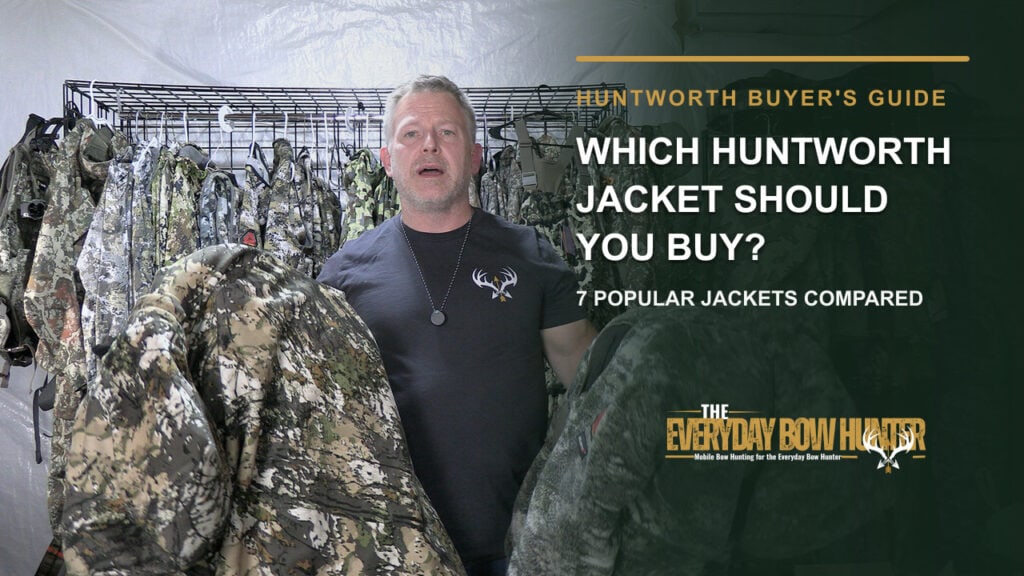
Huntworth has reached the point where having more jacket choices can make the buying decision harder instead of easier. I own seven of the jackets hunters ask me about most, and after putting them beside each other, weighing the exact samples, wearing them, and looking closely at how each one is built, I do not think they belong in one simple warmest-to-lightest ranking.
The Kenora is the heaviest jacket I measured. The Halifax is the most expensive and carries Huntworth's highest warmth position. The Matterhorn is the bad-weather outlier. I currently put the Saginaw ahead of the Saskatoon as a complete hunting system because the hood and matching bibs materially change how I would use it.
That is the problem with choosing from a temperature label or a price tag. Those numbers do not tell you whether a jacket fits a quiet treestand bowhunt, a wet western hunt, a mobile rut setup, or a long stationary sit.
This guide will help you choose the Huntworth jacket that fits the hunt you actually have. The first step is not finding the jacket with the lowest advertised temperature. It is deciding what job you need the jacket to do.
The Short Answer: Which Huntworth Jacket Fits Your Hunt?
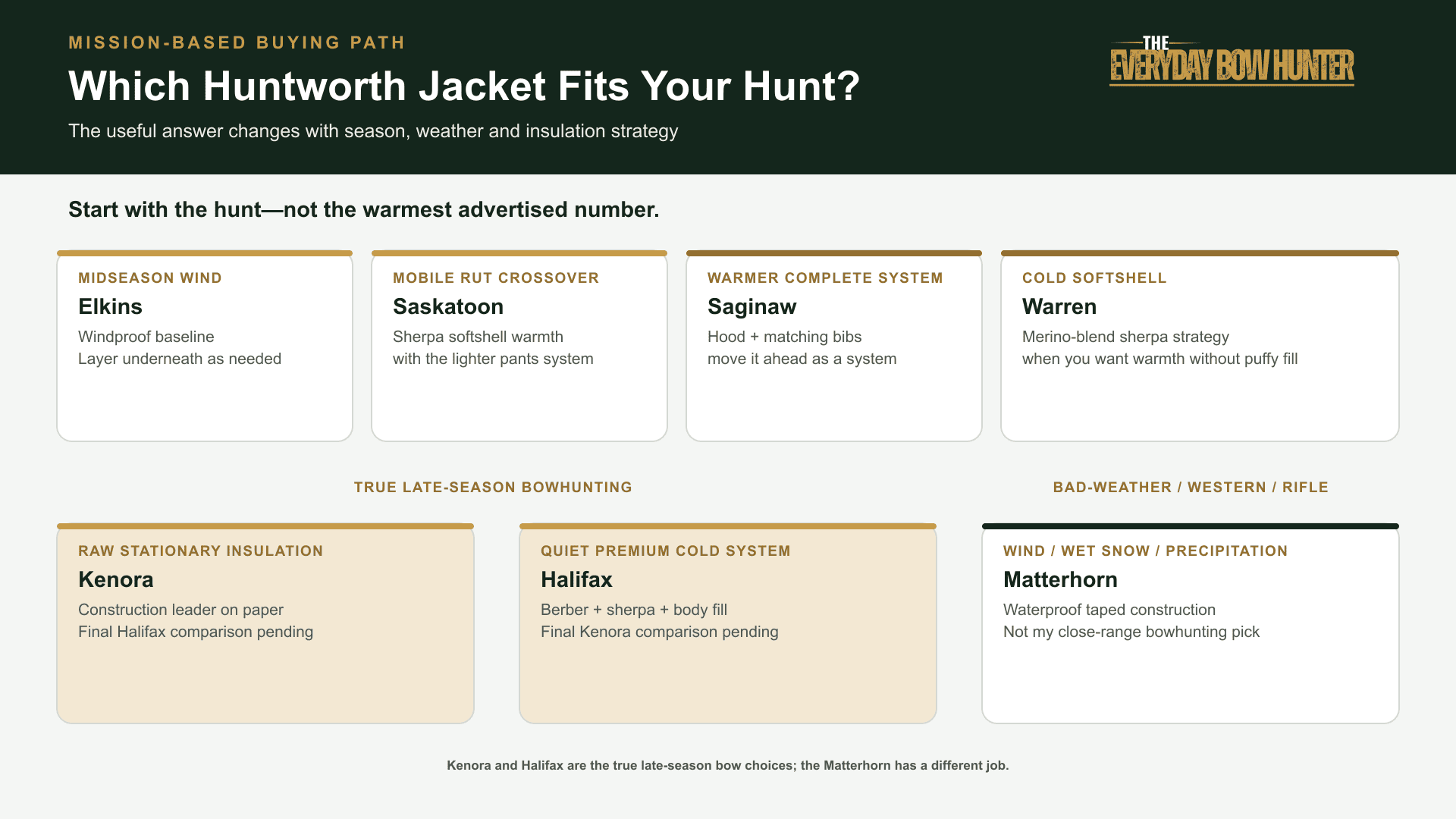
If you want the quick version, this is where I would start:
| Hunting job | My starting point | Why |
|---|---|---|
| Midseason wind control | Elkins | Lightest of my seven samples, windproof, and easy to build layers under |
| Mobile rut and early-cold crossover | Saskatoon | Quiet sherpa-lined softshell with useful warmth and less complete-system bulk |
| Warmer complete midseason system | Saginaw | Hood, Berber fleece, and matching bibs move it ahead of the Saskatoon for me |
| Cold-weather softshell | Warren | High-pile merino-blend sherpa without moving into a conventional insulated coat |
| Bad weather, wet snow, and western hunts | Matterhorn | Waterproof taped construction and strong wind protection, but not my bowhunting choice |
| Expected maximum raw insulation | Kenora | Heaviest measured sample and 100-gram fill through the body, sleeves, and hood |
| Premium quiet late-season system | Halifax | Berber exterior, high-pile sherpa, body insulation, quietness, and Huntworth's highest warmth position |
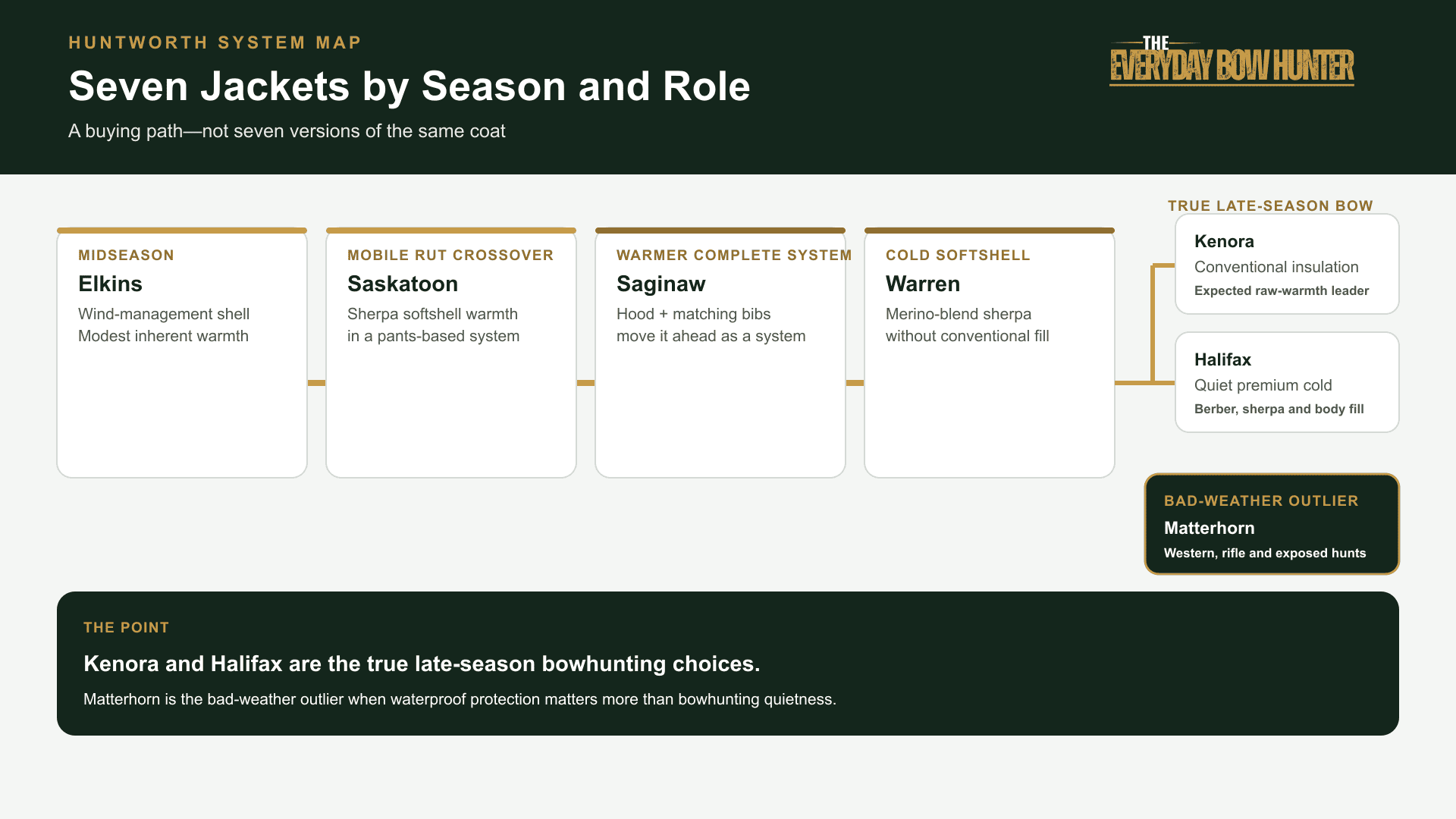
There is no honest overall winner yet. For true late-season bowhunting, Huntworth's two real choices are Kenora and Halifax. I am going to test those two under matched cold-weather conditions this season. Until that happens, the Kenora is my construction and measured-weight leader, while the Halifax is Huntworth's premium quiet late-season choice.
The Matterhorn can hunt during the same late-season part of the calendar, but I do not put it in the same bowhunting decision. It is the bad-weather jacket in this group. Its waterproof protection is useful, but its noise keeps it from competing directly with Kenora and Halifax for a close-range bowhunting job.
Huntworth sends me gear to test, including some of the products discussed here. I am not sponsored by Huntworth, the company does not control what I say, and that relationship does not change the strengths or weaknesses in this guide.
Start With the Complete Hunting System, Not the Temperature Label
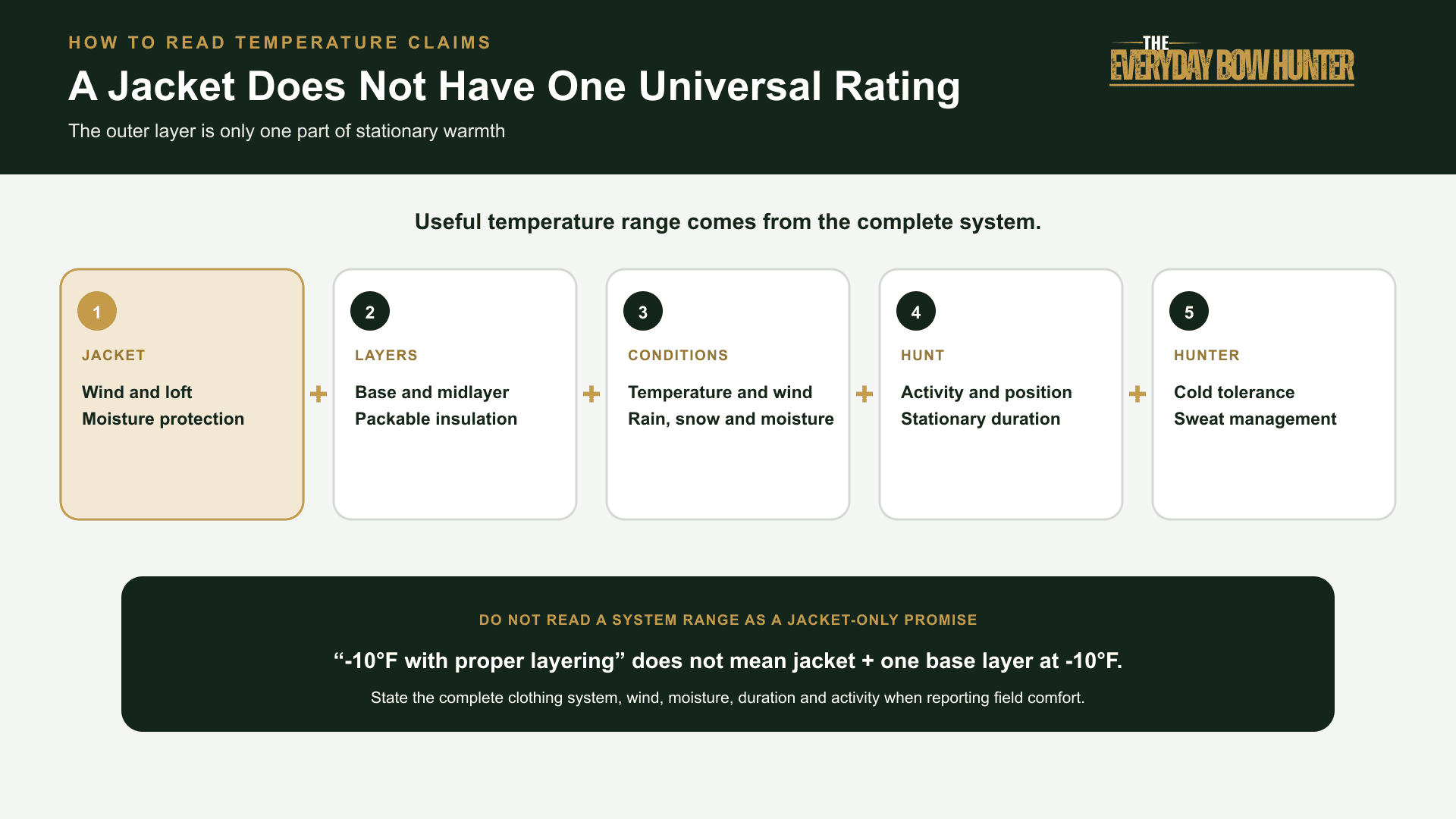
Huntworth publishes temperature guidance, but those numbers assume layering. A jacket rated for very cold weather is not a promise that you can wear it over one base layer, sit motionless in wind, and stay comfortable at the bottom of that range.
Your base layer, midlayer, walk in, sweat, wind, moisture, hunting position, and length of the sit all change the result. The matching pants or bibs matter too. That is especially important in this comparison because the Saginaw has matching bibs while the Saskatoon uses pants. I do not separate that from the buying decision when I know most hunters will purchase and wear the system.
That is why the seven jackets make more sense as a season and mission map than a numbered warmth ladder. Kenora and Halifax finish the bowhunting progression. Matterhorn branches away as the bad-weather option.
Huntworth Elkins: My Midseason Wind-Control Starting Point
The Elkins is the cleanest starting point for a hunter who wants a windproof midseason shell without jumping straight into a heavy cold-weather system. My size-large jacket weighed 1.98 pounds, making it the lightest of these seven samples.
Huntworth builds it around a fleece face, windproof membrane, and grid-fleece interior. In plain language, the Elkins is meant to stop wind and give you modest insulation while leaving room to change the layers underneath it.
It does not have a hood, and I would not choose it expecting late-season warmth by itself. Its value is that it handles a common whitetail job without making you wear a three-pound jacket in weather that does not require one.
Best for: Typical midseason treestand and saddle hunts where wind control matters more than maximum insulation.
Skip it if: You want one jacket to carry you through long stationary late-season sits.
Huntworth Saskatoon: Mobile Sherpa Warmth for the Rut and Early Cold
I have used the Saskatoon system for three seasons. My size-large jacket weighed 2.42 pounds, but the number does not explain why it has stayed in my clothing system.
The windproof softshell and Heat Boost sherpa help hold warmth once I settle in. My jacket was firmer and a little louder when it was new. After multiple seasons and washings, it softened and became genuinely quiet for the way I bowhunt. It also has high chest pockets that remain useful around a saddle or harness.
The Saskatoon does not have a hood, and its matching lower is a pant rather than a bib. I still think it is an excellent heavy-midseason and early-cold crossover because it gives you sherpa warmth without immediately putting you into one of Huntworth's heaviest late-season systems.
Best for: A bowhunter who wants quiet wind protection for the rut, the 30s and 40s, and colder mornings with a good layering system.
Skip it if: You want a hood, matching bibs, or a true extreme-cold outer system.
Huntworth Saginaw: My Warmer Complete Midseason System
The Saginaw sits close to the Saskatoon, and I have changed my order after thinking through how I would actually wear both systems. My size-large Saginaw weighed 2.54 pounds.
Its Berber-fleece exterior, Heat Boost interior, wind protection, and hood make it a warmer complete setup for me. The matching bibs matter too. If I buy the jacket and lower together for a cold stationary hunt, the bib coverage gives the Saginaw system an advantage that a jacket-only construction table can miss.
That does not make the Saskatoon a lesser product. The two jackets solve slightly different versions of the same midseason problem. I would lean toward the Saskatoon when I want the lighter, simpler crossover. I would lean toward the Saginaw when I want the warmer complete system and value the hood and bib coverage.
Best for: A hunter who wants more complete-system warmth than the Elkins or Saskatoon without moving all the way to Huntworth's late-season coats.
Skip it if: You want the lighter mobile option or the raw insulation of Kenora and Halifax.
Huntworth Warren: The Cold-Weather Softshell
The Warren is where the lineup changes. My size-large jacket weighed 2.98 pounds, but Huntworth does not build it like a typical puffy late-season coat.
The Warren relies on a windproof softshell and high-pile Heat Boost sherpa with merino in the material package. There is no conventional lofted fill in the current construction table. That gives it a different feel and a different job than Kenora or Halifax.
I see it as the cold-weather softshell. It is the next step when the Saginaw is not enough, but you still want a fleece-based outer system rather than a thick insulated jacket. It also costs more at regular price than Kenora and Matterhorn, which is a good reminder that price does not form a clean warmth ladder.
Best for: Colder treestand and saddle hunts where you want a windproof sherpa softshell and are willing to pay for that material strategy.
Skip it if: You are buying only for maximum insulation per dollar or need full waterproof construction.
Huntworth Matterhorn: The Bad-Weather Outlier
The Matterhorn does not fit cleanly into a bowhunting warmth ranking, and that is exactly why it deserves its own category. My size-large Matterhorn weighed 3.42 pounds. Huntworth uses a waterproof shell with taped seams, Heat Boost sherpa, wind protection, and 60-gram insulation through the body.
In my thermal testing, the Matterhorn performed like a serious cold-weather jacket. In the field, the tradeoff was just as clear. It is noisier than the bowhunting-focused jackets, and it builds heat quickly when I move.
The men's Matterhorn is also missing pit zips. That is the one change that would materially improve it. A waterproof jacket that holds this much heat needs a better way to dump heat when the climb, walk, or terrain makes you work.
For close-range whitetail bowhunting, the noise and heat management keep it from being my first choice. For bad weather, rifle hunting, muzzleloader hunting, wet snow, and western hunting where wind and precipitation may matter more than absolute quietness, the Matterhorn makes much more sense.
That is not a consolation category. Weather protection is a real job. The Matterhorn just solves a different job than a quiet Berber late-season jacket.
Best for: Bad weather, wet snow, exposed wind, western hunts, rifle hunts, muzzleloader hunts, and hunts where waterproof protection matters more than close-range fabric quietness.
Skip it if: Your main concern is drawing a bow silently with a deer close to the tree, or you need underarm ventilation for active terrain.
Huntworth Kenora: The Heaviest Jacket I Measured
The Kenora is the heaviest jacket in this comparison. My medium, which fits close to the large jackets I normally wear, weighed 3.52 pounds.
Huntworth lists 100-gram synthetic insulation through the body, sleeves, and hood. That gives the Kenora the strongest conventional insulation case on paper. It is thick, comfortable, and clearly built for stationary cold.
What I will not do yet is declare it warmer than Halifax. I had not completed the same-layer field comparison when this guide was drafted. The Kenora's construction and measured weight make it my expected raw-insulation leader, but the Halifax combines a Berber exterior, high-pile sherpa, and body insulation in a different system.
Fit is part of that upcoming test. The medium Kenora fits me, but a large would give me more room for aggressive late-season layering. That can change how much trapped air the complete system holds and how freely I can move.
Best for: The hunter who wants Huntworth's strongest conventional insulated design for long stationary cold-weather sits.
Skip it if: Quiet Berber construction matters more than maximum conventional fill, or you want the weatherproof role of the Matterhorn.
Huntworth Halifax: The Premium Quiet Late-Season System
The Halifax is the most expensive jacket in this group, and Huntworth positions it as the warmest option. My medium weighed 3.42 pounds, so it was 0.10 pound lighter than the Kenora medium I measured.
Its construction is different from the Kenora. The Halifax combines a Berber-fleece exterior, high-pile Heat Boost sherpa, a windproof membrane, and 40-gram insulation in the body. It also feels extremely quiet and comfortable, which matters when the job is a close-range late-season bowhunt.
The medium Halifax fits me more closely than the medium Kenora. I would normally buy a large so I could build the full cold-weather system beneath it without compressing layers or crowding the draw.
The Halifax may prove warmer than the Kenora. Huntworth believes it is. The published position does not settle my buying advice, though, because the Kenora is heavier and carries more conventional fill. I need the matched field test before I name the winner.
Best for: The hunter who wants Huntworth's premium, quiet late-season bowhunting system and values Berber and sherpa construction.
Skip it if: You need full waterproof protection or you are not willing to pay the highest regular price in this comparison before the Kenora head-to-head is complete.
My Measured Huntworth Jacket Weights
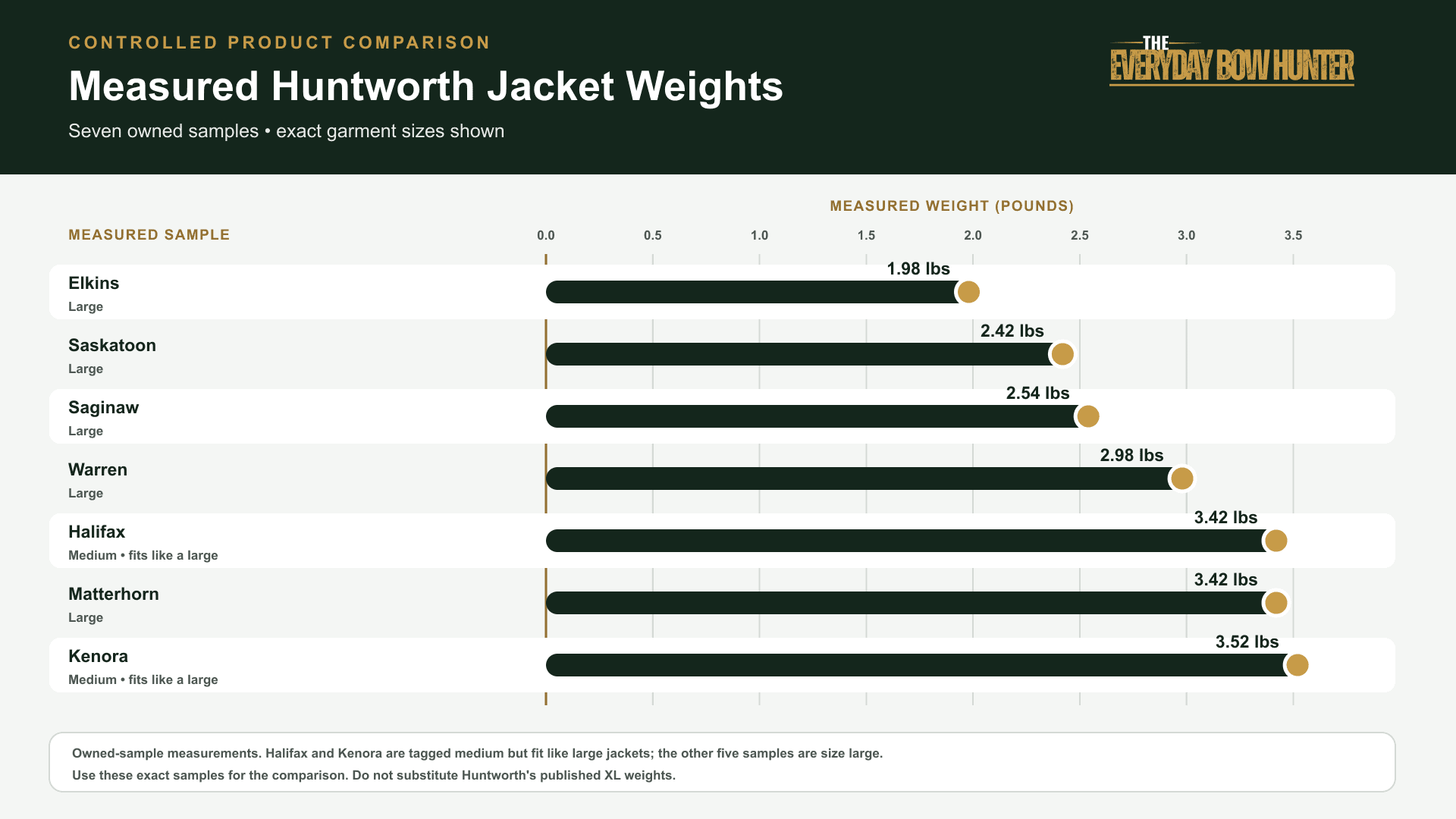
I weighed the exact jackets I own. Five are size large. The Kenora and Halifax are tagged medium but fit close to my large jackets, so this is useful owned-sample data, not a laboratory same-size weight test.
| Jacket | My measured weight | Sample size |
|---|---|---|
| Elkins | 1.98 lb | Large |
| Saskatoon | 2.42 lb | Large |
| Saginaw | 2.54 lb | Large |
| Warren | 2.98 lb | Large |
| Matterhorn | 3.42 lb | Large |
| Halifax | 3.42 lb | Medium; fits close to my large jackets |
| Kenora | 3.52 lb | Medium; fits close to my large jackets |
The important correction is simple: Kenora is the heaviest jacket I measured. Halifax is not. Halifax is the most expensive and carries Huntworth's highest warmth position, but those are different facts.
My Current Warmth and System Assessment
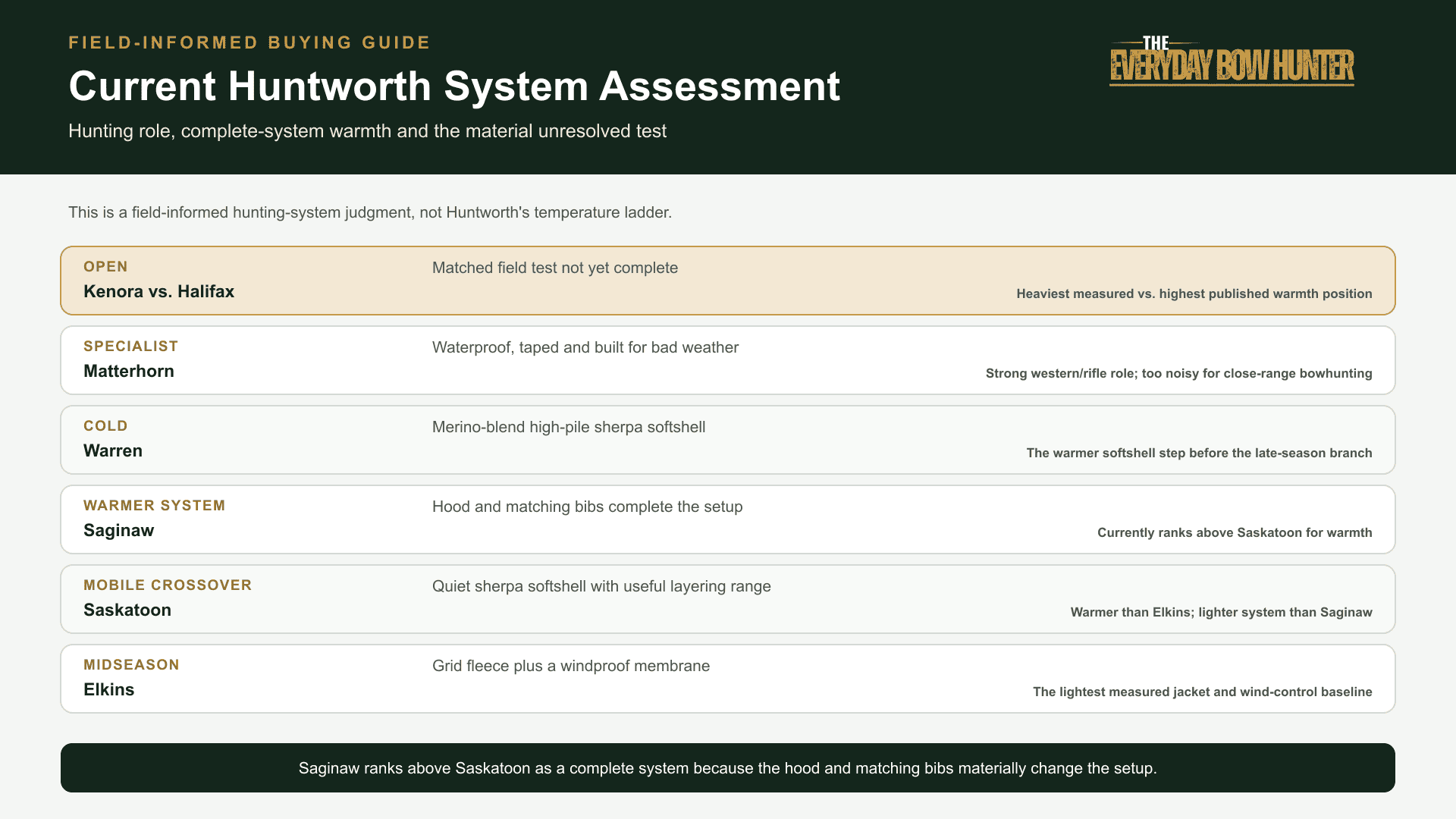
There are two separate comparisons here.
If I look only at jacket construction, Saskatoon's high-pile sherpa could make it appear warmer than the Saginaw. If I judge the complete systems I would actually buy and wear, I currently put the Saginaw above it. The Saginaw's hood and matching bibs add coverage and warmth that matter during a stationary sit.
At the top, I am leaving Kenora versus Halifax open. Kenora leads measured weight and conventional insulation. Halifax leads Huntworth's published warmth position, price, and premium quiet construction. The coming field test will use the same base and midlayers, similar conditions, the same sit length, and careful notes on wind, moisture, mobility, and where I first feel the cold.
That result will be added to this post without changing the URL.
Huntworth Jacket Prices and Value
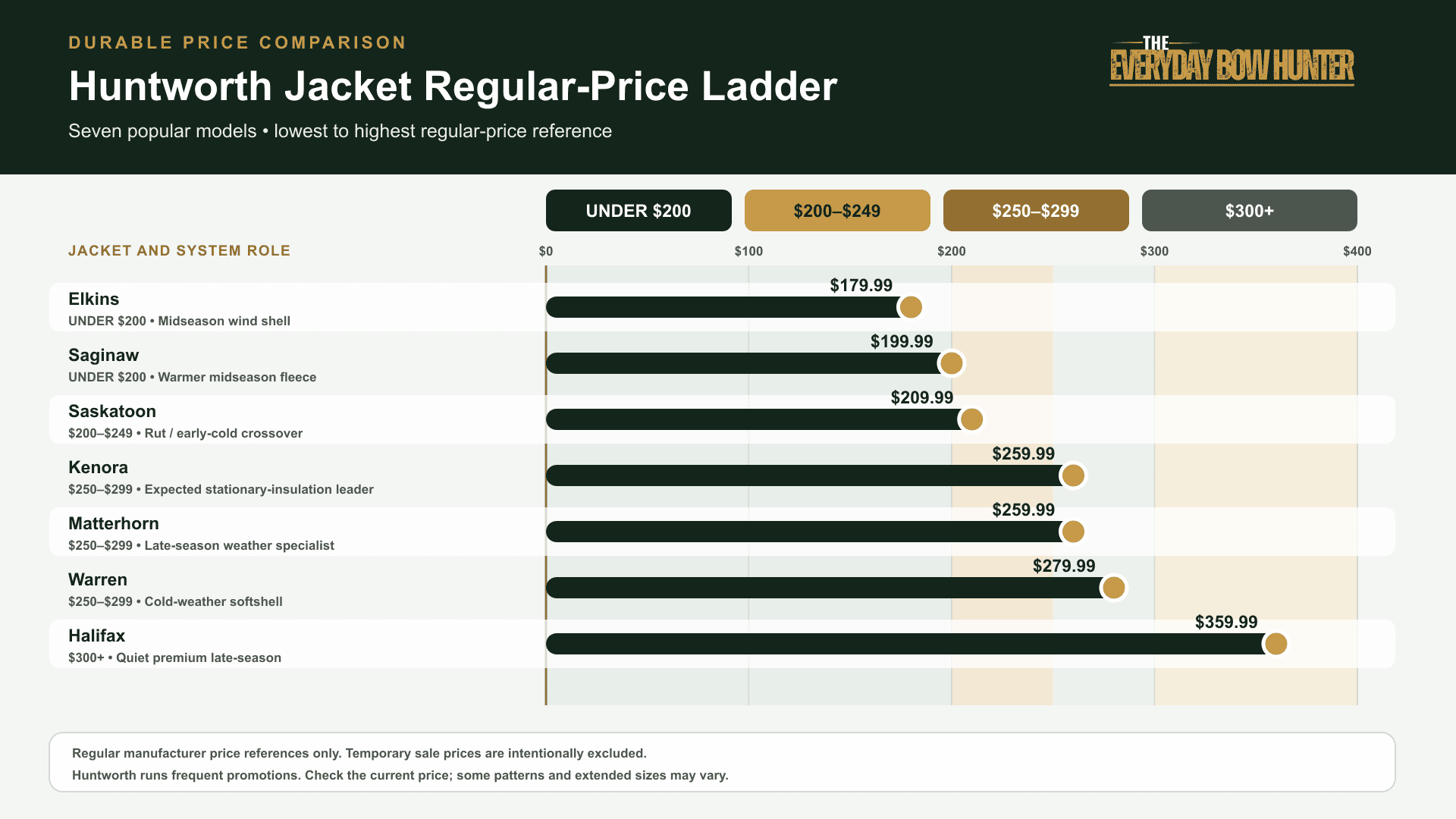
These are full MSRP references, not temporary sales. For example, the Elkins has a full MSRP of $179.99 in this comparison. Huntworth runs promotions frequently, so the amount you see when shopping may be lower. The full-price ladder still matters because it shows what the company is asking you to pay before a promotion changes the number.
| Jacket | Regular-price reference | What the price is buying |
|---|---|---|
| Elkins | $179.99 | Midseason windproof grid-fleece shell |
| Saginaw | $199.99 | Berber fleece, hood, and warmer complete system |
| Saskatoon | $209.99 | Sherpa-lined rut and early-cold softshell |
| Kenora | $259.99 | Heavy conventional insulation throughout the jacket |
| Matterhorn | $259.99 | Waterproof taped construction and severe-weather protection |
| Warren | $279.99 | Merino-blend high-pile sherpa softshell construction |
| Halifax | $359.99 | Premium quiet Berber, sherpa, and body-insulation system |
The price ladder is not the warmth ladder. Warren costs more than Kenora and Matterhorn. Halifax costs $100 more than Kenora at the regular-price reference. Those gaps only make sense if the construction and hunting job are what you need.
Which Huntworth Jacket Would I Buy?
I would not buy one jacket and expect it to solve every part of the season.
For a normal midseason windproof shell, I would start with the Elkins. For quiet mobile rut hunting and a lighter complete setup, I would use the Saskatoon. When I want the warmer hooded and bib-based midseason system, I would move to the Saginaw.
The Warren is the cold softshell. The Matterhorn is the bad-weather specialist and makes more sense for western, rifle, muzzleloader, wet-snow, and exposed-wind hunts than it does for my close-range bowhunting.
For true late-season bowhunting, I would choose between Kenora and Halifax. I would wait for the completed field comparison if the warmth difference controls your purchase. If raw conventional insulation is your priority, the Kenora is the logical starting point. If quiet premium bowhunting construction is the priority, the Halifax is the more natural fit.
The answer is not the jacket with the lowest temperature number. It is the jacket whose construction, noise, ventilation, weight, and matching system fit the hunt you need it to do.
Watch the Seven-Jacket Huntworth Comparison
Want to see exactly what I’m carrying this season? Check out my Personal Bowhunting Gear List for 2026