
My Story: Why I Switched
I didn’t switch to a single-pin sight because it was trendy. I switched because I had to.
Back in 2005, I was in Iraq when an IED hit our convoy. I survived, but I’ve been dealing with traumatic brain injury ever since. One of the long-term symptoms is something most people would never notice unless they’ve lived it: my eyes don’t scan the way they’re supposed to.
Instead of smooth movement, they jump, more like a typewriter than a camera. That might sound small, but when you’re trying to line up a shot and your sight picture is full of pins, that distraction can completely throw you off.
I didn’t understand what was happening at the time. I ran multi-pin sights for my first few years after retiring and did okay, but I always felt like something was off. It wasn’t until I got help in 2013 that I finally understood what was happening and why I struggled to process all those pins in the middle of a high-pressure shot.
When I moved to a single-pin sight, everything changed.
It gave me a clear, distraction-free view. I could focus. I could scan more naturally. And most importantly, I could shoot with confidence again.
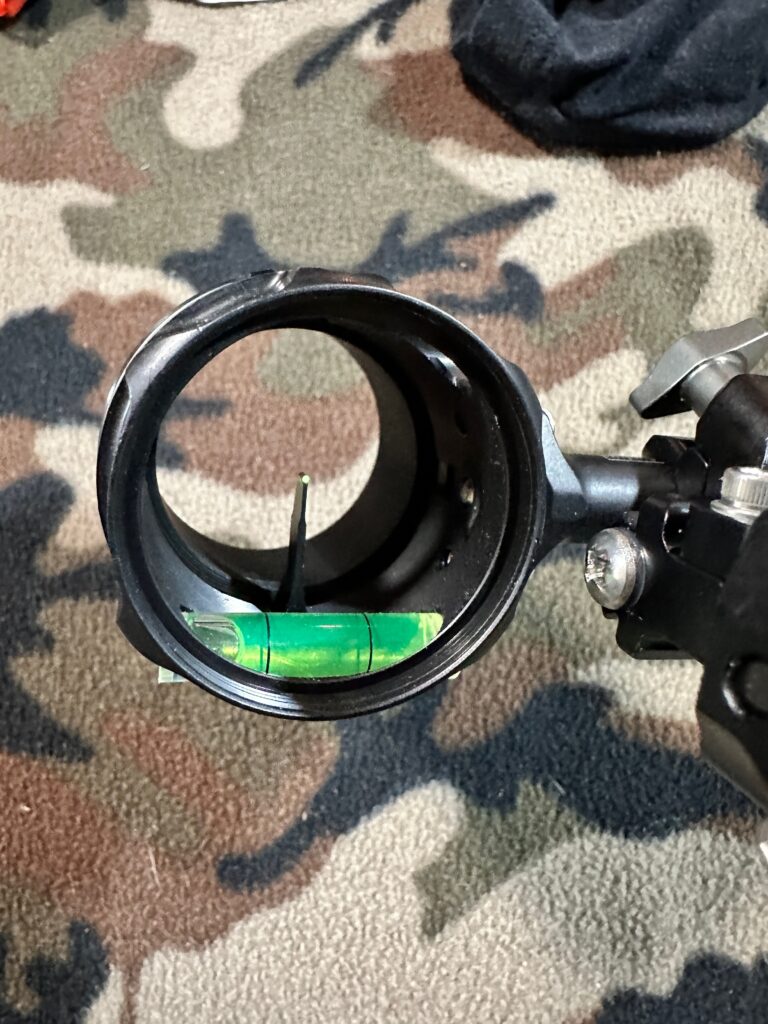
What Is a Single Pin Sight?
A single-pin sight has just one aiming pin, not five or seven stacked together. It uses a yardage dial or slider to move that one pin up and down, so you can adjust for different distances. You usually set it using a sight tape, a sticker, or a printed scale that marks yardages based on how your arrow drops over distance.
This type of sight clears out your view and gives you one simple aiming point. That can be a game changer if you struggle with a cluttered sight picture or shoot better when things are streamlined.
➜ Single-Pin vs Multi-Pin Bow Sights
Dialing In Weight: I use this $15 digital arrow scale to weigh every finished arrow. It’s cheap, accurate, and hasn’t failed me yet.
What I Like About a Single Pin
- Cleaner sight picture
- Easier to focus without distractions
- One aiming point means less thinking in the moment
- Simplifies the mental process under pressure
Drawbacks You Should Know
- You may need to adjust the dial between shots
- Fast-moving deer can catch you off guard
- You need to plan ahead or pre-range spots before the shot
How I Run My Single Pin in the Field
I used to zero my sight at 20 yards like most guys. But over time, I realized that most of my shots happen inside 30 to 35 yards, and usually right around 25.
So I started zeroing at 25 yards and using a bracketing system I learned back in my Special Forces days. That change gave me the ability to hold over or under quickly without guessing. I explain the full method here.
Just make sure your sight is leveled properly on all axes. An unlevel sight can throw off your point of impact, especially from an elevated stand. I cover leveling in detail here:
➜ How to Level Your Bow Sight Axes
Why I Zero My Bow Sight at 25 Yards
By setting my pin at 25 yards, I can bracket my shots. That means I already know how high or low my arrow will hit at various distances around that zero point. Inside 30 yards, I only need to make minor holdover or holdunder adjustments, and I do it without touching the dial.
It’s all pre-calculated in my head.
But here’s the key point. I practice this constantly.
I don’t just guess. I test my pin setup on the range at both flat and elevated angles. I know how many inches I hit high at 15 to 20 yards and how far I drop at 30 to 35. I’ve put in the work so I can shoot fast and accurately without needing to look down at my yardage tape.
➜ Why I Zero My Bow Sight at 25 Yards
What’s a Sight Tape?
A sight tape is a custom scale you stick to the side of your sight. It’s built around your arrow’s speed and trajectory. When you turn the dial to “30,” the pin moves to the exact spot where your arrow will hit at 30 yards. Every bow has its own tape, and you typically figure yours out during setup.
Sight tapes are great when you’re just starting out, and I still use mine for longer shots or tight windows. But over time, I built a faster method: a fixed 25-yard zero with trained holdovers. I walk through that exact training process in my 25-yard post.
Why Timing Matters
When a deer walks in, you might get five seconds. Maybe less. Rarely do you have time to grab your rangefinder, reach for your dial, and still make a clean shot.
That’s why I build the shot plan before it happens. I’ll range key spots ahead of time, dial my sight to where I think the shot will be, and adjust in my head from there.
I’ve done this long enough that I honestly can’t remember the last time I missed a deer due to bad elevation.
My Advice for New Single Pin Shooters
If you’re just starting out, don’t try to do this right away.
Use your yardage tape. Learn how to dial quickly and stay accurate. Build confidence at exact ranges first, then start practicing at unknown distances with a 25-yard pin to see how your arrow flies.
Once that’s second nature, you’ll be able to make the shot without second-guessing.
If you want to try a single-pin sight and want to see what I currently run, I use an Axcel Landslyde with the AVX-41 scope. You can read more about my setup here:
➜ My Current Single Pin Setup and Why I Trust It

If I Had to Go Back to Fixed Pins
If I had to switch back to a fixed pin sight, here’s exactly what I would do:
- I’d run a high pin setup by mounting the sight housing lower on the bracket, which raises the pin stack in the housing and gives me more usable vertical space.
- I’d use fewer pins, probably just 20, 30, and 40 yards, with wider spacing and less clutter.
- I’d make sure the sight supports full 3rd axis leveling so I could stay accurate on angled shots. If you’re not sure what that means, I explain it in detail here:
➜ How to Level Your Bow Sight Axes
- I’d use a dovetail mount if possible, and double-check that my peep sight frames the housing perfectly at full draw while wearing my hunting clothing.
- I’d re-check all leveling at hunting height, not just flat ground, and confirm where my 40-yard pin lands with broadheads.
If you’re running a fixed pin setup and want to see some great options that support high pin layouts, here’s my full guide:
➜ 5 Best Sights for High Pin Setups (That You Can Actually Level Right) (Coming Soon)
Final Thoughts
Not every shooter has a TBI, but every bowhunter can benefit from a cleaner sight picture and simpler decision-making. That’s what a single pin gave me.
The best gear is the one that matches your body, your brain, and your hunting style. It took me years to realize what was holding me back. Once I fixed it, everything about my bowhunting got better.
Try different setups. Test them in the field. And trust what gives you confidence when it’s time to draw back.
Want to see exactly what I’m carrying this season? Check out my Personal Bowhunting Gear List for 2025!