

Every bowhunter wants to circle the “magic week” on the calendar, the stretch when bucks go daylight, does pull them out of cover, and the woods explode with rut activity. But here’s the truth: the rut doesn’t happen on one universal date. It’s shaped by photoperiod, latitude, and genetics. And if you’re not tuned into your region’s timing, you’ll either be a week too early or a week too late.
For 2025, the astronomical trigger everyone talks about—the Rutting Moon—falls on November 5, 2025. That puts the sweet spot for much of the North and Midwest between November 8–18. But the Southeast tells a different story, with some areas rutting in November, others in December, and parts of Alabama and Mississippi peaking in January. Florida? It’s all over the map, from July through March.
Let’s break it down by region and phase so you can plan strategically and hunt the rut with confidence.
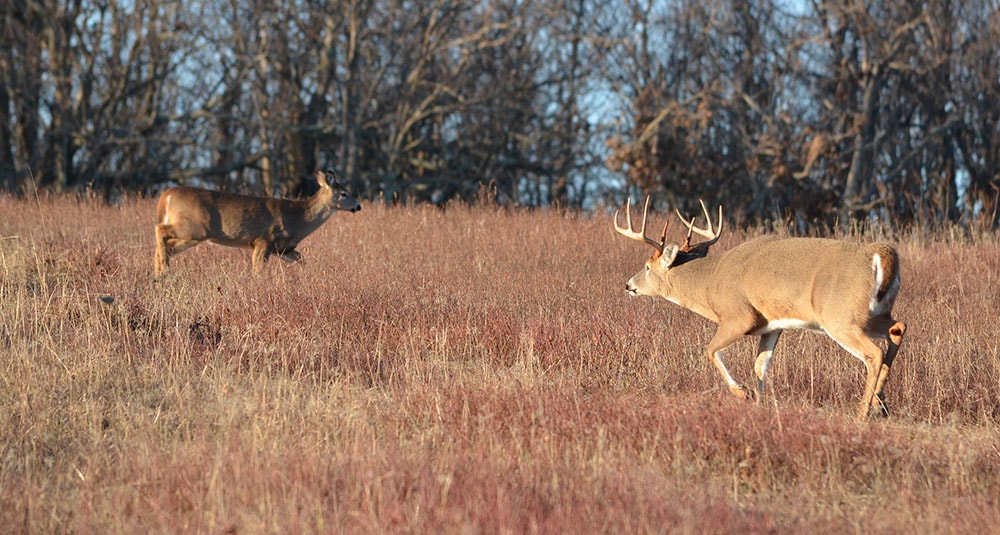
The Science Behind Rut Predictions
Hunters have argued for decades about what really drives the rut, but the science is surprisingly clear. Photoperiod (the length of daylight), is the main driver of breeding timing.
Penn State’s Deer-Forest Study has tracked hundreds of GPS-collared deer over the past decade and found that peak conception consistently falls between November 13–17 each year, no matter what the moon is doing. Mississippi State University’s Deer Lab reports the same pattern across the Southeast: does in a given region breed within just a few days of the same calendar date every year.
This is why biologists often dismiss the moon as a rut predictor, the breeding calendar is biologically fixed. But here’s where things get interesting: while the moon doesn’t change when does get bred, it can change how much daylight movement you see from bucks.
That’s where the Alsheimer/Laroche “Rutting Moon” algorithm comes in. This system keys the seeking-and-chasing phase to the second full moon after the autumn equinox, which often, but not always, lines up with the peak breeding window. In years like 2025, when the Rutting Moon happens to fall early in November, you get a perfect storm: a biologically fixed rut and a moon phase that encourages bucks to move in daylight during the same window.
READ: Peak Rut: How to Hunt the Most Intense Week of the Year
Astronomy for 2025
| Event | Date |
|---|---|
| Autumnal Equinox | September 22, 2025 |
| First Full Moon After Equinox | October 6, 2025 |
| Second Full Moon (Rutting Moon) | November 5, 2025 |
The Rutting Moon typically marks the ramp-up into the chase phase, with peak daylight activity often hitting 3–13 days after. That lines up beautifully with the long-term data showing conception around mid-November in most northern herds.
Gear Tip: During seeking, a simple grunt will pull cruisers inside bow range. This is the call I use to do it every November.
Rutting Moon vs. Peak Conception (Recent Years)
| Year | Rutting Moon | Peak Conception (PA Data) | Alignment |
|---|---|---|---|
| 2023 | Nov 27 | Nov 13–17 | Late – moon lagged breeding peak |
| 2024 | Nov 15 | Nov 13–17 | Perfect overlap |
| 2025 | Nov 5 | Nov 13–17 | Slightly early, but still in pre-rut ramp-up |
My Field Take
I’ve logged more than a decade of rut observations and trail camera data across Pennsylvania and surrounding states. What I’ve seen matches the research: does hit peak estrus at almost the same time every year. But I also see a bump in daylight buck sightings in the days surrounding the Rutting Moon; enough that I still pay attention to it when I plan my sits.
For me, the moon isn’t about predicting conception, it’s about predicting huntability. If the Rutting Moon overlaps with the historical breeding window, you can expect a dramatic increase in buck activity during daylight hours.
What Sets This Rut Prediction Apart
Most rut forecasts just throw out dates, or worse, copy the same chart year after year without explaining why those dates matter. This forecast combines three layers of insight:
- Hard Science: We cross-checked the Rutting Moon with long-term conception data from Penn State, Mississippi State, and multiple state wildlife agencies.
- Regional Precision: Instead of a one-size-fits-all North/South split, we break down the Northeast, Midwest, and four different Southern sub-regions (including Florida).
- Field Experience: After years of bowhunting and logging rut activity, I’ve personally tagged multiple mature bucks between November 8–10, right when this forecast calls for peak cruising.
The result is a data-driven, field-tested calendar that helps everyday bowhunters plan their sits with confidence, not guesswork.
Gear Tip: I Tested 7 Cold Weather Hunting Jackets – See the Results
Regional Rut Forecast for 2025
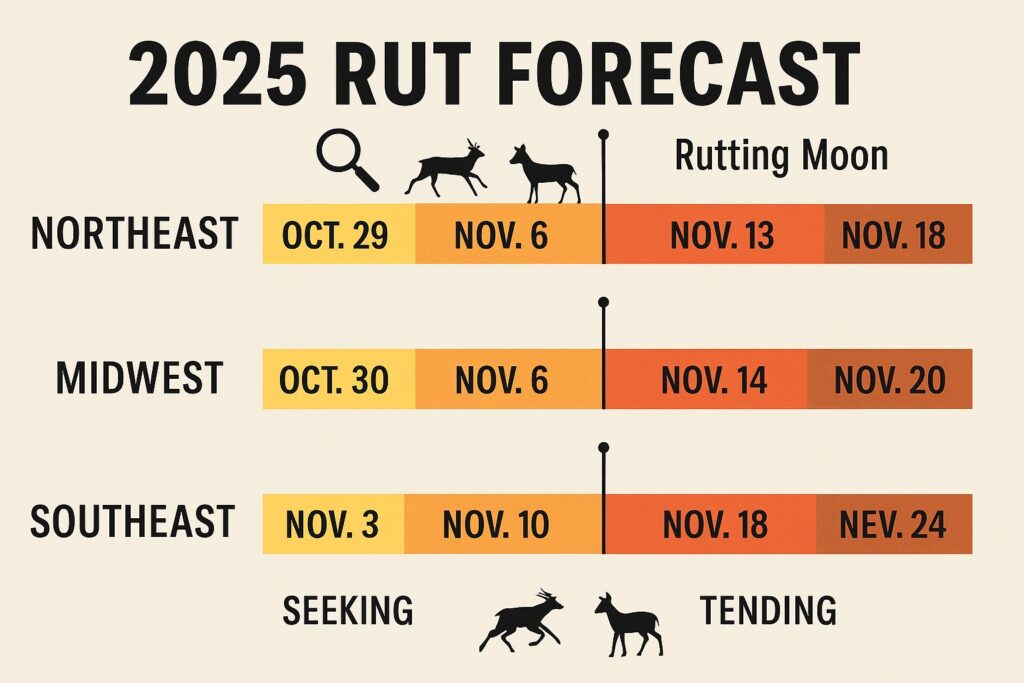
These predictions focus on hunter-visible activity phases — seeking, chasing, and tending — not the exact day does get bred. The goal is to help you plan vacation, prioritize sits, and know what to look for in the woods.
Northeast (PA, NY, OH, WV, NJ, New England)
- Seeking: Oct 29 – Nov 5 (Peak Nov 3–5)
- Chasing: Nov 6 – Nov 13 (Peak Nov 9–11)
- Tending/Lockdown: Nov 12 – Nov 18 (Peak Nov 14–16)
Why: Decades of Pennsylvania Game Commission data put median conception between Nov 11–17. This aligns perfectly with a Nov 5 Rutting Moon, meaning the chase phase should overlap the main breeding window. If you’re scheduling time off, the week after Nov 5 is your money week.
Field Note: Over the years, I’ve noticed a clear pattern in my own logs — November 8–10 is my hottest window for daylight buck movement. In fact, I’ve killed several of my best bucks during that stretch, including more than one on my birthday (November 8). It’s the perfect intersection of biology and hunter opportunity, right before lockdown starts to kick in during the third week of November.
Midwest (MI, WI, MN, IL, IA, IN)
- Seeking: Oct 30 – Nov 6 (Peak Nov 3–5)
- Chasing: Nov 6 – Nov 14 (Peak Nov 10–12)
- Tending/Lockdown: Nov 13 – Nov 20 (Peak Nov 15–17)
Why: Studies covering thousands of does across the Midwest consistently show peak conception Nov 3–16. The Rutting Moon falls right before this biological sweet spot, so expect chasing to be intense and visible Nov 8–12. This is when the giants you’ve been patterning all season finally show in daylight.
Southeast (State-by-State Variation)
The Southeast is where generic rut charts fail — and why serious hunters rely on state conception maps. Breeding dates here are set by genetics, not just latitude, so there are huge differences between regions.
- Upper South / Appalachian Piedmont (western NC/SC, north GA, east TN): Seeking Nov 3–10 | Chasing Nov 10–18 | Tending Nov 17–24
- Coastal Carolinas & SE Georgia: Many herds peak late Oct – early Nov. Shift the above dates 1–2 weeks earlier for these coastal zones.
- Deep South (MS, AL, south GA): Seeking Dec 7–21 | Chasing Dec 21 – Jan 5 | Tending Jan 5–15 Some Alabama zones peak even later, into February.
- Florida: Florida is in a league of its own, with breeding dates ranging July through March depending on the county. Use FWC’s rut map and back up roughly two weeks before mean conception to time your sits around the chase phase.
Pro Tip: If you hunt multiple states, start in the Midwest in early November, then head south in December and January to catch the late ruts. This is how traveling bowhunters stack tags.
How to Use This in the Field
- Plan your best sits for the chase phase. For most northern hunters, that’s Nov 8–18.
- Rely on state maps in the South. Don’t guess. Alabama’s best action might not start until New Year’s Eve.
- Adjust based on sign. Hot scrapes, fresh tracks, and daylight cam pics always override the calendar.
- Match tactics to the phase. Aggressive calling and decoys shine in the seeking phase; patience is key during lockdown.
Bottom Line
In 2025, hunters north of the 35th parallel are looking at one of the best overlaps we’ve had in years. A Rutting Moon perfectly timed with the historical mid-November breeding peak. That means Nov 8–18 is the highest-odds window in the Northeast and Midwest.
In the Southeast, don’t gamble on a one-size-fits-all prediction. Trust your state’s conception data, time your hunts to match the local chase phase, and you’ll be in the woods when the biggest bucks of the year are on their feet.
CONTINUE WITH CURRENT DEER INTELLIGENCE
Your Next Steps
This is an archived 2025 forecast. Use the current forecast and current field conditions when planning this season.
1. Read the 2026 Whitetail Rut Prediction
Use the current regional forecast.
2. Hunt the Season
Compare timing with current sign and conditions.
3. Build Deer Intelligence
Use local evidence to decide when and where to hunt.
Part of the Everyday Bow Hunter System
Want to see exactly what I’m carrying this season? Check out my Personal Bowhunting Gear List for 2026