
A saddle hunting pack can look great until you load it with the gear you actually hunt with. Then the sticks start shifting, loose straps grab brush, and the thing you need first at the tree somehow ends up under everything else.
I have carried packs built for saddle hunting and packs that were never designed for it. The only way I can judge them is to load my sticks, platform, extra clothing, and camera gear, then see how the whole setup carries and works at the tree. A pack can have plenty of room and still be a bad saddle hunting pack.
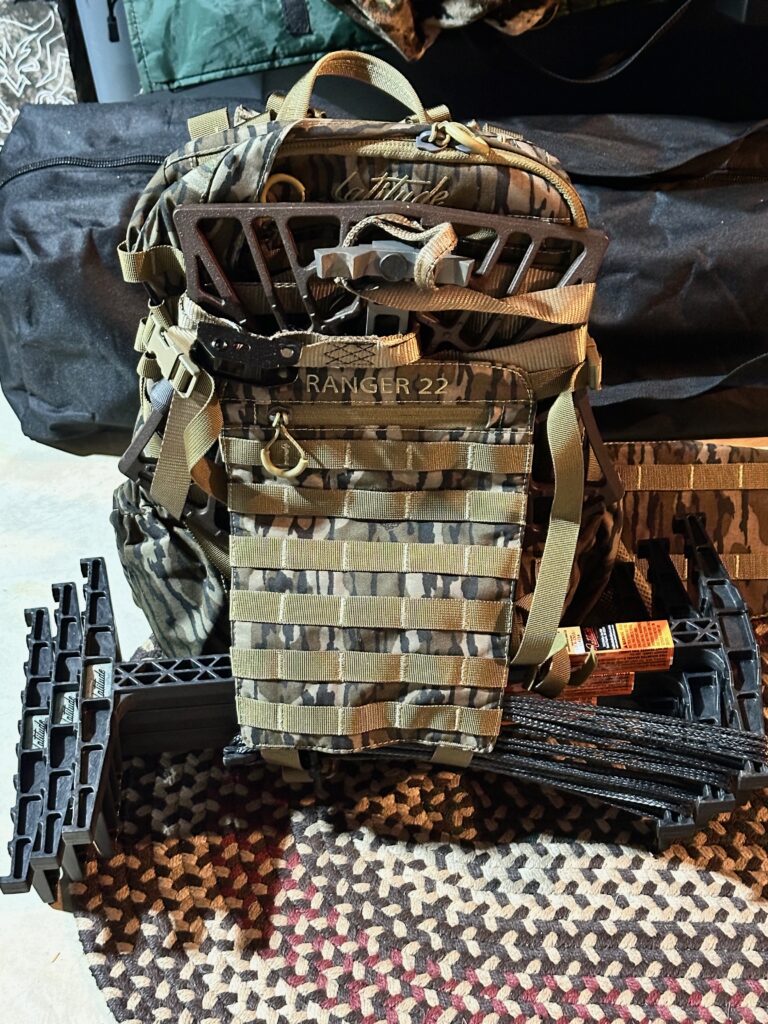
Here is where I land. The Latitude Ranger 22 is the pack I would choose for my normal saddle setup right now. If I expect a heavier load or want real pack-out capability, I would choose the Mystery Ranch Pop Up 30. The Eberlestock X2 gives me the most enclosed room, and the Trophyline CAYS 2.0 makes the most sense when organization is the main problem.
That is why I would not pick one of these packs by capacity or pocket count alone. Start with the bottom line below and match the pack to the job. Then I will show you what happened when I used them with a real saddle setup, where each one gave something up, and what changes when you add late-season clothes, camera gear, or the possibility of a heavy walk out.
THE BOTTOM LINE
Choose the Saddle Hunting Pack by the Job
These are the four clearest starting points. Each one solves a different problem, so the best choice depends on what you carry and what you may ask the pack to do after the shot.
BEST SADDLE-SPECIFIC SYSTEM
Latitude Ranger 22
The cleanest purpose-built choice for carrying my normal saddle setup through most of the season. The platform, sticks, and pack work together without forcing me to invent attachment fixes.
Best for: A complete saddle system and normal whitetail loads.
Skip it if: You need a true meat shelf or heavy-load frame.
BEST FOR HEAVY LOADS
Mystery Ranch Pop Up 30
The better fit when you want one mobile hunting pack that can carry a normal hunt load, then open into a load shelf when the job gets heavier.
Best for: Hunters who value load support and pack-out capability.
Skip it if: A quiet, compact tree pack is the main goal.
BEST HIGH-CAPACITY OPTION
Eberlestock X2
The most enclosed capacity in this group and one of the two packs I would consider when the load may go well beyond a basic saddle setup.
Best for: Extra clothing, camera gear, and larger loads.
Skip it if: You want a light, purpose-built saddle pack.
BEST ORGANIZATION
Trophyline CAYS 2.0
A good fit when you want a place for each part of the saddle setup and quick access matters more than heavy-load capability.
Best for: Hunters who want organized access at the tree.
Skip it if: You need a pack-out frame or a minimalist system.
Need the quietest pack in the tree? The Mystery Ranch Treehouse 20 remains my quietest option, but availability has been inconsistent. Check current Treehouse 20 availability or read my field review.
Compare the Packs Side by Side
On a phone, each row becomes a card so you can compare the details without dragging a wide table sideways.
| Pack | My Verdict | Capacity | Weight | Heavy-load or Pack-out Capability | Current Options |
|---|---|---|---|---|---|
| Latitude Ranger 22 | Best saddle-specific pack | 22L | 4 lb. 2 oz. fully configured | No dedicated meat shelf | See Ranger 22 options |
| Mystery Ranch Pop Up 30 | Most versatile | 30L | 4.9 lb. | Yes—expandable frame and load shelf | Check availability |
| Eberlestock X2 | Best high-capacity option | 2,450 cu. in. | 5.5 lb. | Yes | See X2 options |
| Trophyline CAYS 2.0 | Best organization | About 2,000 cu. in. | About 4 lb. | No | Check availability |
| Trophyline Palisade | Best structured compact option | 1,600 cu. in. | 3.9 lb. | No | Check availability |
| Mystery Ranch Treehouse 20 | Quietest in the tree | 1,275 cu. in. | About 3 lb. | No | Check availability |
| Elevation Mobile Hunter 1100 | Compact traditional pack | 1,100 cu. in. | About 2.5 lb. | No | See current options |
How I Evaluate Saddle Hunting Packs
I do not rank a saddle hunting pack by counting pockets or repeating the manufacturer’s feature list. I want to know how the pack performs through the complete hunt.
- How securely it carries climbing sticks and a platform
- Whether the load shifts, catches brush, or creates unnecessary noise
- Comfort during short and long walk-ins
- Stability with early- and late-season clothing loads
- How quickly I can remove the sticks and platform in the dark
- Whether important gear is accessible without digging
- How quietly it works once I am in the tree
- Whether it can carry heavier loads or help pack out an animal
My basic rule is simple: everything should come out of the pack in the same order and return to the same place. I want to work under a headlamp without stopping to think about where something is located.
Latitude Outdoors Ranger 22 Review — Best Saddle-Specific Pack
The Ranger 22 is the pack that made me rethink my top recommendation.
It has enough room for a legitimate saddle hunting setup without feeling like a big western hunting pack. I can carry my normal gear, extra clothing, and the other things I need through most of the season. The removable waist belt, compression panel, and frame stays also let me strip the pack down or build it back up depending on the hunt.
The compression panel is one of the most useful parts of the design. It gives me a secure place for my platform, sticks, or bulky clothing without having loose equipment hanging everywhere.
Watch my Ranger 22 carry setup to see how I pack and organize it with the rest of my saddle hunting gear. The video starts at the Ranger 22 section at 8:48.
Why I Like the Latitude System
I’ve used the Profile Platform for two years, and I love it. I’m also using Latitude Carbon SS climbing sticks. Adding the Ranger 22 showed me how much thought Latitude has put into making its products work together.
The pack, platform, and sticks don’t feel like three unrelated products. They feel like parts of one system. That matters to me because I don’t want to waste time creating workarounds just to carry my equipment into the woods.
I’m not recommending the Ranger simply because I like the other Latitude products. I like it because the quality is good, the system is well integrated, and it made my complete mobile setup easier to manage.
If you want the product-by-product breakdown behind that system, read my full Latitude Outdoors saddle hunting system review. It covers what I would buy again, what is optional, and where the setup falls short.
What I Like
- Enough capacity for most of the season without feeling oversized
- Removable waist belt, compression panel, and frame stays
- Secure way to carry a platform and climbing sticks
- Clean exterior without a lot of loose equipment
- Works extremely well with my Latitude platform and Carbon SS sticks
Where It Falls Short
- It isn’t designed to pack out a deer
- A true minimalist hunter may not need 22 liters
- Hunters using a completely different stick-and-platform setup may need to adjust the attachment system
Best for: Saddle hunters who want one purpose-built pack that can handle most of the whitetail season.
Skip it if: You need a true meat-hauling frame or carry almost no equipment.
Check out the Latitude Ranger 22 here
What About the Ranger 11 and Ranger 33?
I’ve only field-tested the Ranger 22. I haven’t tested the Ranger 11 or Ranger 33, so I’m not going to pretend I can review them. They are worth mentioning because they give hunters a smaller and larger option built around the same basic idea.
The Ranger 11 is the more minimalist version. It has 11 liters of storage and weighs about 2 pounds. On paper, it makes the most sense for short hunts, early season, scouting, or hunters who carry their platform and sticks separately. See the Ranger 11 here.
The Ranger 33 goes in the other direction. It has 33 liters of space and is better suited to bulky late-season clothing, camera equipment, and all-day sits. More storage doesn’t make it a meat hauler, though. It still doesn’t have the load shelf you get with the Pop Up 30. See the Ranger 33 here.
For the way I hunt, the Ranger 22 looks like the sweet spot. It’s also the only Ranger pack I’ve personally tested.
Mystery Ranch Pop Up 30 Review — Most Versatile
The Pop Up 30 surprised me.
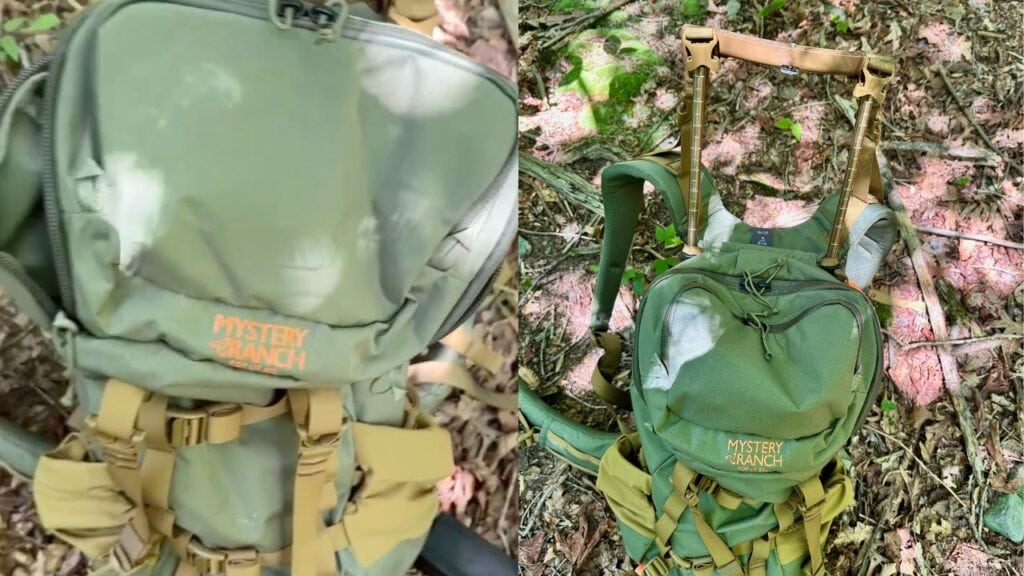
It isn’t a saddle-specific pack. It’s a compact 30-liter daypack with a telescoping frame and load shelf. During the hunt, it doesn’t feel like I’m carrying a huge load-hauling pack. If I need it, though, the frame opens up and gives me the ability to carry much more weight.
That flexibility is what makes the Pop Up 30 different. I can use it for a normal mobile hunt, carry extra cold-weather clothing or camera gear, and still have a legitimate way to handle a heavy load after the shot.
The Pop Up 30 and Eberlestock X2 are the only two packs in this comparison I would consider for helping pack out a deer. The Pop Up is especially impressive because it gives me that capability without feeling excessively large during the hunt.
How I Attach My Platform
I use the Mystery Ranch Quick Attach Accessory Straps to mount my saddle platform to the pack. This is a simple change, but it made the setup much better.
The longer straps give me more room to position the platform and lock it down. It stays tighter against the pack and is easier to attach than it was with the standard setup.
These are the Quick Attach Accessory Straps I use.
What I Like
- Compact enough to use as a normal daypack
- Telescoping frame and load shelf
- Handles much heavier loads than a saddle-specific pack
- Enough room for clothing and camera equipment
- The Quick Attach straps make platform attachment much better
- One of the only packs here that can help pack out a deer
Where It Falls Short
- Heavier and more expensive than a small saddle pack
- The standard setup wasn’t designed specifically for carrying a saddle platform
- Current availability can be difficult
- More pack than you need for a stripped-down early-season hunt
Best for: Hunters who want one compact daypack that can carry a normal saddle setup and still handle heavy loads.
Skip it if: You don’t need the frame and carry only a lightweight setup.
Check current Pop Up 30 availability

Eberlestock X2 Review — Best High-Capacity Pack
The Eberlestock X2 is a workhorse. At 2,450 cubic inches, it’s got enough capacity to haul climbing sticks, a saddle platform, camera gear, cold‑weather layers, and even meat out of the woods.
This pack has an internal aluminum frame, MOLLE webbing that blends into the camo, big external bottle pockets, and a breathable mesh back panel that keeps you cooler on warm‑weather hunts. Plus, a comfortable waistband that provides all the support you need for long hikes.
Story from the field:
I ran the X2 on long‑distance public land hunts where I had to hike in for miles to my spots in the dark. The pack’s layout changed my entire SOP. Everything went in the same place every time so I could work in the dark without fumbling. After one morning hunt, I quartered a deer in the field, strapped the meat to the frame, and still had room for my sticks and platform. That’s the kind of capability you don’t get with smaller minimalist packs.
Best for: Long‑distance hunts, heavy loads, hunters who might pack meat out.
Cons: Can be a little noisy when handling areas of the pack that have waterproofing.
Check out the Eberlestock X2 Here.
Trophyline CAYS 2.0 Review — Best Organization
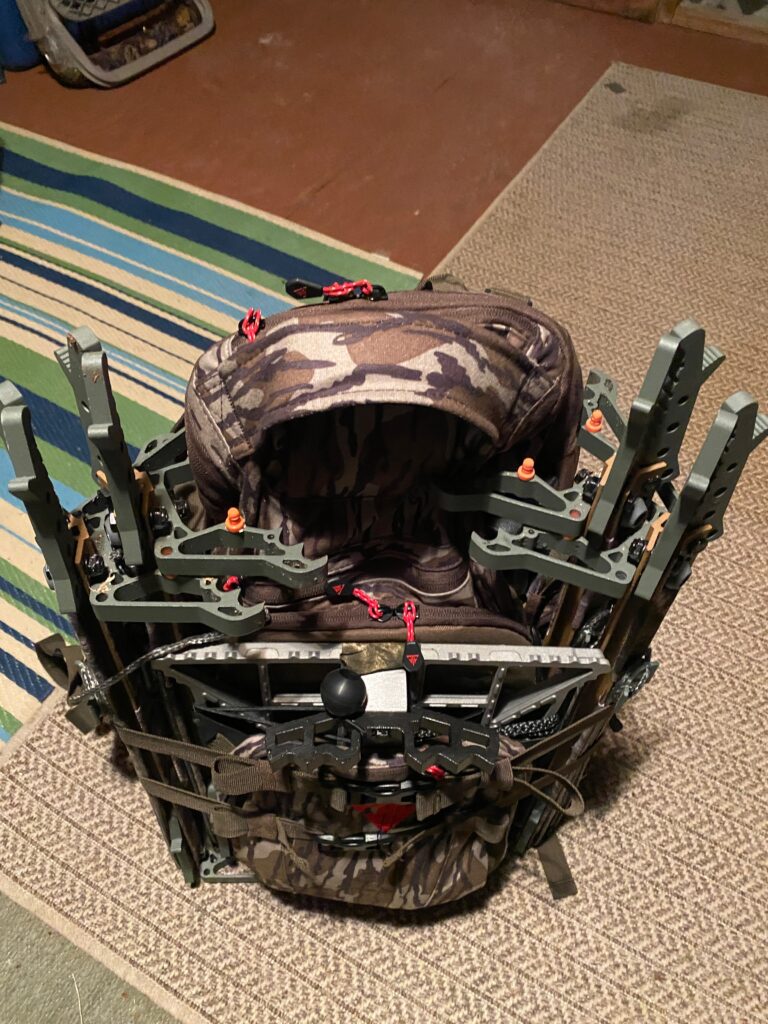
The Trophyline CAYS 2.0 is purpose‑built for saddle hunters. With a waist belt for load‑bearing and around 20 pockets, it carries sticks and a platform with ease while keeping gear organized. At 1900 cubic inches, this pack gives you a lot of space in a small footprint.
The strap system makes getting sticks and platforms off the pack quick and quiet, and the pocket layout gives you a spot for everything; from rangefinders to extra gloves. It rides great and is purpose built for saddle hunting.
Story from the field:
I ran this pack for an entire season, and the waist belt saved my shoulders on long hikes in. My tree setup got faster too. I could pop the straps, grab my sticks and platform, and start climbing without digging. Once in the tree, it hung open on my right side so I could grab calls, scent wipes, or a camera arm without moving much.
Best for: All‑day sits, hunters who want max organization and comfort in the tree.
Cons: Not a rigid pack.
Check current CAYS 2.0 availability.
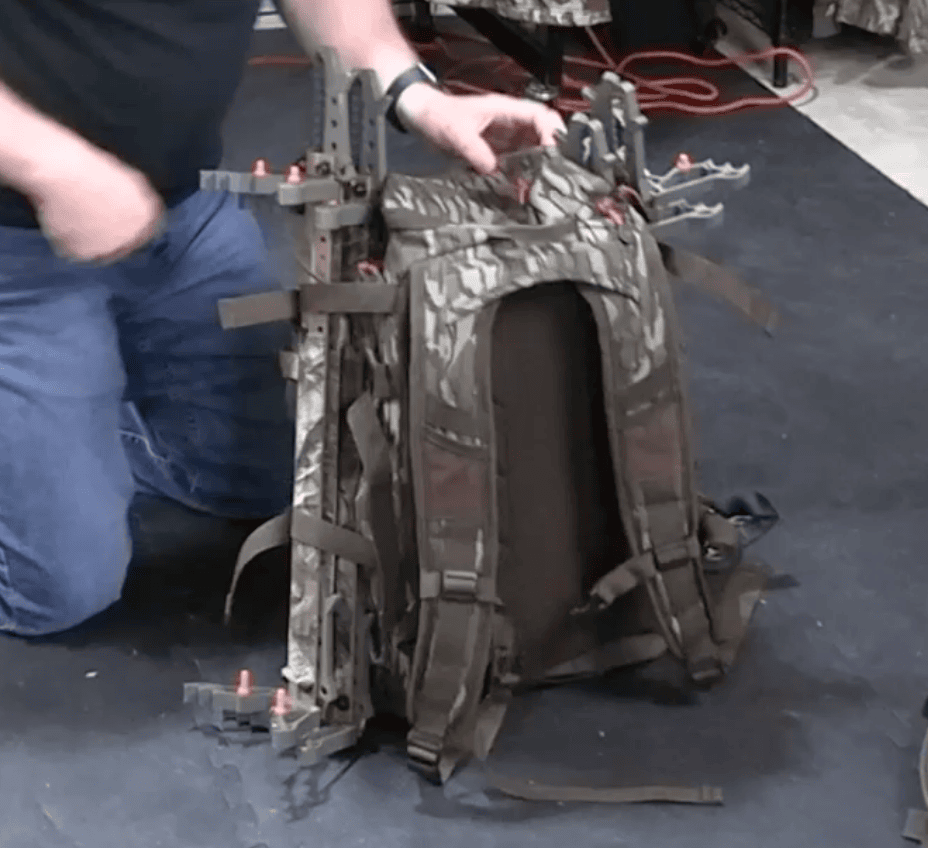
Trophyline Palisade Review — Best Structured Compact Pack
The Palisade is the CAYS 2.0’s lighter sibling. It’s an “EVA Molded Foam Body & Bucket Fill Design” pack that drops the waist belt but adds an EVA molded front pocket to protect fragile gear like cameras or binoculars. At 1,600 cubic inches and 3.9 pounds, it’s built for a more minimalist saddle hunter. This is one of my favorite packs.
Story from the field:
I moved to the Palisade after a season with the CAYS 2.0. The molded foam body was a big win for my camera and other sensitive gear, but I did miss the waist belt on longer walk‑ins. The side straps held my Tethrd Skeletor climbing sticks securely, and the pack still rode comfortably, even loaded with a platform and cold‑weather layers.
Best for: Minimalist saddle hunters who still want structured protection for gear.
Cons: No waist belt for carry stability when carrying heavier loads.
Check current Palisade availability.
Mystery Ranch Treehouse 20 Review — Quietest in the Tree
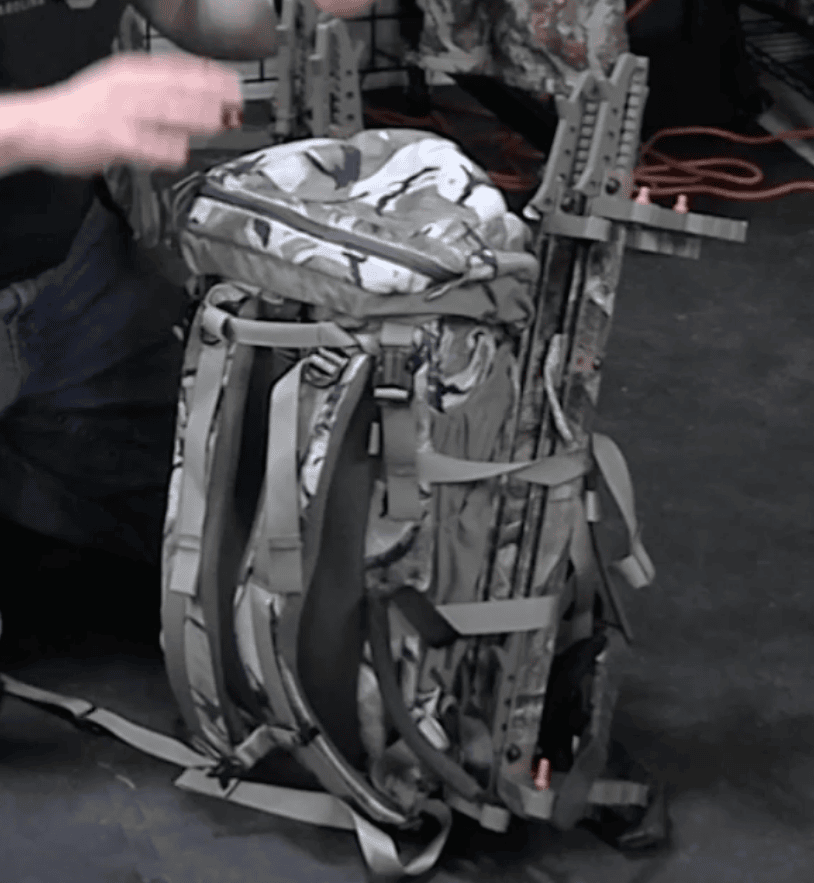
The Treehouse 20 is the quietest pack here. It’s treestand‑focused but works well for saddle hunting if you value stealth over capacity. At 1,275 cubic inches, it’s the smallest so far, but its soft exterior and deep elastic pockets keep noise down when you’re reaching for gear.
It can carry your sticks and platform, but is even better in the tree. One of the best treestand/ deer hunting specific packs I’ve tested.
Story from the field:
My brother Dan ran this pack last season. One morning we had deer feeding 40 yards away while he reached for gear, no zippers, no noise, no problem. The trade‑off is capacity; you have to be disciplined with what you carry. But if quiet matters most, it delivers. *Dan loves this pack.
Best for: Stealthy treestand hunts in close‑quarters situations. This is a very quiet pack. Great for in tree use.
Cons: Can collapse on itself due to lightweight setup. Outer pockets are not secure due to elastic pocket setup. No waist belt.
Availability note: Mystery Ranch currently does not provide an estimated restock date for the Treehouse 20. Check current availability.
*Note: The Mystery Ranch Treehouse 38 pack has a waist belt and has 2370 cubic inches of space.
Elevation Mobile Hunter 1100 Review — Compact Traditional Pack
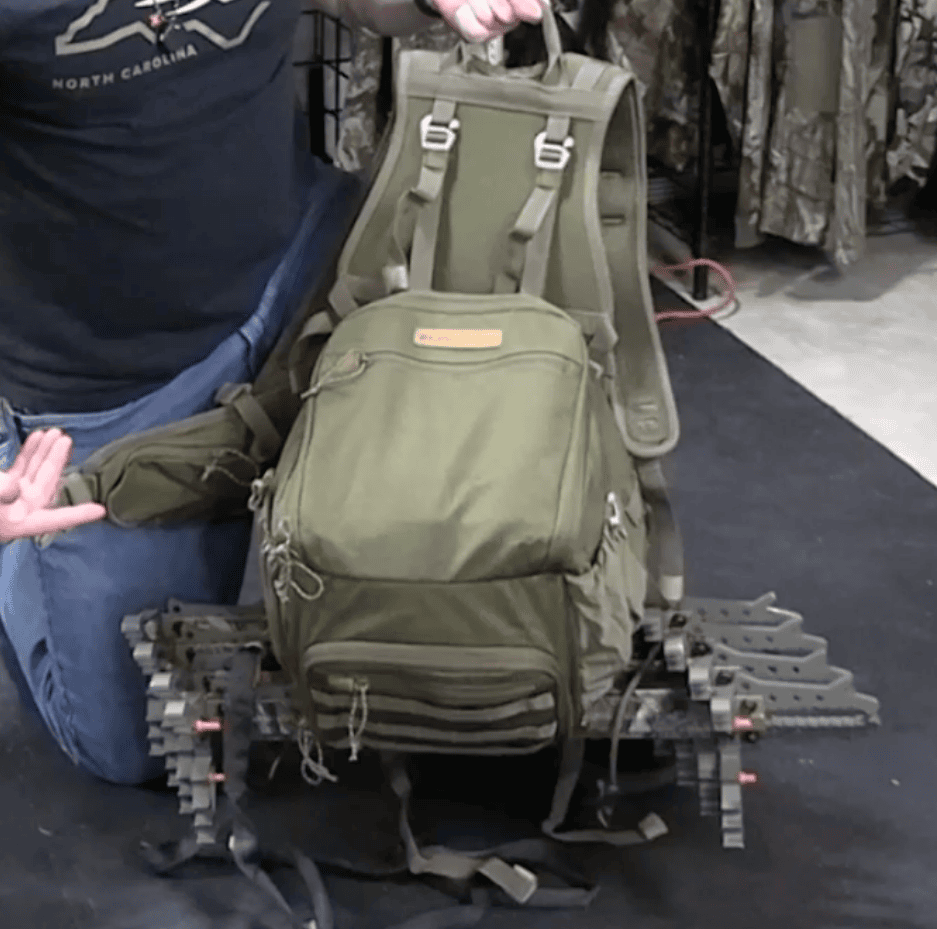
At 1,100 cubic inches, the Elevation Mobile Hunter 1100 is the smallest pack in this lineup. It’s built for speed and flexibility, with multiple carry configurations and a waterproof bottom to handle wet ground. The waist belt and shoulder straps are built to carry a heavy load, so even on a minimalist setup, it rides great.
You can strap a platform between the pack and harness and run climbing sticks underneath. You can use it for a hang and hunt mobile stand as well. It’s a true run‑and‑gun design.
Story from the field:
I used this pack as a compact mobile setup. It’s fast to deploy, and the waterproof bottom is a nice touch for setting it down on damp ground. The stick placement takes some getting used to, and I’ll be watching how it holds up over a full season, but for lightweight mobility, it’s tough to beat.
Best for: Run‑and‑gun hunters who want the lightest setup possible.
Check out the Elevation Mobile Hunter 1100 here.
New Saddle Hunting Packs I Want to Test
The packs below look promising based on their designs and published specifications, but I have not carried them through my complete saddle hunting setup. They are not included in my rankings.
CRUZR Escape 2.0 Pack — View the Product
The CRUZR Escape 2.0 Pack gets praise for being durable, lightweight, and purpose-built for saddle hunters. Its compact profile and streamlined carry interest me, but I still need to evaluate it with a full platform-and-stick setup, late-season clothing, and camera equipment before recommending it.
When I test additional packs, I will evaluate their load stability, noise, stick and platform attachment, snag resistance, in-tree access, and performance with early- and late-season loads.
Minimalist Saddle Hunting Pack Options
Minimalist saddle hunting doesn’t always require a traditional backpack.
If you only carry a platform, sticks, saddle gear, water, and a few essentials, a platform pack may make more sense than buying the smallest regular backpack you can find. I haven’t tested all of the options below, so I’m not naming a winner. These are the systems that look the most useful to me right now.
Latitude Ranger 11
The Ranger 11 is the smallest traditional backpack in the Latitude family. It gives you 11 liters of enclosed storage and weighs about 2 pounds. It looks like the best fit for short hunts, warm weather, scouting, or hunters who carry their sticks and platform separately. I haven’t field-tested it. See the Ranger 11 here.
Latitude Profile Platform Pocket
This is the most stripped-down Latitude option. The regular version weighs 15 ounces and is designed to carry a platform and up to three Carbon SS climbing sticks. It can be used by itself or attached to a Ranger pack. Since I already use the Profile Platform and Carbon SS sticks, this is the minimalist setup I’m most interested in trying. See the Profile Platform Pocket here.
Latitude Flyer Pack
The Flyer is a six-liter minimalist pack with an aluminum and carbon-fiber frame. It weighs 2 pounds, 15 ounces, so it’s much heavier than a platform pocket but should provide better structure and load support. I haven’t tested it, and six liters may or may not be enough once real hunting conditions change. See the Flyer Pack here.
Tethrd Universal Platform Pack
The Universal Platform Pack can be worn by itself or attached to a larger backpack as a compression panel. It carries the platform inside the semi-rigid pack and has bottom straps for climbing sticks. The regular version weighs 1 pound, 7 ounces. I haven’t tested it, so I’m listing it as an option rather than recommending it. See the Tethrd Universal Platform Pack here.
Tethrd Workhorse Platform Pack
The Workhorse uses the same basic idea. You can wear it as a standalone platform carrier or attach it to another pack. I would want to compare it directly against the Universal Platform Pack before deciding whether the lower price comes with any meaningful tradeoffs. See the Workhorse Platform Pack here.
Trophyline Platow Pack
I haven’t tested the Trophyline Platow Pack, but it looks like a good option for hunters who want to stay minimalist without giving up all the organization of a traditional backpack. It provides 1,200 cubic inches of storage and weighs 2.6 pounds, with dedicated loops for carrying a platform or small treestand and cinch straps for climbing sticks, clothing, or other bulky gear.
It is more substantial than a simple platform pack, but it could be a good middle ground for hunters who want to carry the essentials without moving into a full-size saddle hunting pack. See the Trophyline Platow Pack here.
My take: The Ranger 11 is a small conventional pack. The Profile Platform Pocket and Tethrd options are true platform carriers. The Flyer sits between those ideas by adding a frame and a small amount of enclosed storage. The Platow Pack appears to be pure minimalist. I’m not picking a winner until I’ve carried them as complete hunting setups.
Why Pack Setup Matters for Mobile Hunting
In mobile hunting, efficiency kills. I’ve seen hunters waste 10 minutes in the dark untangling straps or digging for gear. This is time that deer use to get past them (or hear them).
My rule: everything goes into the pack the same way it comes out. I want to be able to set up under a headlamp without thinking. That’s why climbing stick and platform carry systems matter. They save time, keep noise down, and let you focus on the hunt.
Which Saddle Hunting Pack Should You Choose?
- Choose the Ranger 22 if you want the best purpose-built saddle hunting pack and value system integration.
- Choose the Pop Up 30 if you want the most versatility and need heavy-load or pack-out capability.
- Choose the X2 if you want more enclosed capacity and proven meat-hauling performance.
- Choose the CAYS 2.0 if organization is your highest priority.
- Choose the Treehouse 20 if in-tree silence matters more than capacity.
- Choose the Palisade if you carry cameras or sensitive gear and want a structured pack.
- Compare the minimalist systems if your priority is eliminating pack weight and bulk.
Final Verdict
If I were choosing one pack specifically for saddle hunting, I would start with the Latitude Outdoors Ranger 22. Its capacity, organization, adjustability, and integration with a complete saddle hunting system make it the strongest purpose-built option I have tested.
If I needed one pack capable of handling everyday saddle hunts and much heavier loads, I would choose the Mystery Ranch Pop Up 30. Its ability to remain relatively compact and then transform into a load hauler gives it flexibility the Ranger cannot match.
If I needed the most enclosed capacity and wanted a pack I have already used to carry meat, the Eberlestock X2 would remain my choice.
Those are three different jobs. The right answer depends on which job matters most to you.
CONTINUE YOUR MOBILE HUNTING SYSTEM
Your Next Steps
Evaluate this piece as part of the load you carry, deploy, and use—not as a stand-alone product.
1. Review My Complete Saddle Setup
Start with the full system before choosing the pack that carries it.
2. See the Climbing Sticks I Use
Compare another major part of the mobile setup.
3. Review My Current Gear List
See how the complete loadout fits together.
Part of the Everyday Bow Hunter System
Want to see exactly what I’m carrying this season? Check out my Personal Bowhunting Gear List for 2026