
Most bowhunters are unknowingly shooting arrows that are too light for their setup. It’s like putting .22 rounds in a .45-caliber pistol. The shot goes off, but the power is wasted, and the performance just doesn’t show up where it counts.
I see this every week in the Arrow Speed, KE, and Momentum Calculator here on my site. Guys shooting 70 or even 80-pound bows, with 340+ IBO ratings, and punching in arrows under 425 grains. On paper, it looks fast. But in the field, it’s noisy, underpenetrating, and flat-out inefficient.
Let’s break down what’s happening and how to fix it fast using the Everyday Arrow Weight Formula.
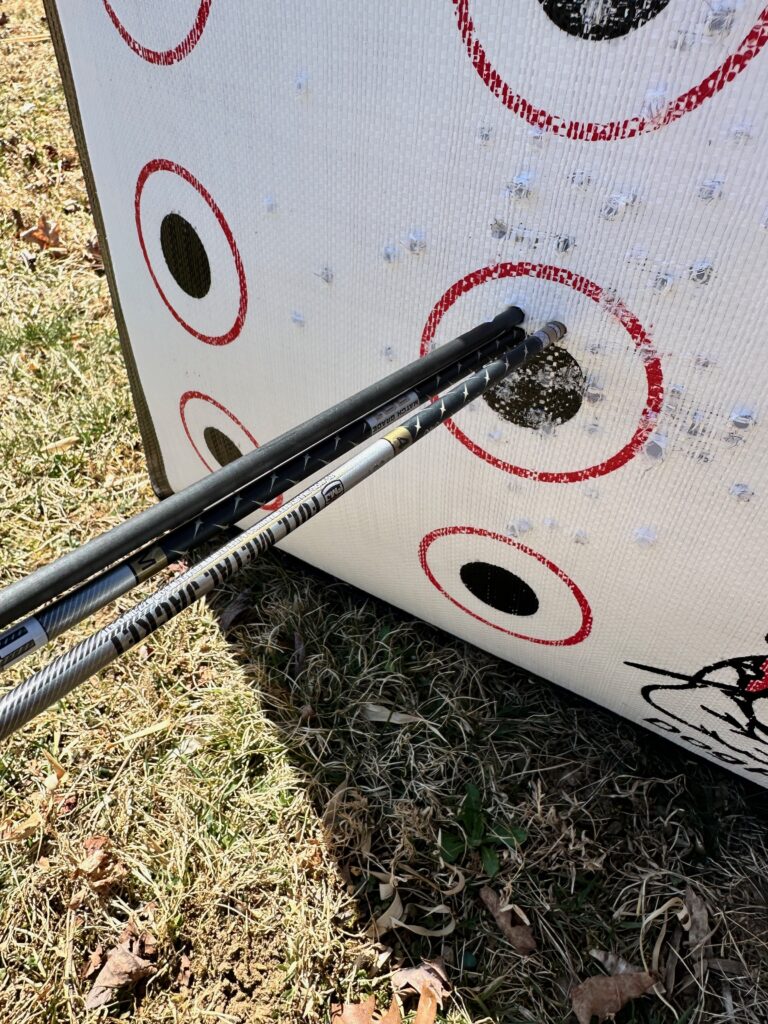
Speed Doesn’t Mean Efficiency
Arrow speed is often misunderstood as performance. But speed by itself is just one piece of the puzzle.
When you shoot an arrow that’s too light:
- You leave stored energy in the bow that doesn’t transfer to the arrow
- That leftover energy becomes noise, vibration, and wear
- You lose momentum, which directly impacts penetration
- You create a flatter trajectory, but with less control and stability
- You’re shooting a 70 lb bow like it’s a 60 lb bow
In simple terms, your bow is doing work it’s not getting credit for. You built a power curve capable of launching a high-performance projectile and instead, you’re flinging a toothpick.
Dialing In Weight: I use this $15 digital arrow scale to weigh every finished arrow. It’s cheap, accurate, and hasn’t failed me yet.
The Physics: Same KE, But Totally Different Outcomes
You might hear, “My 375 grain arrow has the same Kinetic Energy (KE) as your 450.”
Sure.
Kinetic Energy = ½mv². So a lighter arrow going faster can produce similar KE.
But kinetic energy drops fast with distance. Lighter arrows shed energy quicker. Heavier arrows carry it further, hit harder, and tune better. They’re quieter and more stable in flight.
The real predictor of penetration is momentum and heavier arrows always win that fight. Learn the Physics of Arrow Penetration here.
The Sound Factor
Lighter arrows don’t absorb enough of the bow’s stored energy. That extra energy has to go somewhere. It comes out as:
- String slap
- Riser vibration
- Sharp noise spikes deer pick up fast
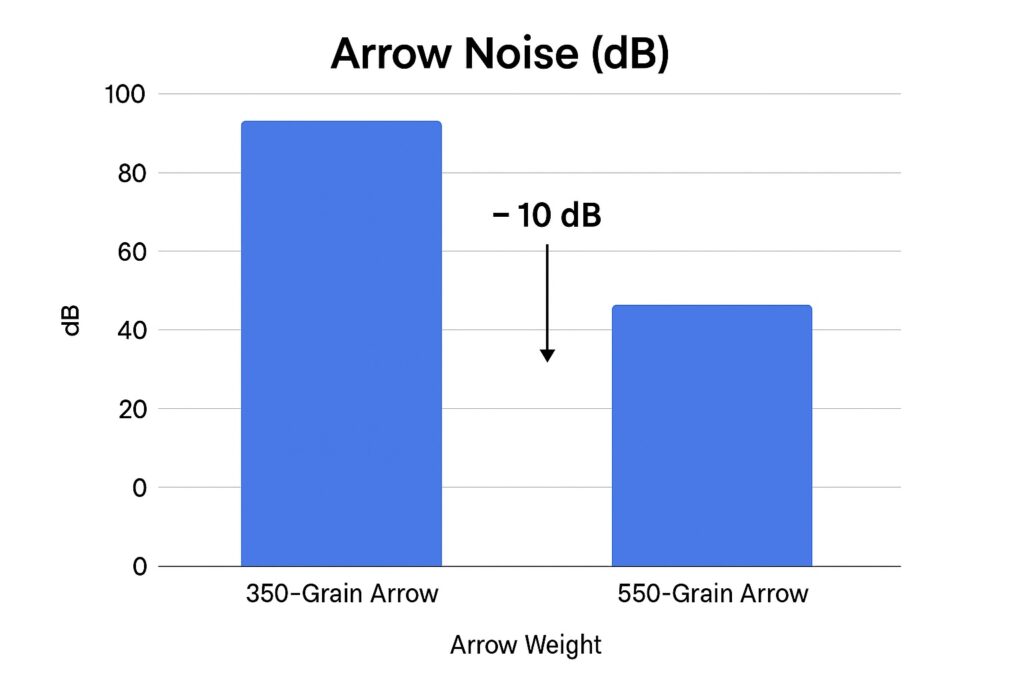
Heavier arrows soak up more of the bow’s output — making your shot quieter, deadlier, and less prone to string jump.
Here’s a quick comparison from real-world test data:
The Fix: Match Your Arrow to Your Bow’s Power Curve
Most bows over 60 pounds of draw weight are built for arrow weights in the 450–550 grain range.
That’s where you maximize:
- Energy transfer
- Sound suppression
- Penetration
- Broadhead flight
- Durability
If you’re shooting below that, especially under 425 grains, you’re giving up nearly everything that makes your setup deadly.
What About Trajectory?
This is where most guys push back.
They say, “Yeah, but won’t a heavier arrow drop too much?”
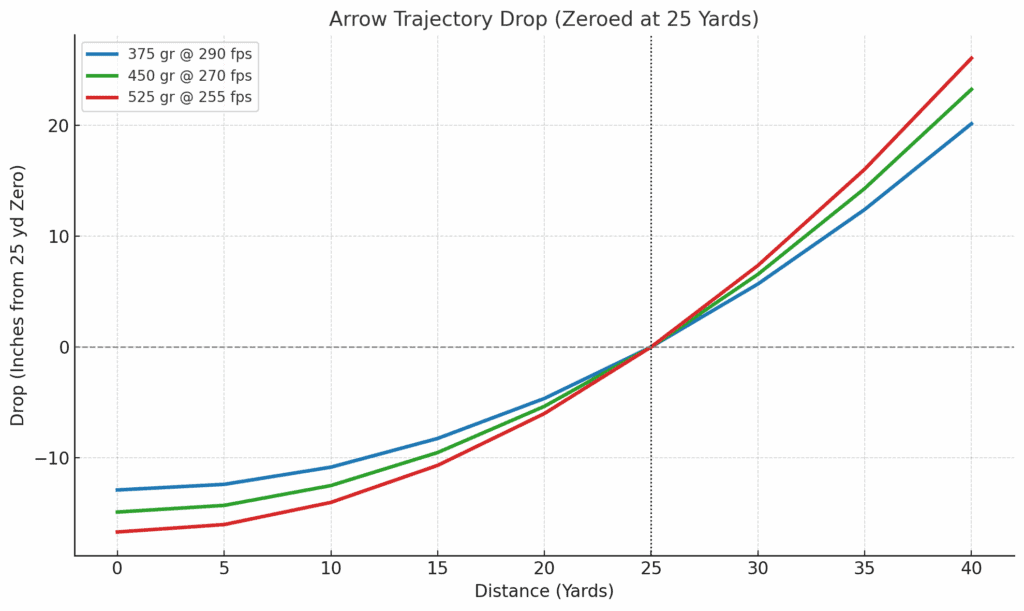
Here’s the truth. Not inside 30 yards.
I zero my bow at 25 yards because that’s the shot window I train for. It’s where most of my encounters happen in the real world. And guess what?
Even with a 500+ grain arrow, I’m still within about 2 inches of point of aim from 15 to 30 yards.
If you’re shooting a properly tuned arrow that matches your bow’s power curve:
- At 15 yards, your arrow will hit slightly high
- At 25 yards, it’ll be dead-on
- At 30 yards, it’ll be maybe an inch or two low and well within the kill zone
That’s not a problem. That’s precision.
And the bonus? Heavier arrows fly better in the wind, they group tighter at real ranges, and they hit with authority.
Unless you’re flinging long shots out West and you know how to compensate for drop, you’re not losing anything. You’re gaining control.
⚠️ Real-World Example: Wasted Momentum, Missed Potential
Is This You?
Here’s an actual setup one hunter submitted through my arrow calculator:
- Bow Specs: 70 lbs, 27.5” draw, 342 IBO bow
- Arrow Weight: 420 grains
- Arrow Speed: 281.6 FPS
- Kinetic Energy: 73.97 ft-lbs
- Momentum: 0.525 slugs
- Speed at 30 yards: 252 FPS
- Momentum at 30 yards: 0.437 slugs
Sounds good, right?
But here’s the problem…
👉 That’s a 70-pound bow with over 90 ft-lbs of stored energy potential and this arrow is only converting about 74 ft-lbs of that into KE and just barely crossing into momentum territory that I’d consider minimum viable for shoulder shots or heavy bone.
Now imagine this:
- Add 60–70 grains up front
- Drop your speed to 265–270
- And your momentum jumps to 0.580+
- Your bow gets quieter
- And the arrow actually penetrates deeper, even with similar KE
This is why arrow weight isn’t about math on a screen. It’s about real-world energy transfer, inertia, and how your bow’s power curve is being used.
Not Sure Where You Stand?
That’s exactly why I built the Everyday Arrow Weight Formula. It takes your bow specs and helps you choose an arrow weight that:
- Matches your draw weight and draw length
- Stays efficient inside 30 yards
- Maintains energy and momentum
- Keeps your shot quiet and deadly
Whether you’re a mountain hunter with longer shots or a treestand bowhunter with close-range encounters, the formula gives you a range, not a single number, so you can build arrows that actually work with your setup.
Not Ready for a Full Arrow Overhaul?
If you’re reading this and thinking, “I don’t want to rebuild my whole setup right now,” that’s fine.
Here’s a simple starting point: 👉 Add 25 grains up front.
That could mean:
- Swapping a 100-grain broadhead for a 125
- Using a heavier insert
- Or even a screw-in weight behind your point
This small increase won’t throw off your tune in most cases, and it gives you two major benefits right away:
- More FOC. which helps your broadhead fly better
- More momentum and energy absorption, which makes your setup quieter and deadlier
And from there, you’ll have a baseline to test and feel the difference. Most guys who make the jump never go back.
Final Thoughts
I’m not here to sell you on heavy arrows for the sake of heavy. I’m here to help you stop wasting energy and start building arrows that hit like your bow was designed to hit.
If your current arrow weighs 385 grains and you’re drawing 70 pounds at 29 inches, I’m telling you flat out, you’re shooting a .22 in a .45 frame. You’re leaving penetration, stealth, and consistency on the table.
✅ Check Your Arrow Using the Everyday Formula
🔧 Then go fix it.
❓FAQ: Arrow Weight, Trajectory, and Your Bow’s Real Power
Want to see exactly what I’m carrying this season? Check out my Personal Bowhunting Gear List for 2025!