
Momentum matters when I compare hunting arrows because it shows how much motion the finished arrow carries through its combination of mass and speed. Within a practical range from the same bow, a heavier arrow normally gives up some speed but carries more momentum and has better penetration capability.
That does not make the heaviest arrow the right arrow for every hunt. A lighter arrow gives you a flatter path and more forgiveness when the yardage is not exact. A heavier arrow brings more mass and momentum to impact. The best all-around hunting arrow sits between those two ends, and that is what the Everyday Arrow Formula is built to help you find.
What Is Arrow Momentum?
Momentum is mass multiplied by velocity. For an arrow measured in grains and feet per second, the calculator uses:
Momentum (slug-ft/s) = arrow weight in grains × speed in fps ÷ 225,218
A slug-foot per second is dimensionally equivalent to a pound-second. I use slug-ft/s in the calculators so the same unit stays consistent across the Everyday Arrow System.
What Momentum Tells the Hunter
Momentum gives you a clean way to compare how arrow mass and speed work together. When two arrows come from the same bow, adding practical arrow mass normally lowers speed and raises momentum. You can see that tradeoff without pretending one number tells the whole story.
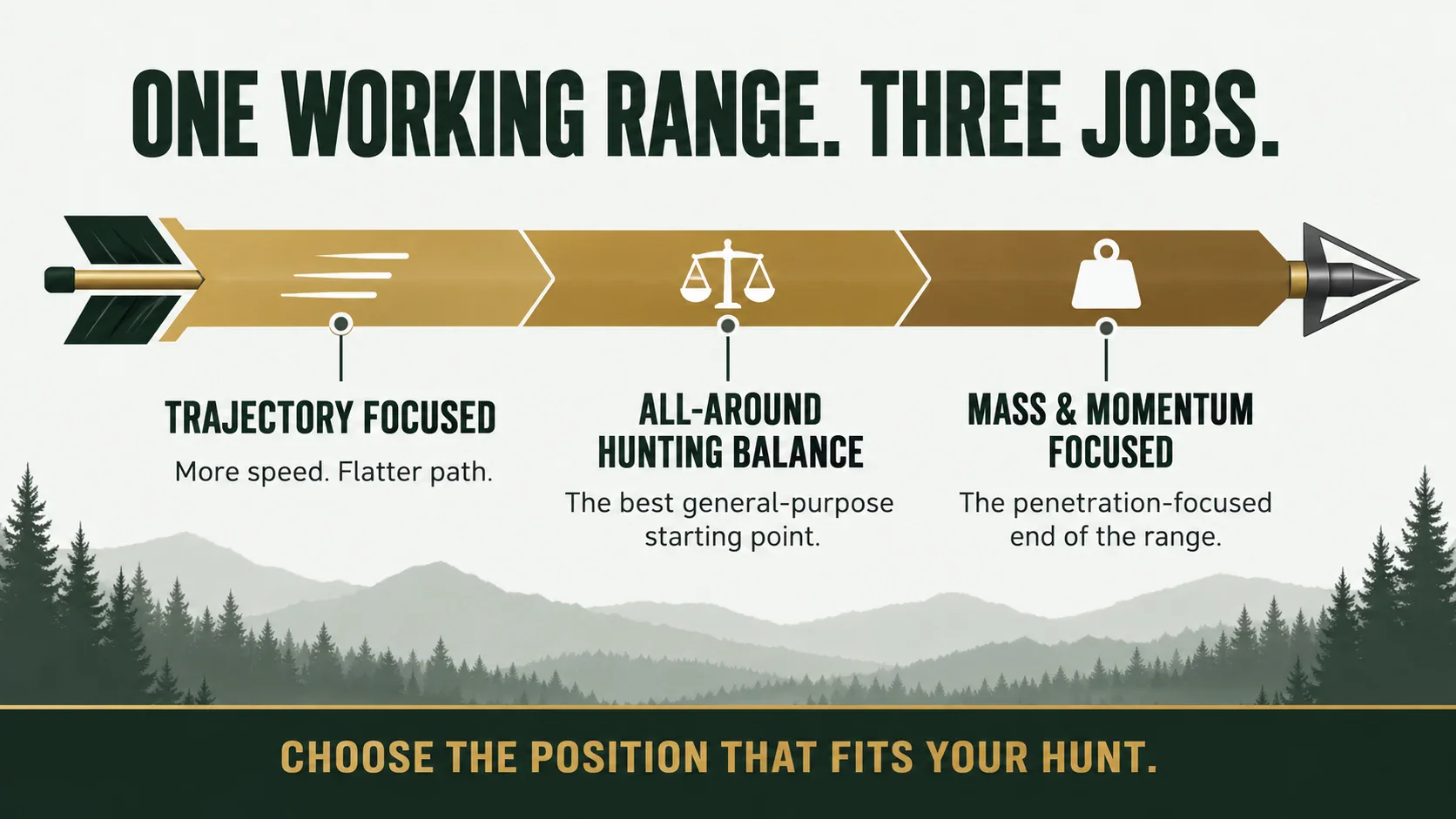
The current Formula uses one bow-specific Working Range with three useful jobs:
- Trajectory Focused: The lower end keeps more speed and a flatter path, but carries less mass and momentum.
- All-Around Hunting Balance: The Formula Target balances practical trajectory with enough mass and momentum for a dependable general-purpose hunting arrow.
- Mass and Momentum Focused: The upper end is the penetration-focused choice. It gives up more speed and trajectory margin to carry more mass and momentum into the animal.
One Bow, Three Valid Arrow Weights
Here is the same worked example used with the Arrow Performance Calculator: 320 fps IBO, 28-inch draw length, 60-pound draw weight, 20 grains on the bowstring, and a 30-yard normal shot distance.
| Build | Weight | Estimated speed | Launch KE | Launch momentum |
|---|---|---|---|---|
| Trajectory Focused | 435 gr | 242.2 fps | 56.69 ft-lbs | 0.468 slug-ft/s |
| All-Around Hunting Balance | 460 gr | 236.3 fps | 57.03 ft-lbs | 0.483 slug-ft/s |
| Mass and Momentum Focused | 485 gr | 231.6 fps | 57.76 ft-lbs | 0.499 slug-ft/s |
The 435-grain arrow is the fastest and has the flattest path. The 460-grain Formula Target is the best all-around starting point. The 485-grain arrow carries the most mass and momentum and has the best penetration capability of the three, while giving up some speed and trajectory margin. Notice that kinetic energy stays close across the entire range. That is one reason I want hunters looking at the complete performance picture instead of chasing one number.
Momentum Is Not Inertia
Inertia is an object’s resistance to a change in motion. Mass is part of that idea, but inertia is not a separate impact force carried by the arrow. Momentum and inertia are related concepts, but they are not interchangeable words.
Momentum Is Not Force
Force describes how momentum changes over time. Impact force depends on how quickly the arrow slows and how the arrow and target interact. Momentum tells us what the arrow brings to the impact, but the final result also depends on the broadhead, arrow flight, structure, alignment, impact angle, and resistance inside the animal.
Momentum vs. Kinetic Energy
Kinetic energy and momentum describe different parts of the same moving arrow.
- Kinetic energy changes with mass and the square of velocity.
- Momentum changes directly with mass and velocity.
- A lighter, faster arrow can carry similar kinetic energy to a heavier, slower arrow.
- The heavier arrow can carry more momentum at the same time.
That is exactly what the worked example shows. Kinetic energy barely moves, while momentum rises as arrow weight increases. For a hunting arrow, I want to understand both values, along with trajectory, broadhead design, FOC, dynamic spine, and the strength of the finished build.
How Momentum Supports Penetration
After impact, the arrow has to keep moving while the broadhead cuts and the shaft pushes through resistance. More practical arrow mass from the same bow normally raises momentum and improves penetration capability. A sharp, efficient broadhead, straight arrow flight, sound structure, and good alignment help the arrow use that advantage.
A controlled puncture study using arrows of identical shape in ballistic gelatin found kinetic energy was a better predictor of penetration than momentum or speed in that specific test. That result belongs to that projectile, target, and test design. A hunting arrow meeting hide, tissue, ribs, and changing impact angles is a more complicated system.
The Ashby reports add field observations about complete arrow systems, broadheads, structure, FOC, and impact outcomes. Taken together, the lab and field evidence point to the same practical lesson: do not separate momentum from the arrow that has to deliver it.
How I Use Momentum in the Everyday Arrow System
- Start with the Formula Target and its 50-grain Working Range.
- Compare arrows from the same bow setup.
- Look at speed, trajectory, kinetic energy, and momentum together.
- Choose the lower end when trajectory is the priority, the center for an all-around hunting arrow, or the upper end when penetration is the priority.
- Build the broadhead, FOC, components, and dynamic spine into the same plan.
- Build and tune one arrow before committing to the full batch.
The Formula does not change physics. It uses the hunter’s bow information to put a realistic working range around those physics. The hunter can then see exactly what is gained and what is given up when moving lighter or heavier.
The Bottom Line
Momentum is not a magic score, but it is an important hunting-arrow measurement. Within a practical range from the same bow, a heavier arrow normally carries more momentum and has better penetration capability. A lighter arrow normally carries more speed and gives you a flatter trajectory. The all-around Formula Target is the middle ground between those two useful ends.
That is the decision I want the Everyday Arrow System to make clear. You are not choosing between a good arrow and a bad arrow. You are choosing where you want your hunting arrow to put the emphasis.
Your Next Steps
Apply momentum to a real arrow build. Compare momentum with speed, trajectory, finished weight, components, FOC, and dynamic spine. Start with the Hunting Arrow Planner.
Use the Everyday Arrow System in this order:
- Find your bow-specific Formula Target and Working Range.
- Compare speed, kinetic energy, momentum, and trajectory.
- See how the complete arrow supports penetration.
Build one test arrow before you commit to a full batch. That is where the numbers become a real hunting setup.
Want to see exactly what I’m carrying this season? Check out my Personal Bowhunting Gear List for 2026