

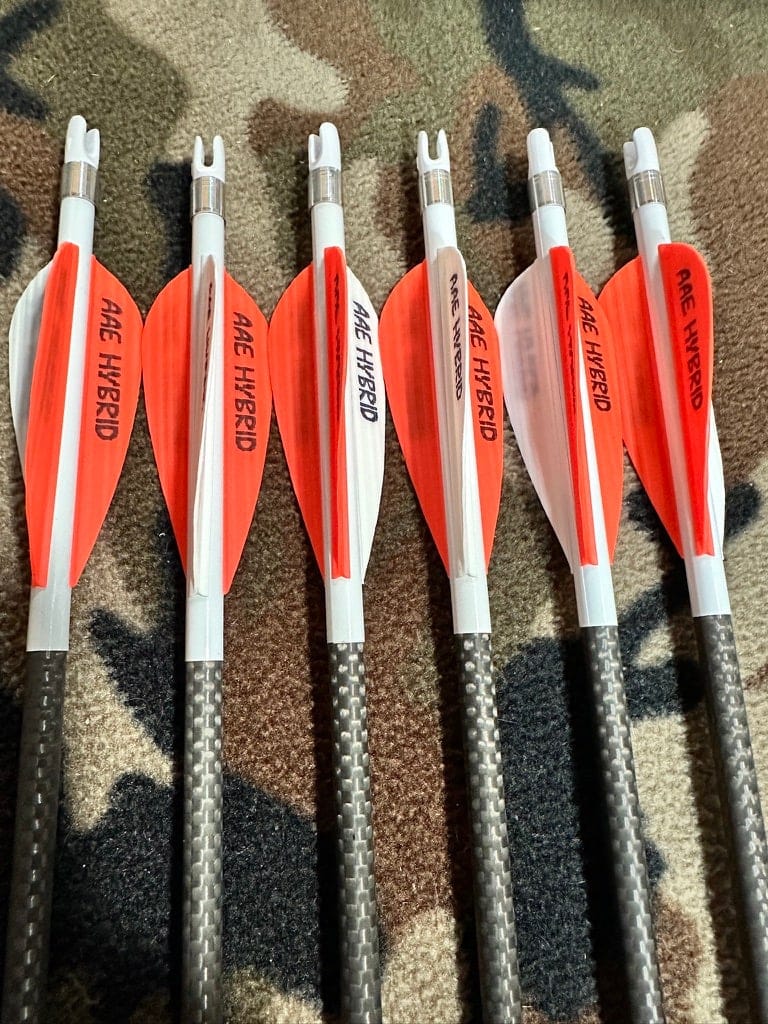
I had a set of custom arrows from Method Archery that I really liked. The arrows were good. The problem was the fletching.
Once I stretched those arrows past 40 yards, the installed vanes produced a slight whistle. I cannot identify the vane model, but the sound was clear enough that it pushed me to start testing AAE Hybrid 26 vanes.
The Hybrid 26 was quiet in my use. My four-fletch AAE Max Stealth setups were exceptionally quiet, too. The Max Stealth tradeoff was not sound. It was the additional drag that comes with putting four large vanes on the rear of an arrow.
For the way I hunt, that tradeoff made sense. Most of my shots are inside 30 yards. I only consider a 40-yard shot when the situation is very easy and clean. I wanted the added control behind my single-bevel broadhead, even if the fourth vane probably did not change much inside 30 yards once the complete arrow was properly tuned.
After reviewing Precision Cut’s direct three-versus-four Max Stealth comparison, I no longer think the fourth vane should be automatic. My next Max Stealth builds will start with three at two degrees. I will add a fourth only if the finished arrow proves it needs more control.
That is why I do not choose a hunting vane by length, brand, or popularity alone. The vane has to solve a job on the complete arrow. It must provide enough steering for the broadhead without adding more drag, rear weight, noise, or clearance risk than the hunt requires.
The first thing I would decide is how much steering the broadhead actually needs. That tells you whether to start with three vanes, add more angle, or accept the weight and drag of a fourth. From there, the Hunting Arrow Component Finder and Everyday Arrow Planner can help you compare the parts and see what each choice does to the complete arrow before you finish a full batch.
The Short Answer: Match the Vane to the Job
Start with three vanes when three provide enough control, clear the bow, and group the hunting broadhead. Add more vane area, angle, or a fourth vane only when it solves a real problem.
I purchased every vane discussed from my own funds. None was supplied by a vane manufacturer.
My practical starting points are:
- Inside 30 yards with a demanding single-bevel setup: My four-fletch AAE Max Stealth arrows at two degrees were exceptionally quiet and gave me the control I wanted. The direct three-versus-four data now gives me a better starting point: three Max Stealth vanes at two degrees, with a fourth added only if the finished arrow proves it needs more steering.
- A quiet three-fletch AAE path: Hybrid 23 and Hybrid 26 are the two Hybrid models I have used. Both were quiet in my experience; choose between them by profile, rear weight, clearance, and broadhead control rather than a supposed sound advantage at a particular distance.
- A familiar compact baseline: I used Bohning Blazer vanes for years in three-fletch setups. They worked, but they were louder than both AAE configurations in my experience.
- A longer-distance setup: I used the 2.75-inch TAC Driver in a straight three-fletch configuration.
No vane fixes a poor bow tune, wrong spine, fletching contact, loose broadhead, or crooked component. Fix the launch and alignment first. Then give the broadhead enough steering to prove itself.
Vanes I Would Compare First
These are not first-through-fourth rankings. They are different starting points for different jobs.
AAE Max Stealth: My Proven Setup and Why I Am Moving From Four to Three
AAE currently lists the Max Stealth at 2.8 inches long, 0.50 inch high, and 8.8 grains plus or minus 0.5 grain. Three vanes add a nominal 26.4 grains and four add 35.2 grains before the wrap, nock, bushing, or any other rear component. The Arrow Planner uses the rounded 9.0-grain nominal from AAE's vane selection chart.
I have used Max Stealth in four-fletch configurations. For my single-bevel builds, I normally apply them at two degrees. They were exceptionally quiet in my use and gave me the deliberate steering margin I wanted. The tradeoff beyond 40 yards was the added drag from four vanes, not a whistle.
Precision Cut’s 2025 matched Max Stealth comparison measured a 0.88951 drag constant and 15.05 inches of fixed-blade displacement for three vanes at two degrees. Four vanes measured 0.96869 drag and 14.47 inches of displacement. The fourth vane added 8.8 grains and about 8.9% more drag for a 0.58-inch average correction improvement at 70 yards. The correction confidence intervals overlapped, so the test did not establish a clear steering advantage for four.
The four-fletch setup was also slightly louder in that protocol: 56.0 dB versus 55.7 dB under the deer-weighted measurement. Based on that evidence, I will now start with three Max Stealth vanes at two degrees. Four remains an option when a matched test arrow shows that the broadhead needs more control.
Best for: Start with three when a tuned fixed-blade or single-bevel setup needs quiet flight and strong steering at normal bowhunting distance.
Use four if: A matched test arrow shows that three cannot maintain the broadhead control or forgiveness the hunt requires.
Skip the fourth vane if: Three already group the hunting broadhead with the field point and clear the bow.
System role: A quiet, high-control vane that should earn its count on the finished arrow.
If this control-first setup fits your arrow, check the current Fire Orange AAE Max Stealth pack and pricing.
AAE Hybrid 23 and Hybrid 26: Two Different Three-Fletch Options
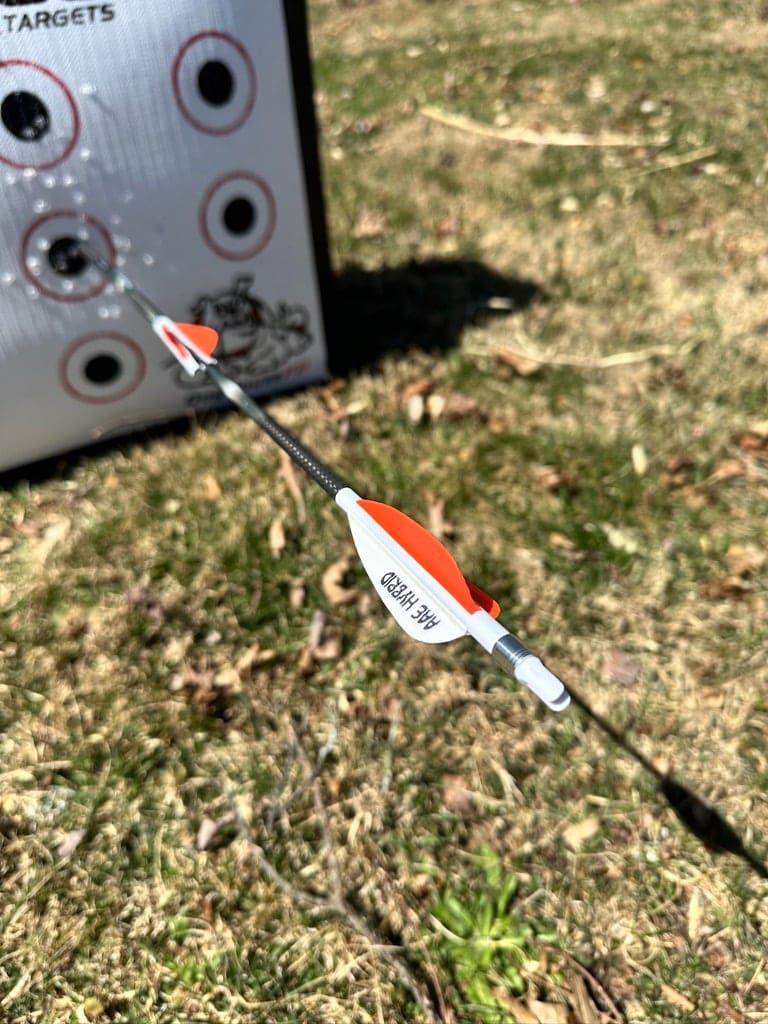
I have used both sizes in three-fletch setups, and the Hybrid 26 is the one I used most recently.
AAE lists the Hybrid 23 at 2.30 inches long, 0.38 inch high, and 5.7 grains plus or minus 0.5 grain. Three add a nominal 17.1 grains. AAE's selection chart lists the Hybrid 26 at 2.80 inches, 0.50 inch high, and 8.3 grains. Three add a nominal 24.9 grains.
That is a meaningful difference. The model name is similar, but the rear weight and profile are not. A hunter should not treat them as interchangeable just because both say Hybrid.
I started testing the Hybrid 26 after I heard the unidentified vanes on my Method Archery arrows whistle past 40 yards. The Method arrows themselves were good arrows. The fletching sound was the problem I wanted to solve. The Hybrid 26 was quiet in my use, and I had also used the smaller Hybrid 23. Because I used the two sizes across different complete builds, I am not assigning a controlled sound ranking to one Hybrid model over the other.
Best for: A hunter who gets enough broadhead control from three vanes and wants to compare a lighter, smaller Hybrid 23 with the larger Hybrid 26.
Skip it if: The chosen Hybrid does not control the hunting broadhead or the arrow needs a different clearance, drag, or rear-weight plan.
System role: A three-fletch path that lets the exact Hybrid size match the arrow instead of forcing one profile onto every build.
To compare the two sizes, check the current Fire Orange Hybrid 23 pack or check the current Fire Orange Hybrid 26 pack. Verify the vane size before ordering because the two Hybrid models solve different rear-weight and profile jobs.
Bohning Blazer: The Familiar Compact Baseline
The Blazer is the compact hunting vane many bowhunters recognize. I used it for years in three-fletch setups.
For this article, I am using the 2026 Bohning Technical Guide specification: 2 inches long, 0.53 inch high, and 6.6 grains. Three vanes add 19.8 grains. Bohning also gives the Blazer a 6.0 value on its own stiffness scale. That number is useful inside Bohning’s product line, but it is not a universal cross-brand stiffness measurement.
The Blazer was louder than both AAE configurations in my experience. That does not make it a bad vane. It means sound was one area where another complete configuration worked better for me.
Best for: A hunter who wants a compact, common vane and has already verified broadhead flight and clearance.
Skip it if: Reducing vane sound is the controlling priority and another tested configuration groups as well or better.
System role: A familiar hunting baseline with wide availability.
If the Blazer fits the job, check the current Bohning Blazer combo-pack options.
TAC Driver 2.75: My Longer-Distance Setup
I used the 2.75-inch Driver because I was building a straight three-fletch setup around longer-distance shooting. Each vane weighs 6.2 grains, so three add 18.6 grains to the rear of the arrow. The longer profile fit that mission, but the finished arrow still matters more than the model name.
System role: A longer-distance three-fletch experience that shows why count and angle may change with the mission.
For this longer-distance option, check the current TAC Driver listing. Verify that the selected variation is the 2.75-inch Driver before ordering.
What Precision Cut’s Testing Put Near the Top
I have not shot every vane Precision Cut tested, so I am not going to act like I personally proved these rankings. What the study gives me is a better list of vanes worth testing on my own arrows. It measured drag, fixed-blade correction, and sound as separate jobs. No vane won every one of them.
The 2025 vane study and 2026 vane study used controlled rigs and published the test conditions. The order can change with the arrow, speed, fletch count, angle, broadhead, and launch. I use the category leaders as better starting points, then make the finished arrow prove the choice.
| Priority | Research-backed standout | What it means for a hunting build |
|---|---|---|
| Strongest fixed-blade correction | AAE AIRAZR Talon 3.0 | It produced the least fixed-blade drift in the published correction testing, but it was not the quietest or lowest-drag choice. |
| Quietest measured flight | Flex-Fletch FFP-360 | It led the sound results while still providing useful correction, making it a serious research-backed hunting option. |
| Strong overall balance | DCA Super Sabre | It combined low drag, strong correction, and relatively low sound without needing to win only one measurement. |
| Lower-drag TAC path | TAC Driver | The Driver 2.25 ranked well for drag and useful steering, while the Driver 2.75 was identified as a good all-around option. Verify the exact size before ordering. |
A lot of hunters will notice that the Flex-Fletch Silent Knight is not one of the main vanes I pulled from the study. Precision Cut tested it, and I looked at it because the name alone makes you expect a quiet vane.
The three-inch Silent Knight measured 58.6 dB under the deer-weighted sound analysis. The FFP-360 measured 53.3 dB while also producing less drag and less fixed-blade displacement in that test. Precision Cut also tested the shorter SK2. It reduced drag, but it gave up some broadhead correction and measured louder.
That does not make the Silent Knight a bad hunting vane. It explains why the FFP-360 became the Flex-Fletch model I decided to test against my Max Stealth setup.
The closest published match to my setup also changed my decision. Three Max Stealth vanes at two degrees produced nearly the same fixed-blade correction as four while carrying less rear weight and drag. The three-fletch FFP-360 produced essentially the same correction as four Max Stealth vanes while measuring lower in drag, sound, and rear weight. That makes the FFP-360 the next vane I plan to test against three Max Stealth vanes. It is not my field winner before I shoot it.
James Yates’s detailed interpretation of the 2025 results also placed the DCA Super Sabre, TAC Driver 2.25, and Flex-Fletch Silent Knight 2-inch in the leading drag-versus-correction group. He identified the AIRAZR Talon as the strongest correction-first option and the FFP-360 as the quietest. He also warned that a low-drag winner may not provide enough correction for a large fixed blade after a poor launch.
Among the options I have actually used, I will now start my short-range single-bevel build with three AAE Max Stealth vanes at two degrees. The FFP-360 is the research-backed challenger I plan to test against it. The AAE Hybrid 26 remains my quiet three-fletch path, and the straight TAC Driver 2.75 remains my longer-distance example. The study helps choose what to test; the finished arrow still has to prove the decision.
What a Hunting Arrow Vane Actually Does
An arrow does not leave the bow in a perfectly calm state. It can have yaw, pitch, and shaft movement. The broadhead can also create steering force at the front of the arrow.
The fletching works behind the arrow’s balance point. As air moves over it, the vanes help bring the shaft into line with the flight path. Offset or helical application can also make the arrow rotate.
That work comes with a cost. A vane creates drag. More vane area, more angle, and more vanes can increase the steering force, but they can also increase resistance, sound, rear weight, and clearance demands.
The goal is not maximum fletching. The goal is enough stable control for the hunting broadhead with the fewest new problems.
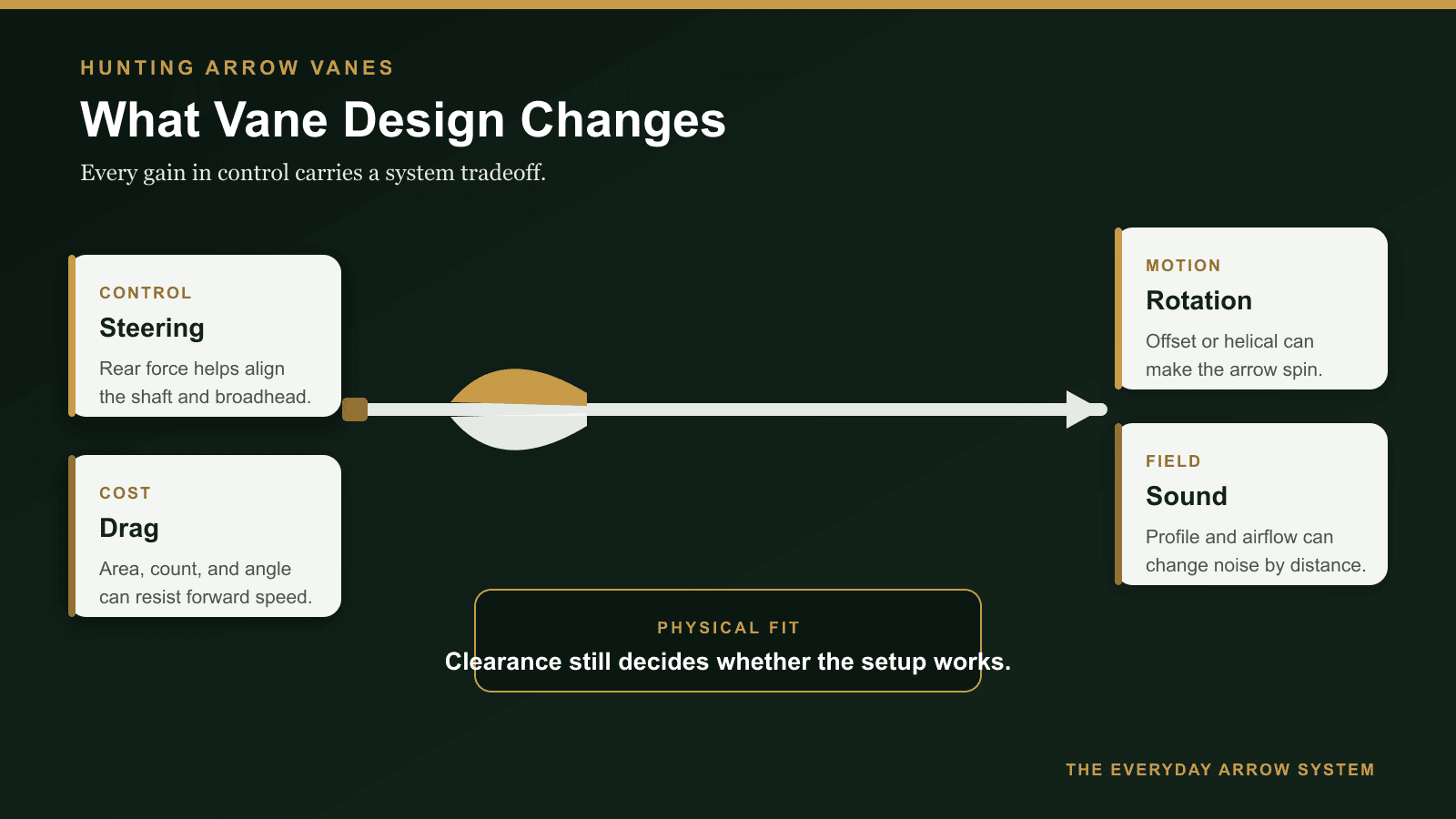
A vane adds control behind the arrow’s balance point, but its area, count, and angle can also add drag, sound, and clearance demands.
Length Does Not Decide the Vane by Itself
Two vanes can have similar lengths and behave differently because their height, shape, material, edge design, and application are different.
A short, tall vane puts working area into a compact space. That can provide useful control when arrow clearance allows it. A longer, lower-profile vane spreads the working shape over more length and may provide a different balance of clearance, drag, recovery, and sound.
Length matters, but it must be read with:
- maximum height;
- total profile and working area;
- material and recovery;
- vane weight;
- number of vanes;
- straight, offset, or helical application;
- broadhead steering demand;
- bow and rest clearance.
Do not shop by a single dimension. A short, tall Blazer-style profile and a longer Hybrid-style profile may solve the same broad question in very different ways.
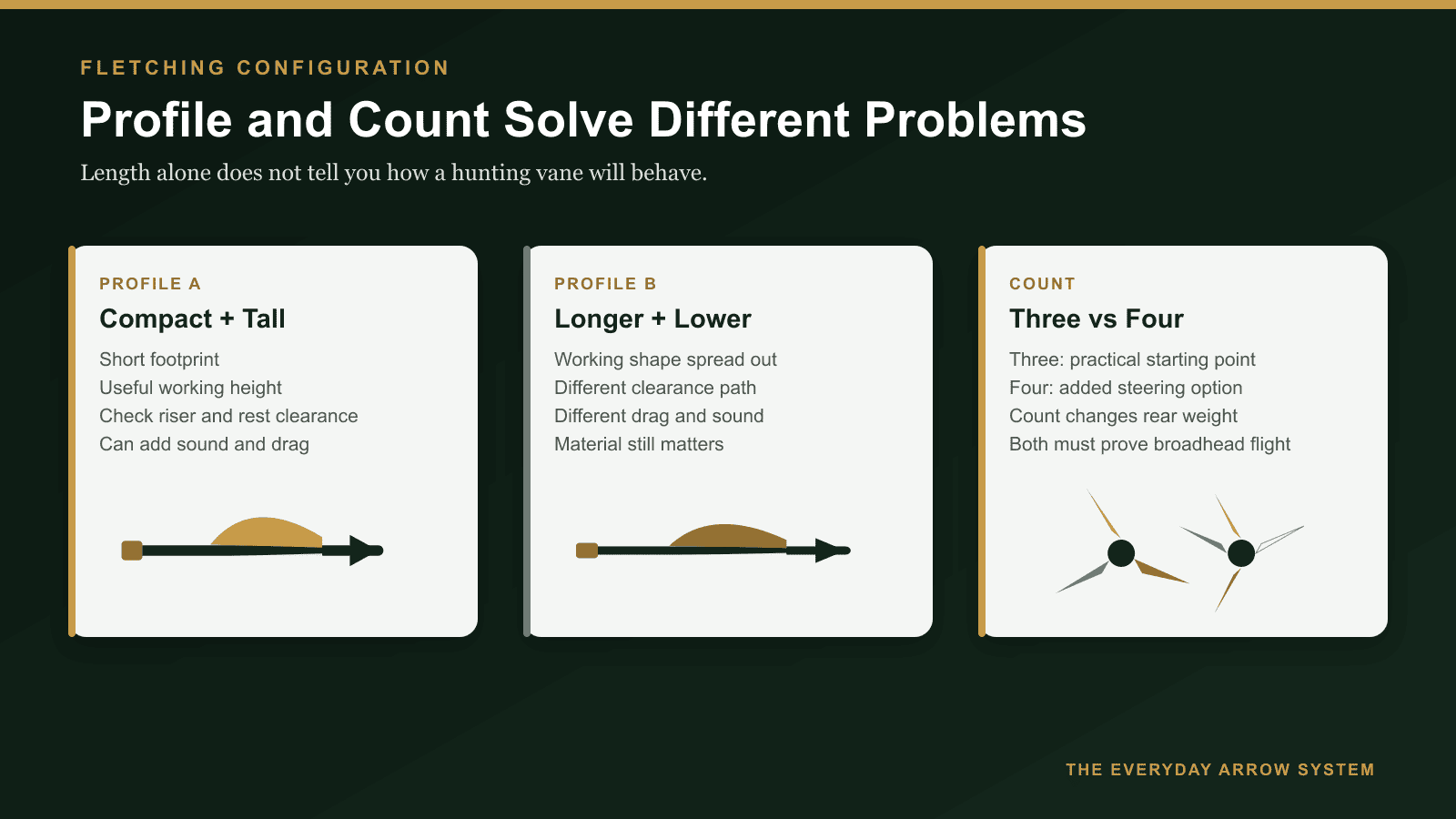
Length, height, count, and profile work together. No single measurement decides the finished configuration.
Stiff Versus Flexible Vanes
Stiffness is often discussed as if every manufacturer uses the same scale. They do not.
A stiffer material may resist deformation and hold its intended shape under airflow. A more flexible material may recover well after contact and may be more forgiving around some clearance problems. Adhesion, base preparation, temperature, and the way the vane returns after being bent also matter.
That does not give us a clean universal ranking. Bohning publishes a stiffness scale for its own vanes. AAE describes MAX and Hybrid Plastifletch materials. Other brands describe their compounds in different terms. Without one standardized test across brands, it would be false precision to say one brand is exactly a certain amount stiffer than another.
Use stiffness as a design question:
- Does it hold its profile?
- Does it recover after contact or storage?
- Does the base bond correctly with the required preparation?
- Does the finished vane clear the bow?
- Does the hunting broadhead group?
The test arrow answers more than a marketing adjective.
What the Method Arrows Changed in My Testing
The Method arrows were good arrows. The unidentified fletching on my set whistled beyond 40 yards, so I used that problem to choose the next test instead of blaming the whole arrow. Hybrid 26 became the next three-fletch setup I wanted to hear and shoot.
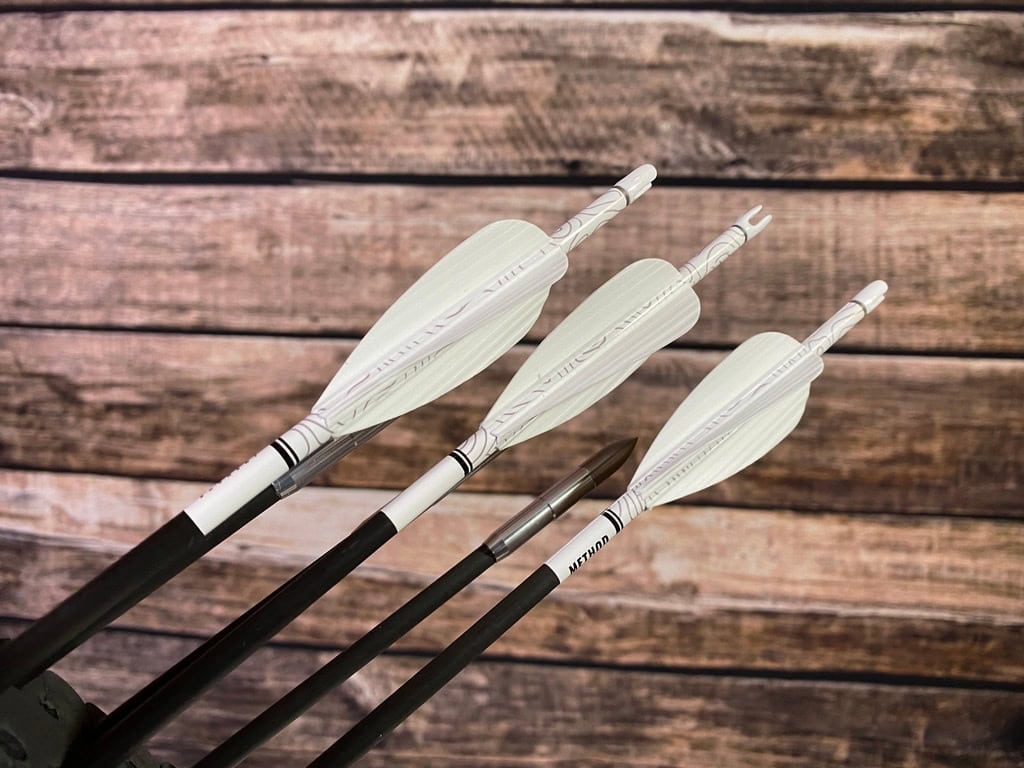
My Method Archery arrows were good arrows, but the unidentified vanes installed on this set produced a slight whistle beyond 40 yards. That experience led me to begin testing AAE Hybrid 26 vanes.
Sound and Drag Are Different Vane Problems
My four-fletch Max Stealth configuration was exceptionally quiet. The Blazer configuration was louder than both AAE configurations in my experience. The Hybrid 23 and Hybrid 26 were also quiet, but I used them across different complete builds and am not assigning them a distance-based sound ranking that I did not test.
In North American Whitetail's vane comparison, Jace Bauserman described the Max Stealth as ultra-quiet and reported tight groups with it from 20 to 120 yards. He also found little three- versus four-fletch grouping difference at normal whitetail distances, with the four-fletch advantage starting to show around 60 to 70 yards. His setup was not mine, but his sound description points in the same direction as my Max Stealth experience.
There are several possible contributors:
- vane profile;
- vane count;
- application angle;
- edge and surface shape;
- arrow speed;
- arrow rotation;
- airflow changing as the arrow slows;
- shaft, wrap, and nock differences;
- bow and launch differences.
I did not isolate those variables or measure decibels. I also will not claim what a deer hears or how a deer reacts. The useful conclusion is narrower: listen to the complete configuration through the full distance it may actually be used, and do not assign a sound to a named vane until the source is verified.
For a measured comparison, Precision Cut Archery's 2025 vane study examined aerodynamic drag, fixed-blade restorative lift, and human- and deer-weighted sound under its own protocol. That research is useful because it treats sound, steering, and drag as separate variables instead of assuming one vane wins all three. It does not recreate my bows or complete fletching configurations, so it does not replace testing the finished arrow.
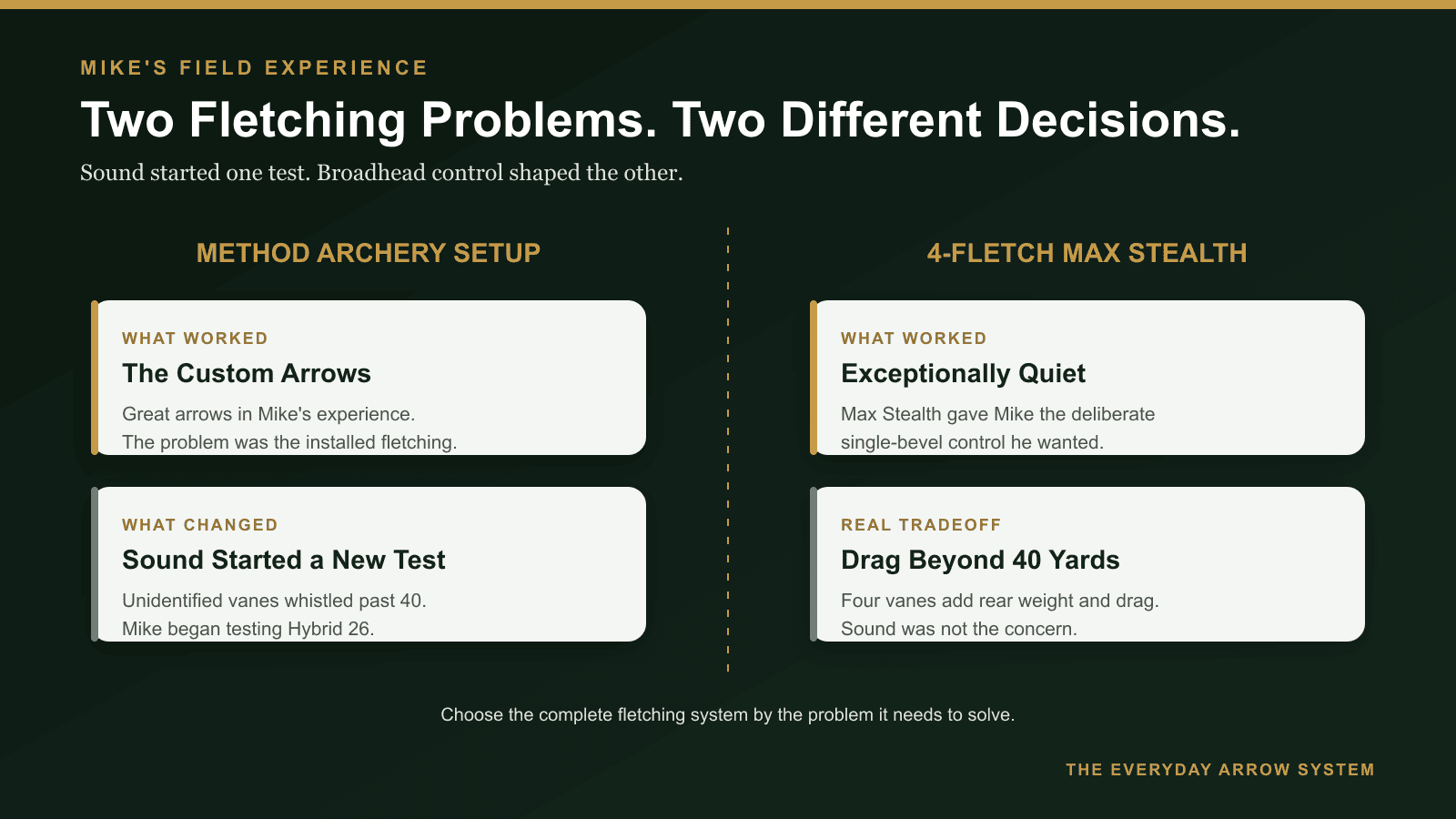
The Method fletching exposed a sound problem and started my Hybrid 26 testing. The four-fletch Max Stealth solved a different job: quiet control behind my single-bevel broadhead, with added rear weight and drag as the tradeoff.
Short-Range Control Versus Longer-Range Drag
Inside normal bowhunting distance, rapid control can be worth a reasonable drag cost. The arrow does not have as much time to lose speed, but the broadhead still has to settle and stay behind the point of impact. That is where my four-fletch Max Stealth single-bevel configuration fit. The direct count comparison now gives me a reason to test whether three Max Stealth vanes can do the same job with less rear weight and drag.
As distance grows, drag has more time to matter. A configuration that provides more steering than the broadhead needs may give away speed without adding a useful result.
That does not mean every longer shot needs a smaller vane or straight fletch. It means the hunter must decide which job is primary:
- fast broadhead control;
- less drag over a longer path;
- lower rear weight;
- more clearance;
- quieter flight across the full distance;
- the smallest configuration that still groups the hunting head.
My TAC setup was straight three fletch for a longer-distance mission. My Hybrid 23 and Hybrid 26 configurations were quiet three-fletch options. My Max Stealth setup was exceptionally quiet, but four vanes added rear weight and drag that a longer-distance build has more reason to question. Those are useful firsthand boundaries, but they are not universal rules.
Broadhead Style Changes the Steering Job
Mechanical broadheads
A closed mechanical head normally presents less exposed blade area than a fixed blade. That can reduce the steering demand at the front, but it does not remove the need for tune, alignment, clearance, and verified groups.
A hunter may find that a three-fletch configuration with less drag is enough. The actual hunting head still has to be shot and confirmed.
Fixed-blade broadheads
Exposed blade area can act like fletching at the wrong end of the arrow. The larger the steering influence at the front, the more important a clean launch and adequate rear control become.
Do not try to overpower a tuning problem with oversized fletching. Tune first. Align the broadhead. Then compare the smallest rear configuration that keeps the head with the field point and produces repeatable groups.
Single-bevel broadheads
My proven single-bevel setup used four Max Stealth vanes at two degrees, and it worked. Based on the matched count data, my next build will start with three at two degrees. I will add the fourth only if the finished arrow shows that it needs more control.
The question is whether that configuration controls that broadhead from that bow. If three vanes already clear and group, the fourth has to justify its weight, drag, and extra clearance point.
For the deeper count decision, see When a 4-Fletch Setup May Help a Fixed-Blade Hunting Arrow.
Three or Four Vanes?
Three is my practical starting point. It uses less material, carries less rear weight, and gives the bow fewer vanes to clear. If three control the broadhead and produce repeatable groups, there is no reward for adding a fourth just because four sounds more serious.
The direct Max Stealth comparison reinforces that rule. Four vanes added 8.8 grains and about 8.9% more measured drag, while the average fixed-blade correction improvement was only 0.58 inch at 70 yards and the confidence intervals overlapped. I am therefore moving my Max Stealth starting point from four vanes to three. The fourth has to earn its place in a matched-arrow test.
Four can help when the finished setup needs more steering or when four smaller vanes fit the clearance and profile goal better than three larger vanes. It can also offer more indexing choices with some rests.
The costs are real:
- another vane’s weight;
- more total drag;
- another possible contact point;
- more fletching work;
- a different sound profile;
- a change to finished weight and Planned FOC.
Do not decide by distance alone. Distance can expose the tradeoff, but broadhead control, drag, sound, weight, and clearance decide whether three or four works better.
The index vane does not belong in one universal position on every bow. Its practical job is to help you clock the finished arrow so the other vanes clear your installed rest. If your shaft has an alignment mark—or you need to find a repeatable axis on an unmarked shaft—use my spine-alignment and index-vane guide before fletching the complete batch.
Straight, Offset, and Helical Application
A straight vane is aligned with the shaft. Offset turns the vane slightly. Helical wraps the vane around the shaft more aggressively.
Offset and helical application can create more rotation and may add control. They can also add drag, sound, and clearance demands. The amount a jig can apply cleanly depends on vane length, shaft diameter, clamp, base contact, and the fletching tool.
My normal starting point is at least one degree. I used two degrees on my four-fletch single-bevel configurations, and I will use two degrees for the three-fletch Max Stealth and FFP-360 comparison. My TAC Driver longer-distance setup was straight three fletch.
Those are my build choices, not universal minimums or maximums. The vane base must sit correctly on the shaft. A claimed two-degree setting is not useful if the base lifts or the vane contacts the bow.
Feathers Versus Modern Molded Vanes
Natural feathers are light and can provide strong steering for their weight. They also collapse around contact better than many molded vanes. That can make them useful in some traditional and clearance-sensitive systems.
They also bring practical limits. Feathers can be affected by water, wear, storage, and noise. A bowhunter who expects rain, wet vegetation, or rough travel should decide whether those limits fit the hunt.
Modern molded vanes are generally easier to make weather resistant and consistent. Their materials, profiles, and preparation requirements vary. Some require a specific cleaner, primer, or adhesive system. Follow the manufacturer’s current process instead of assuming the glue routine for one vane applies to every material.
The decision is not tradition versus technology. It is whether the finished fletching remains reliable through the conditions the arrow must face.
Vane Weight Changes the Arrow Plan
Vane weight is not just a catalog number. Multiply it by the count, then add the wrap, nock, bushing, lighted-nock parts, and any other rear component.
Using the current reviewed values:
- Four Max Stealth vanes at the Planner’s 9.0-grain nominal add 36.0 grains.
- Three Hybrid 23 vanes at 5.7 grains add 17.1 grains.
- Three Hybrid 26 vanes at the reviewed 8.3-grain nominal add 24.9 grains.
- Three Blazer vanes using Bohning’s 2026 guide value of 6.6 grains add 19.8 grains.
- Three TAC Driver 2.75 vanes at the reviewed 6.2-grain nominal add 18.6 grains.
The difference between four Max Stealth vanes and three Hybrid 23 vanes is 18.9 grains at the rear before any wrap or nock difference. That can change finished weight and Planned FOC enough to matter to the original arrow plan.
It does not automatically make the heavier rear configuration wrong. It means the control benefit has to justify the cost, and the arrow should be recalculated before the batch is built.
Use the Hunting Arrow Component Finder to compare exact vane entries and compatible parts. Then bring the complete system into the Everyday Arrow Planner to study finished weight, Planned FOC, modeled speed, trajectory, and Dynamic Spine.
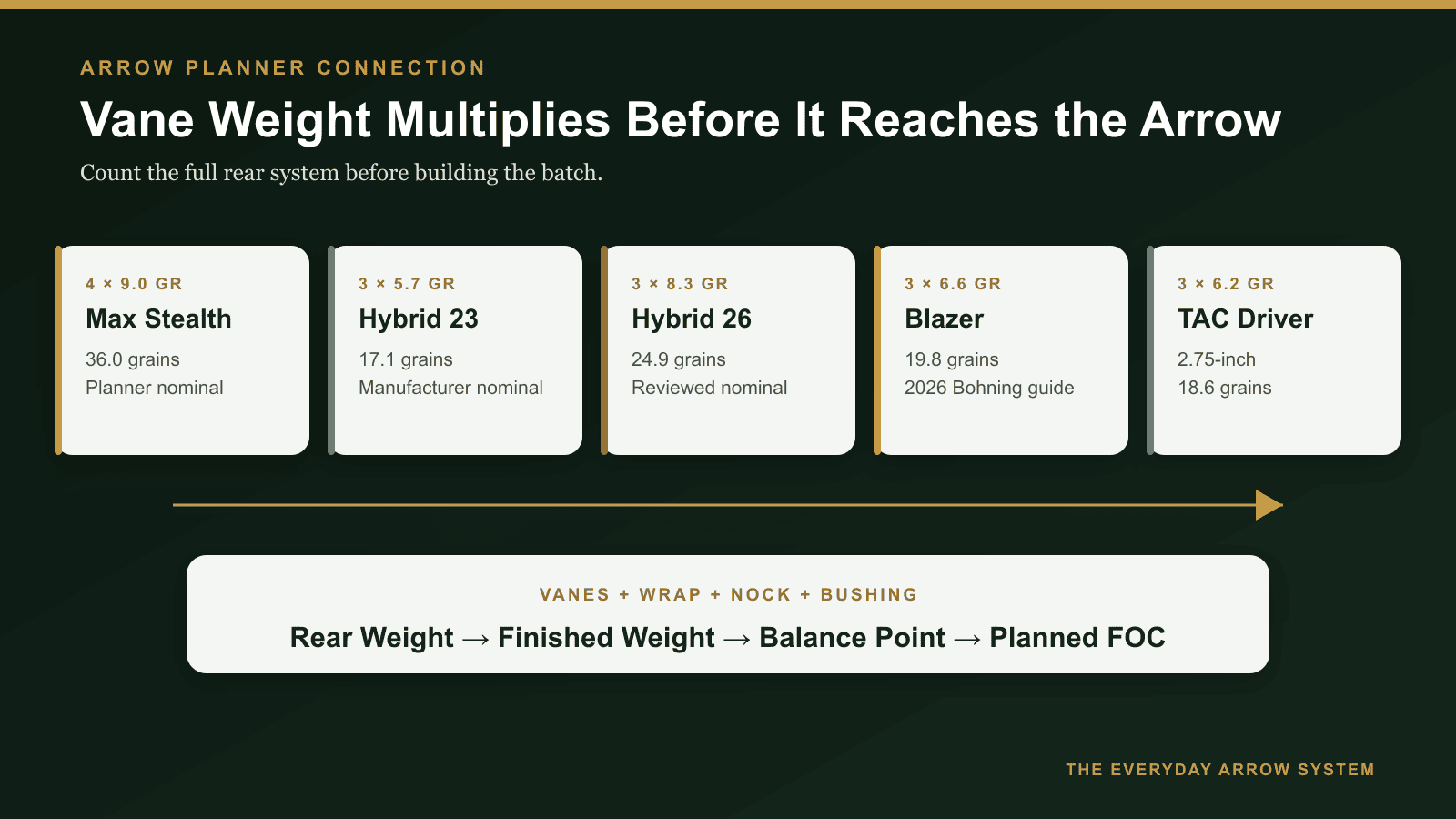
Multiply the per-vane weight by the count, then add the rest of the rear system before recalculating the finished arrow.
The Main Vane Types I Would Compare
There are more hunting vanes on the market than I could test honestly. I sort them by the job they are trying to do, use exact products as examples, and then decide which ones deserve a matched-arrow test.
Compact, higher-profile molded vanes
Examples include the Bohning Blazer and other short hunting profiles. Their shape can put useful steering area into a short footprint. Check clearance, sound, and whether the broadhead needs that profile.
Longer mid- or lower-profile molded vanes
Examples include AAE Max Stealth, AAE Hybrid 26, Bohning Alpha, and other longer hunting profiles. Products within this class still differ in height, material, weight, and intended application.
Smaller and lighter three-fletch options
AAE Hybrid 23 is a firsthand example for me. Smaller products may lower rear weight and drag, but they still have to control the hunting head.
Very stiff or high-speed material systems
Some manufacturers market materials around stiffness, recovery, or higher arrow speed. Those claims must stay attached to the manufacturer unless independent testing supports more. One brand’s stiffness number cannot be treated as the same scale as another brand’s description.
Natural feathers
Feathers create a different weight, recovery, weather, and durability decision. They belong in the comparison, but not as a universal traditional-bow answer.
When I compare a vane, I separate what the manufacturer publishes, what I have used, what independent research measured, and what the finished arrow still has to prove. That keeps a catalog number, somebody else’s test, and my own field experience from getting mixed together.
How I Would Test a Hunting Vane Before Building the Batch
- Start with a tuned bow and one known arrow platform.
- Keep the shaft, length, front system, broadhead, nock, and wrap constant where possible.
- Build one complete arrow in each candidate configuration.
- Weigh the finished arrows and measure the real balance point.
- Check rest, cable, riser, and containment clearance.
- Confirm field-point flight before blaming or praising the vane.
- Shoot the actual hunting broadhead.
- Compare at 20, 30, 40, and the farthest distance you have already verified as ethical for your ability and setup.
- Listen for hiss, flutter, buzz, or whistle from a safe position behind or beside the shooter. Never place a listener downrange.
- Compare groups, point of impact, adhesion, visible damage, and vane recovery.
- Recalculate the selected rear system in the Planner.
- Build the rest of the batch only after the test arrow earns trust.
Changing two or three variables at once may produce a good arrow, but it will not tell you which change mattered. If you want a real comparison, control what you can.
Use the Component Finder and Planner as One Path
The new vane decision should fit the rest of the arrow system:
- Use this guide to choose the vane class and configuration job.
- Compare exact products in the Component Finder.
- Use the Component Finder instructions when you need the full workflow.
- Save the complete component system rather than treating the vane as a loose part.
- Bring that system into the Arrow Planner.
- Recalculate finished weight, Planned FOC, modeled speed, trajectory, and Dynamic Spine.
- Build and prove one finished arrow.
The Planner helps you study connected numbers. It cannot hear the arrow, verify physical clearance, or prove broadhead groups from your bow.
For the full system logic, read How to Choose Hunting Arrow Components That Work Together and The Everyday Arrow System.
My Bottom Line
The best hunting vane is the one that gives your broadhead enough control without adding drag, weight, sound, or clearance problems you do not need.
My field experience gives me four useful starting points. The Hybrid 23 and Hybrid 26 are quiet three-fletch options I have used. The Blazer is familiar and effective, but it was louder than both AAE setups in my experience. The straight three-fletch TAC Driver 2.75 remains my longer-distance example.
Four Max Stealth vanes at two degrees remain a proven, exceptionally quiet setup behind my single-bevel broadhead. The study changed where I start, not what happened in the field.
My next matched test: I will compare three Max Stealth vanes at two degrees with three FFP-360 vanes at two degrees. The fourth Max Stealth vane only comes back if three cannot hold the broadhead control I need.
Those observations came from configurations used across a Mathews Lift, PSE Decree, and Hoyt Vector Turbo. They were not a controlled same-bow laboratory comparison.
Choose the vane by the job. Give the broadhead enough control. Count every grain in the rear system. Keep clearance clean. Do not add drag you cannot justify. Then build one arrow and prove the complete setup before you fletch the rest.
Once you have a complete component system, bring it into the Arrow Planner, then build one test arrow.
Hunting Arrow Vane FAQ
What do vanes do on a hunting arrow?
Vanes create aerodynamic force behind the arrow’s balance point. That force helps align the shaft with its flight path, can create rotation, and helps control steering influence from the broadhead. The same force also creates drag.
Are three or four vanes better for hunting?
Neither count is always better. Three is a practical starting point when it controls the broadhead and clears the bow. Four may provide more steering or allow a different vane profile, but it also adds rear weight, drag, fletching work, and another possible clearance point.
Are longer vanes better for fixed-blade broadheads?
Length alone does not decide control. Height, profile, area, material, count, angle, clearance, and the bow’s tune all matter. Test the complete configuration with the actual fixed-blade broadhead.
Are stiff or flexible arrow vanes better?
It depends on the job. Stiffer material may hold its intended profile. More flexible material may recover differently after contact. There is no verified universal cross-brand stiffness scale, so compare construction, clearance, adhesion, and finished-arrow results.
Are feathers better than plastic vanes?
Feathers are light and can provide strong steering for their weight. Molded vanes generally handle moisture and rough conditions more consistently. The hunt, bow clearance, weather, broadhead, and tested flight should decide.
How much offset or helical should a hunting arrow use?
Use enough clean application to create the rotation and control the setup needs without lifting the vane base or causing contact. I normally use at least one degree. I used two degrees on my four-fletch single-bevel configurations, and I will also use two degrees for my three-fletch Max Stealth and FFP-360 comparison. That is my method, not a universal requirement.
Do heavier arrows need bigger vanes?
Not automatically. Vane demand comes mainly from launch quality, broadhead steering, arrow dimensions, speed, and the required distance. Finished arrow weight is one part of the system, not a direct rule for vane size.
Can changing vanes change FOC?
Yes. Changing vane model, weight, or count changes rear weight. That can change the finished balance point and Planned FOC. Recalculate the complete rear system before building the batch.
Why does an arrow vane whistle?
A whistle can come from airflow interacting with vane shape, edges, count, application angle, speed, rotation, or another part of the rear system. I heard a slight whistle beyond 40 yards from unidentified vanes installed on a set of Method Archery arrows. The arrows themselves were good, but that fletching sound was what led me to start testing AAE Hybrid 26 vanes. My Max Stealth setups were exceptionally quiet. Listen through the full distance you intend to shoot, and do not attribute a complete-arrow sound to a particular vane until you have verified the configuration.
Want to see exactly what I’m carrying this season? Check out my Personal Bowhunting Gear List for 2026