

A fourth vane is not automatically better. I use four when it solves a job that three fletches are not solving—or when that extra vane helps me finish the arrow build I am trying to create.
That can mean adding more steering for a large fixed-blade broadhead. It can also mean adding a little weight to the back of an arrow when the FOC is higher than I want. The fourth vane still has to justify the added drag, weight, cost, and clearance concerns. If three fletches already control the broadhead and the arrow tunes well, I am not adding a fourth just because four looks more aggressive.
The real question is not whether four fletches are better than three. It is whether four solve a problem in your specific arrow build. Here is how I make that decision.
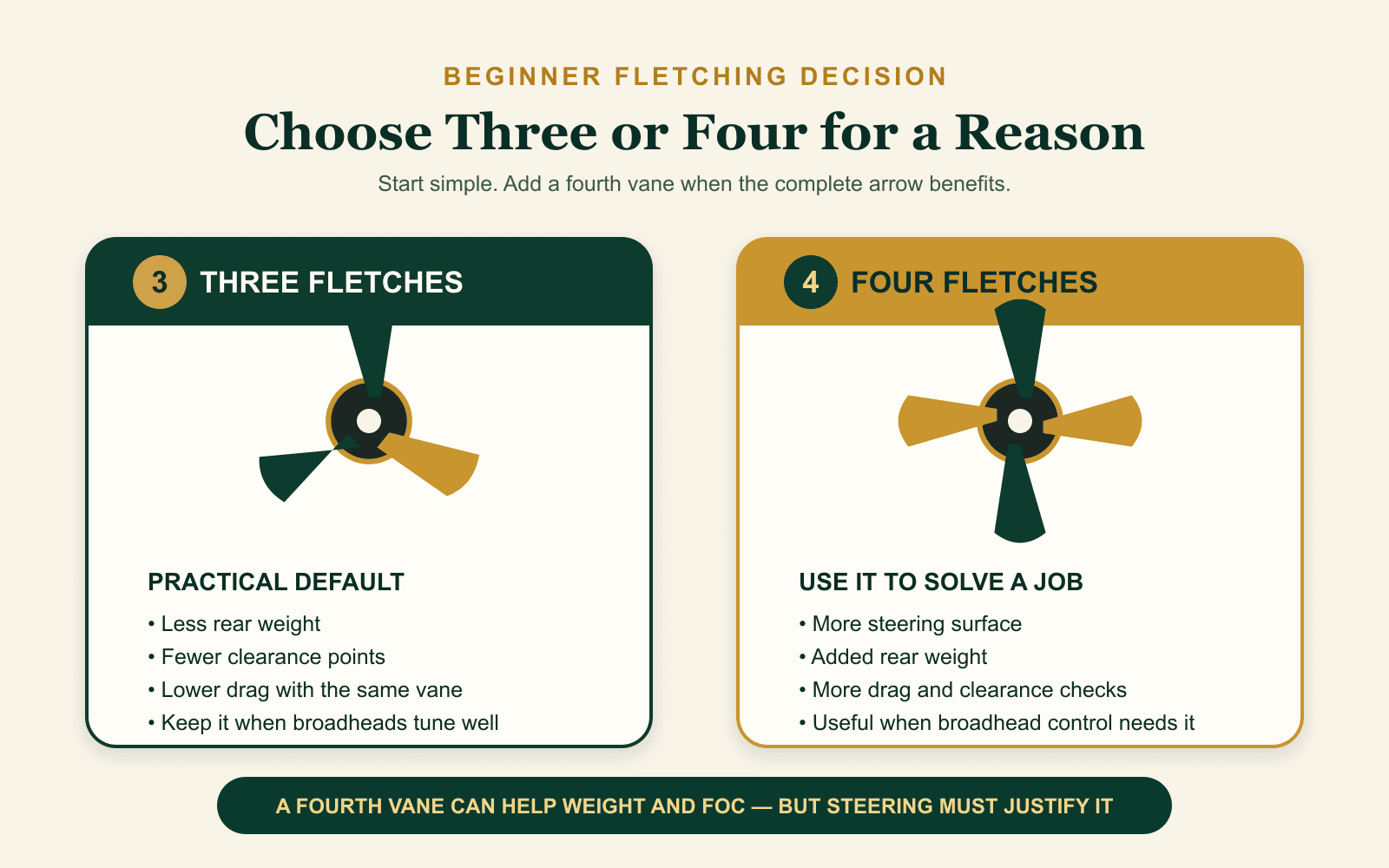
Three Fletch vs. Four Fletch at a Glance
| Decision Factor | Three Fletches | Four Fletches |
|---|---|---|
| Best starting point | The practical default for most hunting arrows | Use when the build has a specific job for the extra vane |
| Steering | Often enough for a tuned fixed-blade arrow | Can add total steering surface for a harder-to-control broadhead |
| Rear weight and FOC | Less weight behind the balance point | Adds rear weight and can lower FOC |
| Drag and sound | Usually less when the same vane is compared | Usually more when the same vane is compared |
| Clearance | Fewer contact points to manage | One more vane, but the 90-degree layout may create a useful clearance option |
| Cost and work | Three vanes per arrow | Four vanes, more adhesive, and more build time |
| Best reason to choose it | The arrow already tunes and controls the broadhead | It solves a steering, clearance, or weight-distribution problem |
What Actually Sets Four Fletches Apart
Four fletches give me another way to manage steering, vane size, clearance, and rear weight. They are not automatically better because there is one more vane on the shaft.
- More steering surface: Four of the same vane normally give the broadhead more total surface working behind it.
- Smaller vane options: Four shorter or lower-profile vanes may give me the control I need without using three tall vanes.
- More rear weight: The extra vane moves a little more weight behind the balance point and can lower FOC.
- A different indexing plan: Four vanes are normally spaced at 90 degrees, which can create a different rest, cable, and riser-clearance plan.
- More drag and another contact point: The fourth vane is not free performance. It can add sound, drag, cost, and another place where contact can occur.
Vane count also does not tell the full story. Four small vanes may have less working surface than three larger vanes. Height, length, material, stiffness, offset, and helical all change how the fletching behaves.
When I Stay With Three Fletches
If three vanes are controlling the broadhead, clearing the bow, and giving me consistent groups, I leave the setup alone. I do not add another part to a working system without a reason.
- The broadheads and field points already group together.
- The arrow clears the rest, cables, and riser.
- The current vanes provide enough control.
- The finished weight and FOC are already where I want them.
- I do not have a specific problem for the fourth vane to solve.
When I Test Four Fletches
I test four when the arrow gives me a reason to test four. That normally comes down to broadhead control, vane profile, clearance, or the weight distribution of the finished build.
- A large fixed-blade or single-bevel broadhead needs more steering after the bow and arrow are otherwise tuned.
- I want to use a smaller or lower-profile vane but still need enough total steering surface.
- The FOC is higher than I want and adding rear weight makes sense within the complete build.
- The 90-degree four-vane orientation gives me a cleaner clearance plan.
- A complete three-fletch test arrow is not giving me the broadhead control I need.
A fourth vane does not fix a poor bow tune, the wrong spine, a crooked broadhead, or contact with the bow. Those problems need to be corrected first.
Vane Surface, Helical, and Noise Still Matter
More vane height can add steering, but it can also make clearance harder. More offset or helical can increase rotation and broadhead control, but it also adds drag and may add sound. The goal is enough control for the broadhead without adding more vane than the arrow needs.
I currently use AAE Hybrid 26 vanes in my hunting-arrow builds. That does not mean every arrow needs that vane or needs four of them. The shaft, broadhead, clearance, FOC, and the way the finished arrow groups still control the decision.
For the deeper vane decision—including profile, rear weight, sound by distance, steering, drag, and how my Max Stealth, Hybrid, Blazer, and TAC Driver configurations differed—read Hunting Arrow Vanes: How to Choose the Best Fletching for Your Setup.
Do You Need to Match Single-Bevel Rotation to Vane Helical?
The rotation created by helical fletching during flight and the cutting action of a single-bevel broadhead after impact are not the same event. I do not choose fletching direction based only on a claim that it has to match the bevel. I choose a consistent direction that clears the bow and groups well, then I test the actual broadhead.
How Four Fletches Change the Complete Arrow
Changing from three vanes to four changes more than the number you can see. It changes finished weight, rear weight, FOC, drag, and potentially dynamic spine. The effect may be small, but the build still needs to be recalculated as a complete arrow.
For the Everyday Arrow System, standard industry FOC guidance is 10–15 percent. My practical working guidance is 13–18 percent, while anything over 20 percent is high FOC. I may use a fourth vane as one way to bring a high-FOC build down, especially when the broadhead also benefits from more steering. I am not using it to chase a number at the expense of safe spine, useful trajectory, or clean broadhead flight.
Four vanes can add steering authority, but they cannot repair contact, poor component alignment, or a bow that is launching every arrow inconsistently. Use the hunting-arrow tuning guide to check clearance, identify whether the problem affects every arrow or one outlier, and finish with broadheads at a realistic hunting distance.
Build One of Each Before Committing to the Batch
The cleanest comparison is one three-fletch arrow against one matching four-fletch arrow. Keep everything else the same so you can see what the vane change actually did.
- Use the same shaft, cut length, insert, point, nock, and broadhead.
- Weigh both finished arrows.
- Calculate the FOC of both arrows.
- Use powder or another safe contact test to confirm rest, cable, and riser clearance.
- Confirm the bow tune before judging the fletching.
- Compare field-point groups at realistic hunting distances.
- Compare broadhead groups at the same distances.
- Listen for a difference in vane noise.
- Choose the setup that gives you the most reliable hunting result.
That test tells you more than a universal three-fletch or four-fletch rule ever will.
Your Next Steps
Plan the fletching change before building the batch. A fourth vane changes rear weight and can affect FOC and dynamic spine, so carry that choice into the complete arrow plan. Start with the Hunting Arrow Planner.
If you are working through the manual Arrow System, use the tools in the order the decision is made:
- Set the starting target with the Everyday Arrow Weight Formula.
- Compare speed, energy, and momentum in the Arrow Performance Calculator.
- Check the real rise and drop in the Hunting Arrow Trajectory Calculator.
- Use How to Choose Hunting Arrow Components to fit the vanes into the complete build.
- Recalculate the new balance in the FOC Calculator.
- Build one three-fletch and one four-fletch test arrow before committing to the batch.
The high-performance hunting-arrow build guide walks through the full manual process from the starting measurements to the final test arrow.
Want to see exactly what I’m carrying this season? Check out my Personal Bowhunting Gear List for 2026