

I have two deer-hunting arrows that show why this question cannot be answered with one product name or one finished weight.
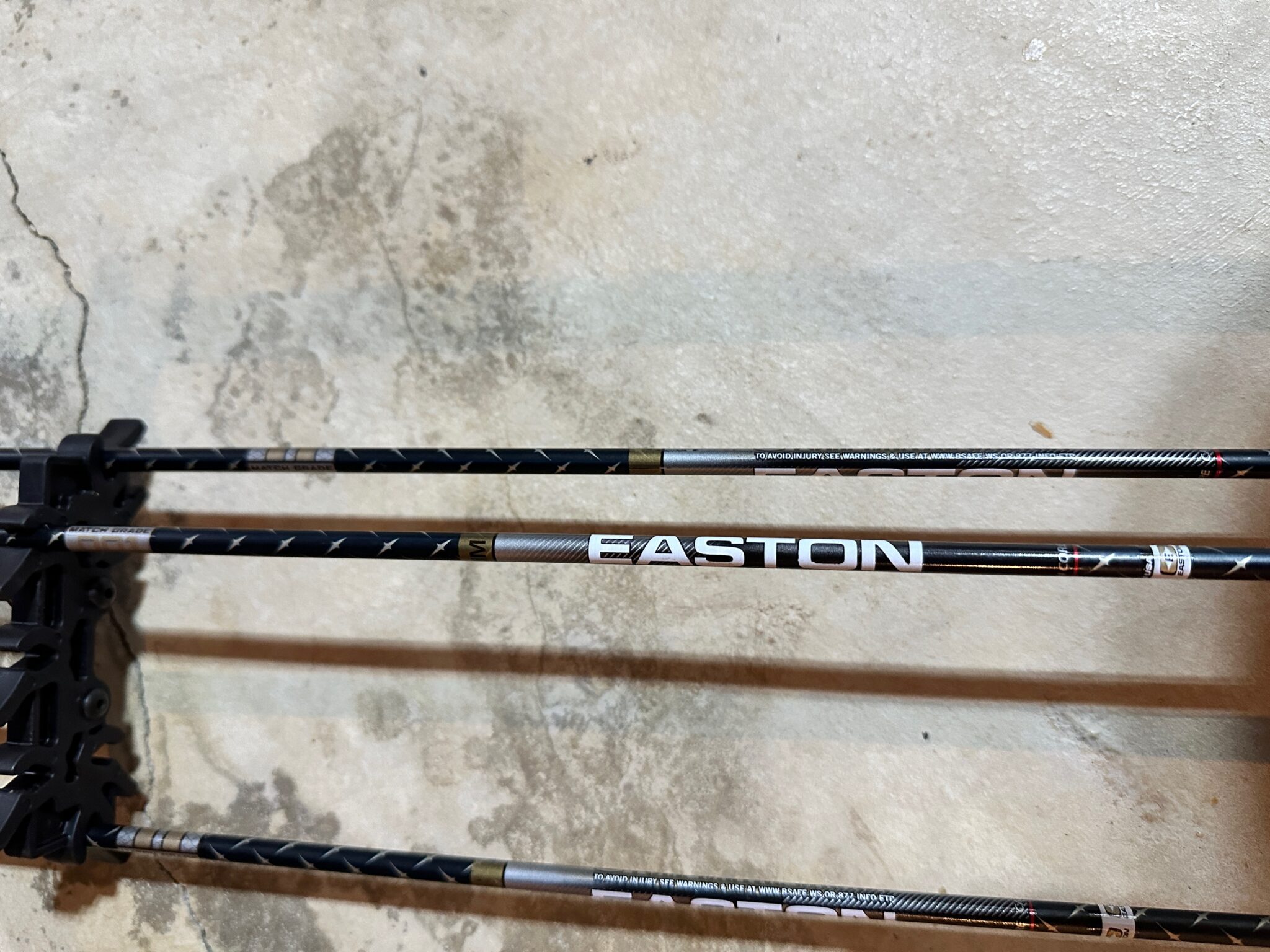
One is a Victory VAP TKO Elite that finishes at approximately 480 grains. The other is an Easton 4mm FMJ that finishes at approximately 515 grains. Both are serious hunting arrows. Both were built around a 125-grain broadhead. But they use different shaft construction, different component paths, and a different balance of mass, speed, and front-end design.
That does not mean there is no best arrow for deer hunting. It means the best arrow is personal.
The best arrow for deer hunting is the one fully optimized for you, your bow, the distances and way you hunt, the broadhead and components you use, the penetration capability you need, and the trajectory and sight window that let you make the shot effectively.
You do not need to be an arrow engineer to reach that answer. You do need to stop treating one number, whether it is weight, speed, kinetic energy, momentum, FOC, or shaft diameter, as though it can make the whole decision by itself.
Bottom Line: Two Real Deer-Arrow Builds
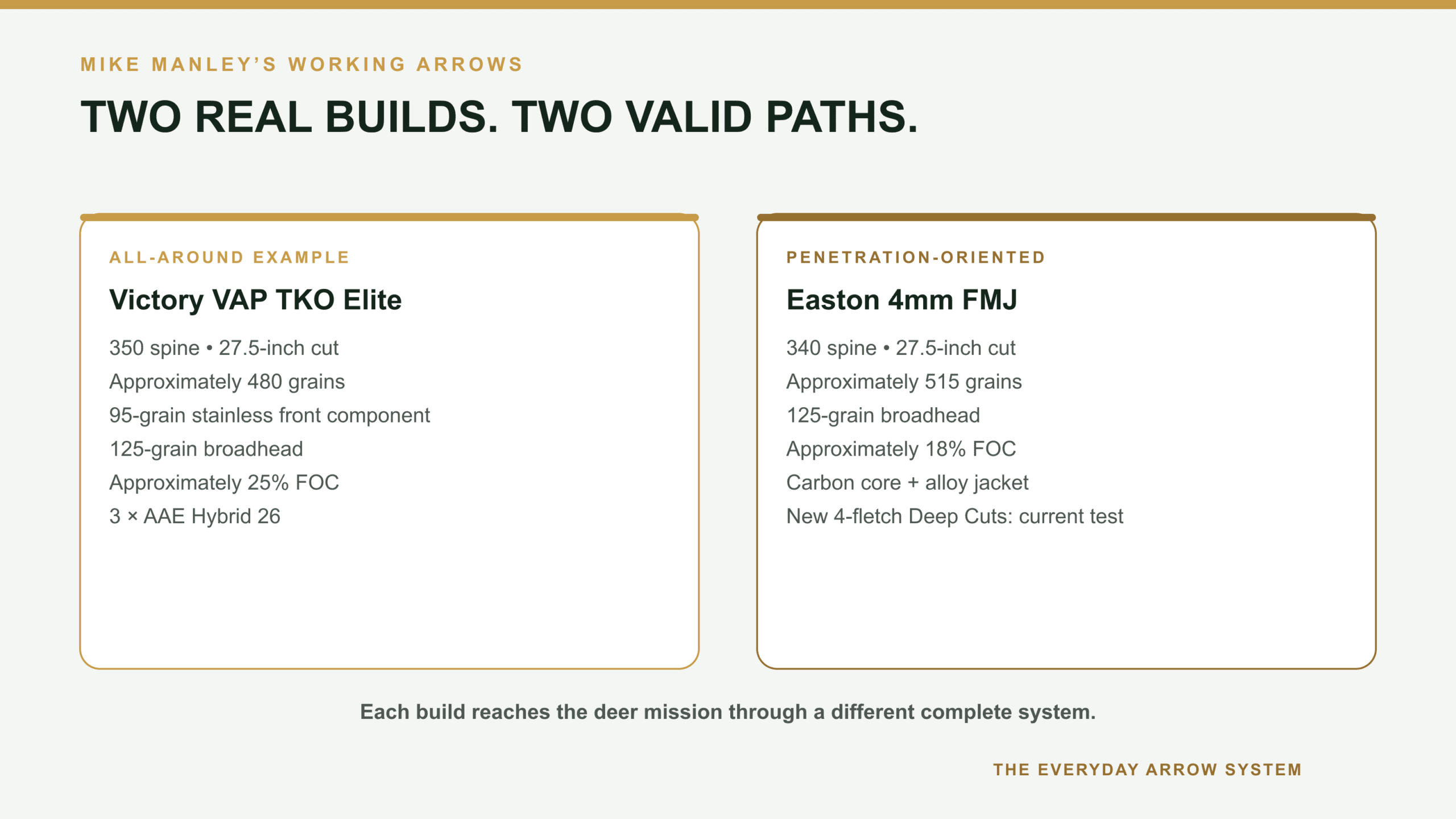
| Build detail | Victory VAP TKO Elite | Easton 4mm FMJ |
|---|---|---|
| Spine | 350 | 340 |
| Cut shaft length | 27.5 inches | 27.5 inches |
| Finished weight | Approximately 480 grains | Approximately 515 grains |
| Front component | 95-grain stainless Victory insert/half-out | Exact current configuration remains under verification |
| Broadhead weight | 125 grains | 125 grains |
| FOC | Approximately 25 percent | Approximately 18 percent |
| Fletching | Three AAE Hybrid 26 vanes | Newest setup uses four fletch and remains in current testing |
| Construction | .166-series, all carbon | 4mm/.166 carbon core with a 7075 alloy jacket |
| System role | My balanced, all-around example | My heavier, penetration-oriented example |
The VAP TKO Elite is my balanced, all-around example for mixed-distance woods and field edges. The 4mm FMJ is the heavier, penetration-oriented side of my current examples.
These are not two recipes every hunter should copy. They are two real examples of how different finished arrows can meet the deer-hunting mission when the shaft, components, broadhead, bow, trajectory, and hunting distance are considered together.
If you want to use these examples as a starting point without doing all the math yourself, the Everyday Arrow Planner can connect your bow, hunting distance, broadhead, trajectory, and component choices into a build plan.
To understand which direction fits your bow, start with the two jobs every deer arrow must do: work on the deer and work for the hunter taking the shot.
The Best Deer Arrow Must Work for the Deer and the Hunter
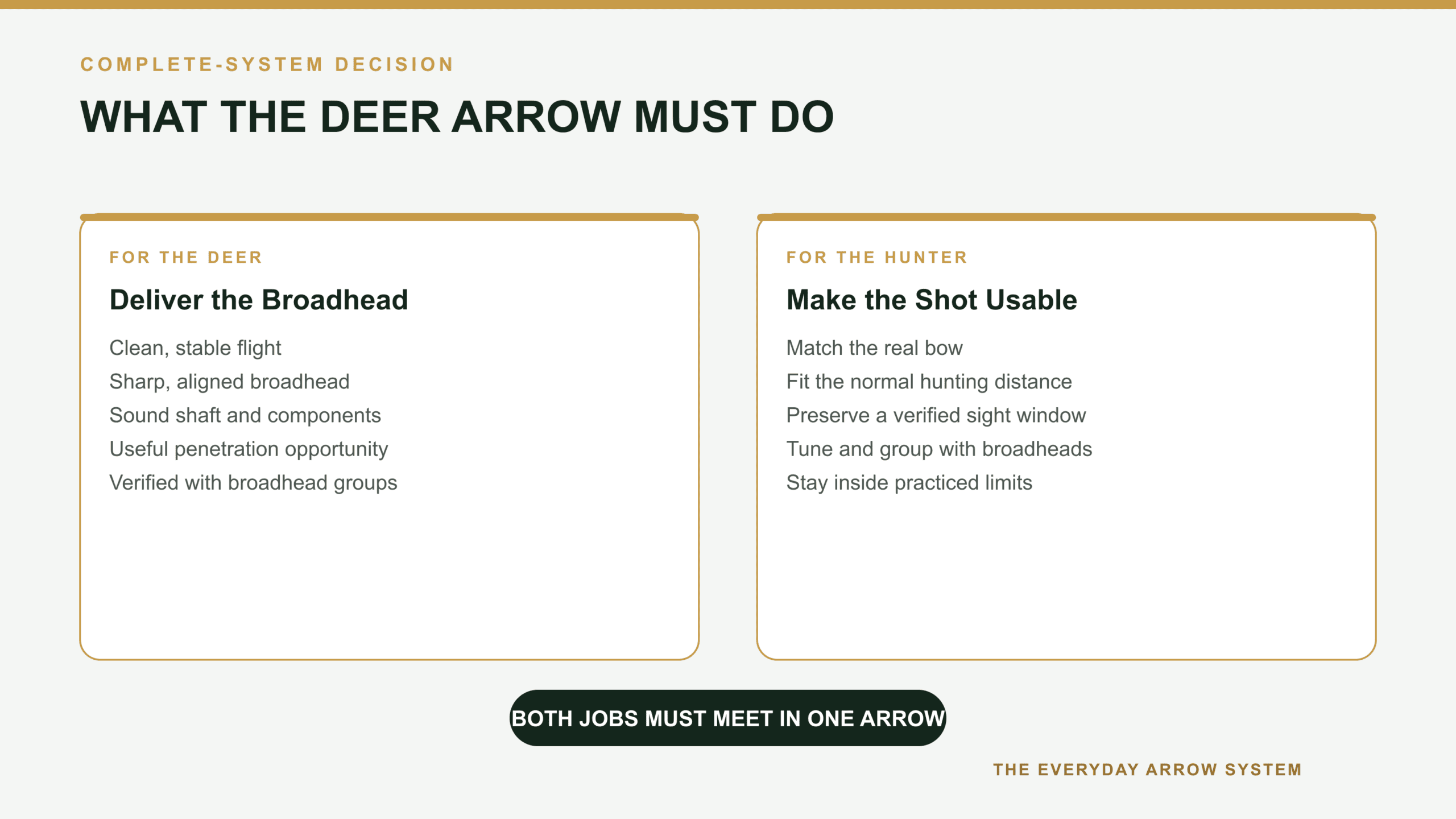
A complete deer arrow has two jobs.
First, it has to work on the animal. That means clean flight, control of the hunting broadhead, a sharp and properly aligned point, sound components, and enough mass, momentum, and structural strength to support dependable penetration.
Second, it has to work for the hunter taking the shot. It must match the real bow, tune correctly, stay inside a useful trajectory window, and remain predictable at the distances, angles, sight settings, and field positions the hunter has verified.
Those two jobs have to meet in the same arrow.
From the same bow, the lighter arrow normally leaves faster and follows a flatter path. The heavier arrow normally carries more mass and momentum and has better penetration capability, but it gives up speed and creates more trajectory drop. The best deer arrow is the one that puts those advantages in the right place for the hunter’s bow and normal shot distance.
One Working Range, Three Different Jobs
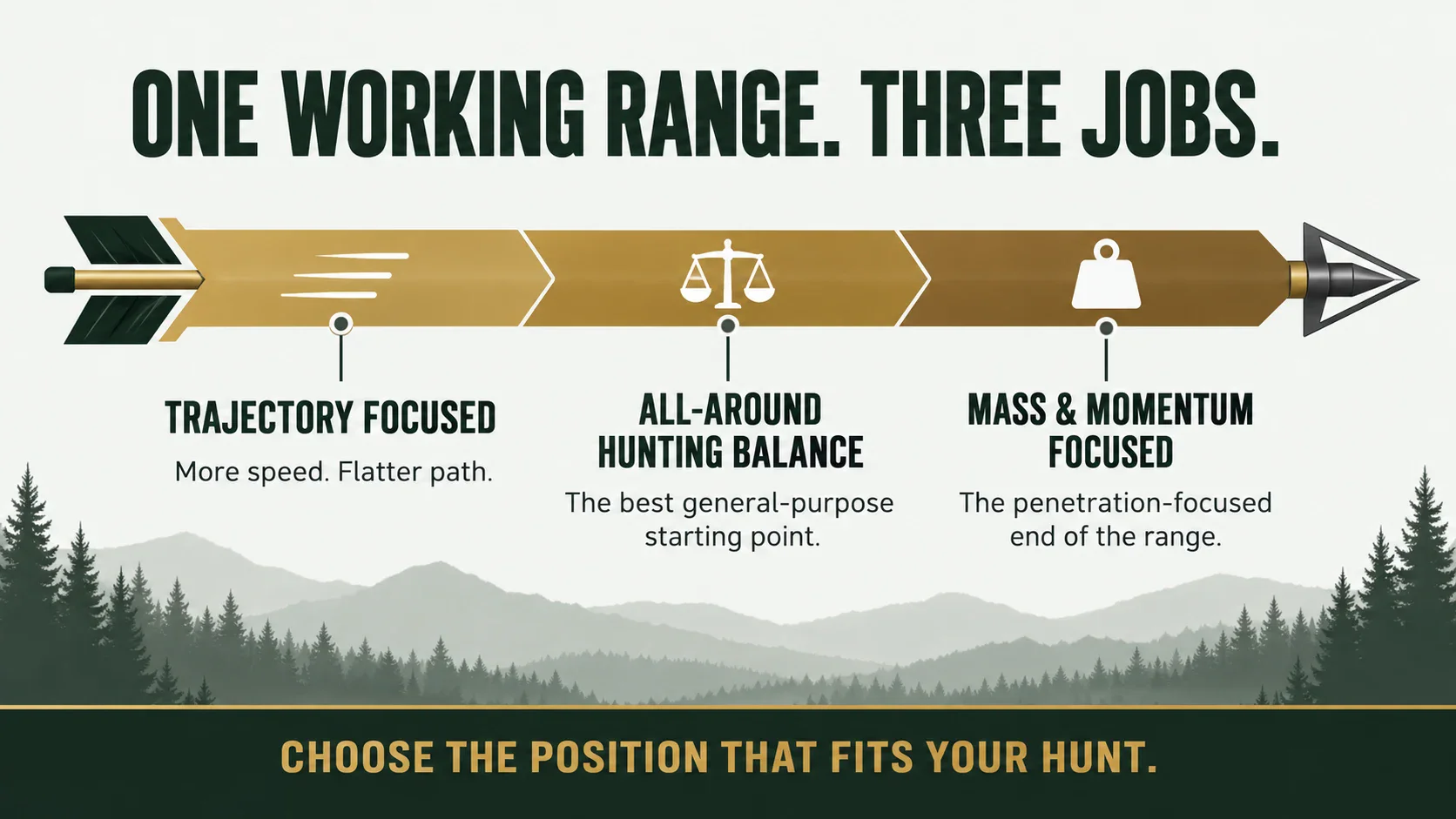
In the Everyday Arrow System, balanced means balancing speed and trajectory against arrow mass and momentum for your bow and normal hunting distance. The Formula Target is the best all-around starting point. It is not one mandatory finished weight.
- Trajectory Focused: The lower end keeps more speed and produces less drop, with less mass and momentum than the heavier choices.
- All-Around Hunting Balance: The Formula Target balances practical trajectory with useful mass and momentum for the hunter’s bow and normal shot distance.
- Mass and Momentum Focused: The upper end is the penetration-focused choice. It puts more mass and momentum behind the broadhead while accepting less speed and more trajectory drop.
Best for: Hunters who want an arrow matched to their actual bow and deer-hunting method.
Skip the copied recipe if: It was built around another hunter's draw length, draw weight, broadhead, normal distance, or sight setup.
System role: This guide explains what the complete deer arrow must do. The Everyday Arrow Planner connects those requirements into a build for your bow.
Start With Your Bow and the Shot You Are Preparing For
Your bow sets the starting point. Actual draw weight, draw length, bow efficiency, string accessories, and finished arrow weight all affect the speed and energy that reach the arrow.
That is why someone else's 500-grain arrow does not automatically produce the same result from your bow. A shorter draw length or lower draw weight can change speed and trajectory enough to change the useful balance. A faster setup can often carry more finished mass while still preserving the hunting window the shooter wants.
The shot also matters.
A hunter in tight cover who normally shoots inside 25 yards may place more value on quiet flight, strong broadhead control, and a simple center hold. A hunter working mixed woods and field edges may need a broader trajectory window. A western hunter or anyone preparing for longer open shots may put more weight on time of flight, wind exposure, and range error.
None of those missions makes safety optional. The finished arrow must meet the bow manufacturer's minimum arrow weight. The shaft must qualify under the shaft manufacturer's spine chart before any dynamic-spine estimate is considered. Then the arrow has to be tuned and verified from the real bow.
Why 400 grains does not mean the same thing from every bow
Grains per pound, usually shortened to GPP, is the finished arrow weight divided by the bow's actual peak draw weight.
The same 400-grain arrow works out to:
- 8.0 GPP from a 50-pound bow;
- about 5.7 GPP from a 70-pound bow; and
- 5.0 GPP from an 80-pound bow.
Those are arithmetic examples, not arrow recommendations. Hoyt, Mathews, and Bowtech currently publish warnings against shooting their compound bows below five grains per pound. The current owner manual for the specific bow controls. Five GPP is not a universal permission to run every bow at the edge of its minimum.
Safety is only the first check. A lower-poundage or shorter-draw setup can be safely above its minimum and still produce less speed and a more curved trajectory with the same 400-grain arrow than a higher-output bow. Draw length changes how much energy the bow can deliver even though it is not part of the GPP calculation.
That is why an absolute grain number cannot settle the deer-arrow question. First confirm that the arrow is allowed and properly spined. Then decide whether the complete arrow gives that hunter the broadhead flight, penetration capability, speed, and trajectory the mission requires.
If you want the complete manual sequence, use my guide to building a high-performance hunting arrow for your bow. If you want the calculations and decisions connected for you, start with the Arrow Planner.
Does the Arrow Have Enough Capability for Deer?
This is the question behind most arrow-weight arguments. A hunter hears that 400 grains is enough, another hunter says 450 is the minimum, and someone else says a serious deer arrow should weigh 600 grains.
The honest answer is not hidden in one threshold.
An arrow has enough deer-hunting capability when the complete, tuned system delivers the broadhead accurately, stays structurally sound, preserves a trajectory the hunter can use, and carries the mass and momentum needed for dependable penetration at the shot distance and angle the hunter has prepared for.
Finished weight, speed, kinetic energy, and momentum help describe that system. They do not replace it.
Finished weight
Finished arrow weight affects speed, momentum, trajectory, bow behavior, component choices, and dynamic spine. From the same bow, adding practical arrow weight normally trades speed and a flatter path for more mass, more momentum, and better penetration capability. My deeper guide explains how arrow weight affects a deer-hunting setup.
Speed
Speed affects time of flight and trajectory. More speed can make the arrow less sensitive to small range errors inside the hunting window and can reduce the time a deer has to lower, turn, or step before impact.
That does not make the lightest arrow the best deer arrow. It means the finished build must preserve enough speed for the hunter’s normal distance while carrying the mass and components the mission requires. My Best Arrow Speed for Hunting guide covers that balance, while Can a Deer Jump the String? explains how distance, alertness, sound, and actual downrange speed change the shot.
Kinetic energy
Kinetic energy uses both mass and velocity. Velocity is squared in the formula, so kinetic energy changes quickly when speed changes. It is a useful performance indicator, but it cannot tell you whether the broadhead is sharp, the arrow is flying straight, or the components will stay aligned.
Momentum
Momentum changes directly with mass and speed. Within a practical range from the same bow, a heavier arrow normally carries more momentum and gives the broadhead better penetration capability. Broadhead design, sharpness, tune, alignment, structural integrity, anatomy, and impact angle determine how well the complete arrow uses that advantage.
You can compare estimated speed, kinetic energy, and momentum with my Arrow Performance Calculator. For the deeper limits of the number, read Arrow Momentum Explained.
Penetration
Penetration is where every part of the system meets. More practical arrow mass and momentum improve penetration capability. Clean arrow flight, a sharp broadhead, sound alignment, structural integrity, anatomy, and impact angle decide how effectively that capability reaches the animal.
That is why the Mass and Momentum Focused end of the Formula range is penetration-focused. The complete explanation is in The Physics of Arrow Penetration in Bow Hunting.
Is a 400-Grain or 600-Grain Arrow Better for Deer?
A properly built 400-grain arrow and a properly built 600-grain arrow can both kill deer, but they do different jobs. From the same bow, the 400-grain arrow normally wins on speed, flight time, and trajectory. The 600-grain arrow normally wins on mass, momentum, and penetration capability.
The 400-grain arrow represents the Trajectory Focused side. Its faster, flatter path can increase the useful sight window and reduce the effect of a small ranging error. It still has to meet the bow manufacturer’s minimum arrow weight, use the right spine, control the broadhead, and carry enough structure for the hunt.
The 600-grain arrow represents the Mass and Momentum Focused side. It carries more mass and normally more momentum, which gives it the stronger penetration capability. The tradeoff is lower speed, longer flight time, and more trajectory drop.
A roughly 450-grain arrow gives us a useful middle example. It keeps more speed than the 600-grain build while carrying more mass and momentum than the 400-grain build. That does not make 450 grains a universal answer. It shows why the Formula Target is an all-around starting point and why the hunter can move lighter or heavier inside the Working Range for a specific job.
The right question is not, “Which grain number wins?” It is:
Which complete arrow gives my bow the best balance of broadhead flight, structural integrity, penetration capability, usable speed, and verified trajectory for the way I hunt?
Use my Best Arrow Weight for Hunting guide to establish a target range. Then compare the real tradeoffs in Heavy vs. Light Hunting Arrows and Best Arrow Speed for Hunting.
Your Sight Window Connects the Arrow to the Shot
The sight window, or center-hold bracket, is the verified distance range in which the arrow stays inside the vertical aiming window you accept for the sight setting you are using.
This is the hunter side of the arrow decision, and it is often missing from arguments about weight.
Suppose a hunter wants to hold the center of the vital area without moving a slider for the normal close-range shot. The finished arrow needs to stay inside that hunter's accepted high-and-low window across the distances being considered. A heavier arrow may still do that perfectly from one bow. From another bow, the same finished weight may create more drop than that hunter wants.
A useful sight window can reduce unnecessary sight movement when a legal, ethical shot appears quickly. It does not authorize guessing distance, shooting through brush, taking a bad angle, or reaching beyond the range already proven in practice.
Model the path with the Hunting Arrow Trajectory Calculator. Then confirm every part of the window with the real bow and finished arrow.
My own system is explained in Why I Shoot a Single Pin Bow Sight and Why I Zero My Bow Sight at 25 Yards. Those are my choices for my setup, not a zero or sight method every hunter has to copy.
Broadhead Flight Comes Before the Product Name
A field-point group does not prove that the hunting arrow is ready. The arrow has to group with the broadhead that will be on it in the woods.
Sharpness, broadhead alignment, component fit, tune, vane steering, broadhead profile, and the structure of the finished arrow all affect that result. If the broadheads do not group with the field points, the answer is not to ignore the group and trust the product name.
I have several useful examples, but each has an evidence boundary.
- I used the 125-grain Tooth of the Arrow V-Series XL, and it flew like a field point from my setup. That is a result from my bow and arrow, not a promise for every setup.
- I recently tested the NAP Deep Cuts on a new four-fletch Easton 4mm FMJ configuration. I saw great flight, penetration, and rotation in that testing. Its hunting-season test is still ahead.
- I used the Muzzy Trocar for two seasons, and it worked extremely well for me.
These are useful starting points because I can tell you what I actually observed. They still have to be matched to your arrow, tuned from your bow, and verified at your hunting distances.
Use the Hunting Arrow Component Finder to check reviewed shaft and component paths. The guide to choosing hunting arrow components that work together explains why installed weight and compatibility matter before the arrow is assembled.
Fixed or Mechanical Broadhead for Deer?
Mechanical broadheads can be effective. I killed several deer with the G5 MegaMeat, and I had excellent blood trails with it.
I now prefer fixed blades. I hunt thick cover, and I do not want to deal with an exposed or moving mechanism when I cannot always see every small obstacle around the shot path. That is a personal risk decision based on the way I hunt. It is not a claim that a mechanical broadhead cannot kill deer effectively.
My dad and brother strongly favor the Swhacker Levi Morgan for compound-bow and crossbow use. That is their experience, not my personal test result.
Whichever category you choose, the broadhead still has to match the arrow, clear the bow, group from the real setup, and fit the hunting conditions. My full comparison is in Fixed vs. Mechanical Broadheads.
The Shaft and Front-End System Have to Work Together
The shaft is not just a tube with a broadhead screwed into it. Shaft diameter, construction, insert, half-out, outsert, collar, point weight, nock, and fletching all change the finished build.
A smaller-diameter shaft is not automatically the best deer shaft. Diameter may change the exposed profile and part of the resistance behind the broadhead, but it cannot predict penetration by itself. It may also require a different front-end component system and replacement parts.
The shaft has to begin in the correct manufacturer spine range. After that, installed component weight, arrow length, point weight, and bow settings can be evaluated with the Dynamic Spine Calculator. Dynamic spine is a planning and tuning check. It does not override the manufacturer's chart or the finished-arrow test.
FOC, or forward of center, shows how far the balance point sits in front of the arrow's physical center. It is useful, but it should not be maximized without checking trajectory, dynamic spine, component integrity, and broadhead flight. Use the Arrow FOC Calculator to estimate before the build or measure the finished arrow.
My hunting arrow shaft-diameter guide explains the differences among standard, small, and micro-diameter systems. The deer-specific point is simple: choose the complete shaft and component system, not a diameter label by itself.
Three Fletch or Four Fletch for Deer?
The rear of the arrow must provide enough steering for the tuned broadhead without creating more drag, sound, weight, or clearance trouble than the mission needs.
My VAP TKO example uses three AAE Hybrid 26 vanes. My current FMJ and Deep Cuts test uses four fletches. Those are different complete arrow configurations. They are not a controlled test proving that one vane count always beats the other.
Four fletch can be useful when the broadhead needs more steering after tune, alignment, and clearance are correct. It is not automatically better. Vane profile, material, angle, sound, and the finished broadhead group matter along with count.
Read Hunting Arrow Vanes: How to Choose the Best Fletching for Your Setup for the complete decision. My focused article on when a four-fletch setup may help a fixed-blade hunting arrow goes deeper on count.
Match the Arrow to the Way You Hunt Deer
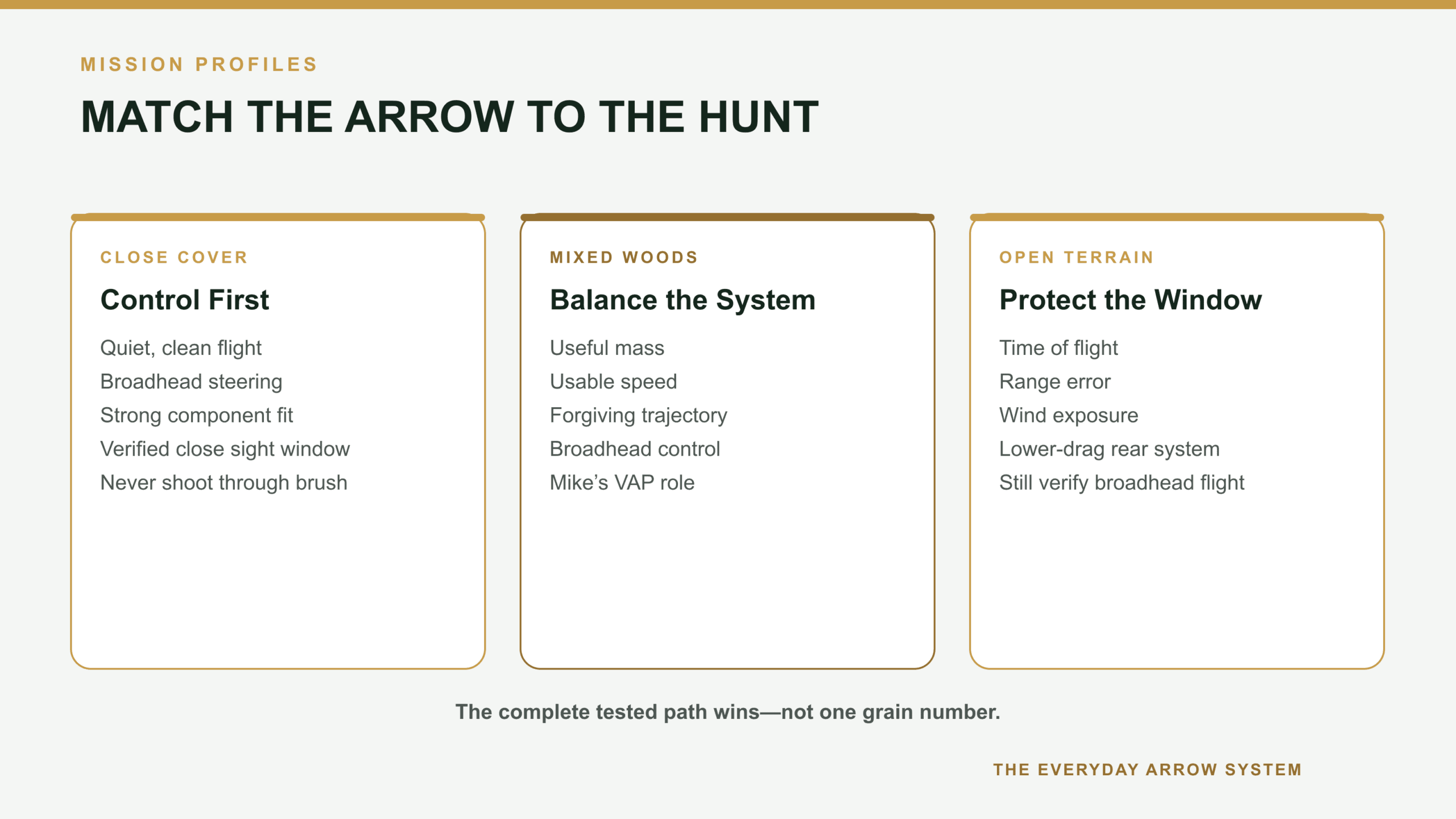
Close cover
A close-cover arrow should emphasize dependable broadhead control, sound structure, quiet flight, and a verified close sight window. A hunter may accept more mass when the bow still provides the trajectory and flight required for that short-range mission.
Close cover does not mean shooting through brush. No arrow build makes an unseen obstruction safe.
Mixed-distance woods and field edges
This mission calls for balance. The arrow needs useful mass and broadhead control while keeping enough speed and a forgiving path for the hunter's normal range.
This is the role I give my approximately 480-grain VAP TKO. It is my all-around example because the complete build fits the balance I want, not because 480 grains or a .166 shaft is automatically best for everyone.
More open terrain
Longer flight puts more pressure on time of flight, range error, wind exposure, and trajectory. That may move the decision toward a build that preserves more speed or uses a lower-drag rear system. The arrow still needs enough structure and broadhead control for the animal and angle.
The lightest shaft does not automatically win. A smaller diameter does not automatically win. The complete tested path wins.
What My Two Builds Show and What I Am Still Testing
Victory currently describes the VAP TKO as a .166-series, 100-percent carbon shaft and digitally spine aligns it. The Elite grade carries a manufacturer-listed straightness tolerance of plus or minus .001 inch. Those are current manufacturer specifications. The finished length, weight, components, FOC, and vane setup in the opening table are my build.
Easton currently lists the 340-spine 4mm FMJ at 11.0 grains per inch with a .240-inch outside diameter. Those are bare-shaft manufacturer specifications, not the weight of my finished arrow.
I am not adding speed, kinetic energy, or momentum without a chronograph result from each exact finished configuration. An assumed speed would make the comparison look more complete while making the evidence worse. I have also left the exact current FMJ front component out until I verify that configuration.
My newest FMJ test uses a four-fletch setup with the NAP Deep Cuts. The early flight, penetration, and rotation results have been excellent. That is current testing. I will not call it a completed hunting-season result before I use it through the season.
My complete whitetail bow setup shows the FMJ at about 18-percent FOC alongside the VAP TKO. That approximate FOC remains the same in the newest four-fletch Deep Cuts setup. The hunting-season result is still open until I use that configuration through the season.
One build is approximately 480 grains and all carbon. The other is approximately 515 grains and carbon-aluminum. Both can fit a deer-hunting system because every part is evaluated together.
Other Shaft Systems Worth Understanding
The following are research examples, not products I am claiming to have field-tested for this article. They show how different shaft classes can begin a complete build.
| Shaft system | Current 340-spine manufacturer specifications | Useful role to investigate |
|---|---|---|
| Easton 6.5mm Bowhunter | 9.3 GPI, .298-inch outside diameter, Acu-Carbon construction | Standard-diameter, practical-value starting point |
| Easton 5mm Axis | 9.5 GPI, .267-inch outside diameter, all-carbon construction, HIT or half-out paths | Middle-diameter all-carbon system with front-end choices |
| Easton 4mm Axis Long Range | 8.3 GPI, .234-inch outside diameter, all-carbon construction, included 50-grain half-out | Micro-diameter system for a hunter evaluating a lighter listed shaft and 4mm components |
These values come from current manufacturer product tables. They do not prove how the finished arrow will perform from your bow. Cut length, spine, installed components, point weight, fletching, wrap, and nock all change the result.
Use the Component Finder for reviewed component paths. Then move the selected shaft system into the Planner so it is judged as part of the complete arrow.
How to Build the Best Deer Arrow for Your Bow
- Enter your real bow and hunting information. Use actual draw length, draw weight, normal distance, and hunting method.
- Respect the hard safety gates. Meet the bow manufacturer's minimum arrow weight and start with a shaft that qualifies under the manufacturer's spine chart.
- Choose a target finished-weight range. Build it around the bow and mission, not one internet number.
- Model performance together. Compare estimated speed, trajectory, kinetic energy, and momentum without treating any one value as the answer.
- Choose a compatible shaft and front end. Confirm the insert, half-out, outsert, collar, broadhead thread, and shaft fit.
- Check the balance of the build. Review arrow length, installed component weight, FOC, and dynamic-spine direction.
- Build one complete test arrow. Do not finish the whole batch because the plan looked good on a screen.
- Measure and inspect it. Weigh the finished arrow, inspect the shaft and every component, and chronograph it when possible.
- Tune and verify the hunting broadhead. Confirm clearance and broadhead groups, not only field-point groups.
- Prove the sight window. Shoot the actual arrow at the distances, angles, positions, and sight settings you intend to use.
That process creates the best deer arrow for your complete setup. It is not a shelf label. It is a verified result.
Let the Arrow Planner Connect the Decisions
You now know why the variables matter. You do not have to calculate and cross-check every one of them by hand.
Enter your bow, arrow, distance, and hunting information in the Everyday Arrow Planner. It connects target weight, speed, penetration-related performance, trajectory, your chosen sight window, arrow length, components, FOC, dynamic spine, and final verification.
The Planner gives you a connected build plan. It does not replace the bow manufacturer's requirements, the shaft maker's chart, tuning, broadhead testing, inspection, or the finished test arrow.
If you would rather work through the complete process yourself, use How to Build a High-Performance Hunting Arrow for Your Bow.
Frequently Asked Questions
What grain arrow is best for deer hunting?
The best finished weight is the one that lets your bow deliver the required broadhead flight, structural integrity, penetration capability, speed, and trajectory inside your verified hunting window. It must meet the bow manufacturer's minimum and use an eligible shaft spine. Do not choose the grain number apart from the complete setup.
Is a 400-grain arrow enough for deer?
A 400-grain arrow can be effective when it meets the bow manufacturer’s requirements, uses the correct spine, tunes cleanly, controls the hunting broadhead, and carries enough mass and momentum for the animal and shot. Its main advantage is speed and trajectory. Whether it belongs in the hunter’s Working Range depends on the real bow and normal hunting distance.
Is a 600-grain arrow too heavy for deer hunting?
Not automatically. A 600-grain arrow may fit a close-range, mass-focused setup when the bow can deliver it and the hunter verifies the resulting trajectory. It becomes too heavy for that hunter when the loss of speed and smaller sight window interfere with the shots the hunter is prepared to take.
How much kinetic energy does an arrow need for deer?
Kinetic energy is a useful indicator, but this guide does not use one universal number as a deer pass/fail rule. Broadhead flight, sharpness, alignment, structural integrity, momentum, anatomy, shot angle, and the finished arrow all affect penetration.
Is momentum or kinetic energy more important for penetration?
Both describe part of the moving arrow. Kinetic energy is especially sensitive to speed, while momentum changes directly with mass and speed. For penetration-focused arrow design, momentum helps show the advantage gained by carrying more practical arrow mass. Broadhead sharpness, alignment, arrow flight, structural integrity, anatomy, and impact angle determine how well the complete setup uses it.
Are small-diameter arrows better for deer hunting?
They can be a strong choice, but diameter alone does not decide the best deer arrow. Evaluate the complete shaft construction, finished weight, components, alignment, replacement support, flight, trajectory, and penetration plan.
Should I use a fixed or mechanical broadhead for deer?
Both can be effective. I now prefer fixed blades for the thick cover I hunt, although I have killed several deer with the G5 MegaMeat and had excellent blood trails. Choose the category that fits your conditions, then verify it from your complete setup.
How do I know whether my deer arrow is ready to hunt?
The finished arrow should meet every manufacturer requirement, pass inspection, tune cleanly, group with the hunting broadhead, and stay inside the sight window and maximum distance you have verified with the real bow. Build and prove one complete arrow before finishing the batch.
Want to see exactly what I’m carrying this season? Check out my Personal Bowhunting Gear List for 2026